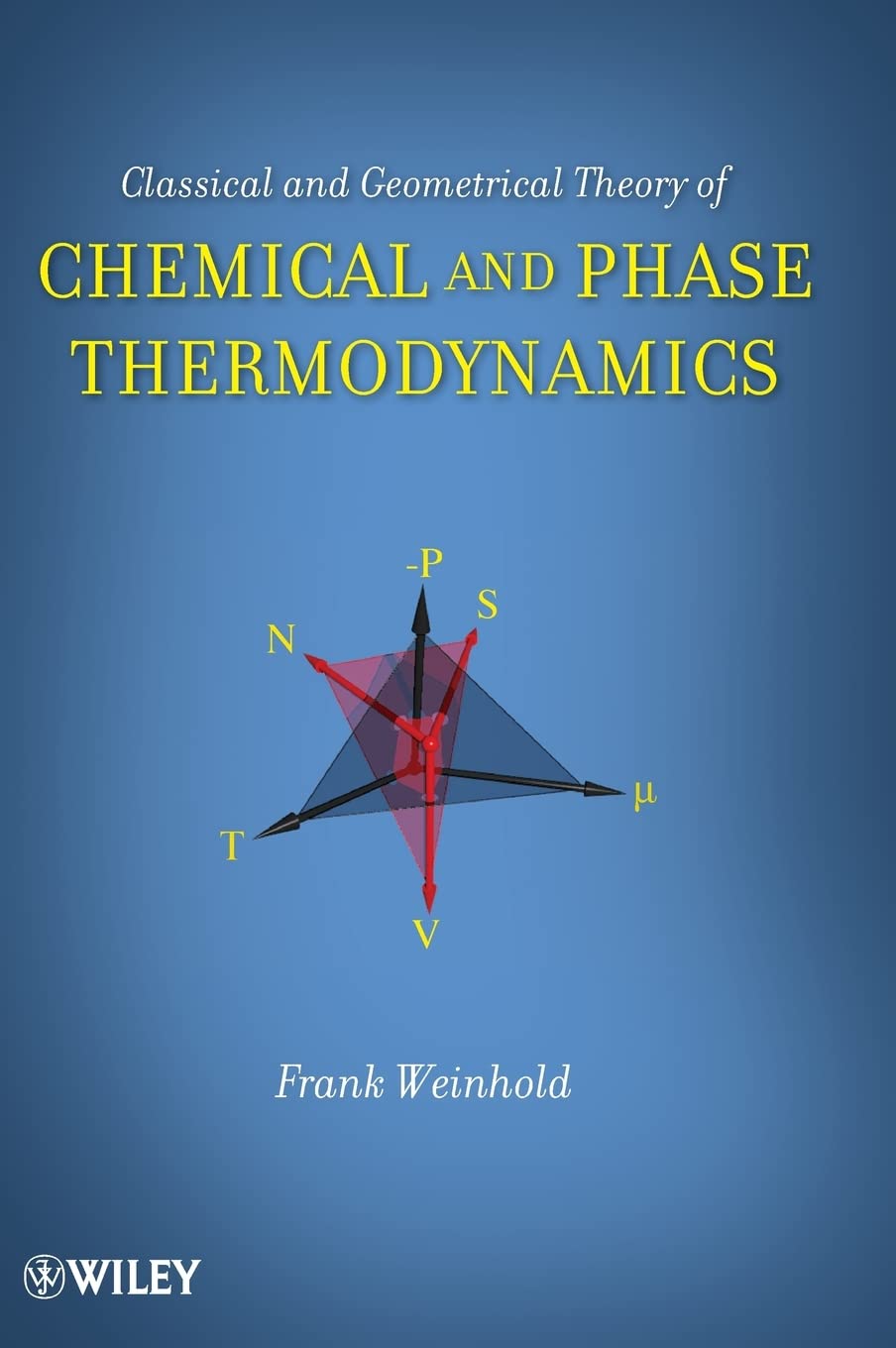
Classical and Geometrical Theory of Chemical and Phase Thermodynamics
$155.00
by Frank Weinhold



Simplified, innovative alternative to standard calculus-based thermodynamics This textbook proves how equilibrium thermodynamics, a traditionally difficult subject, can be accurately expressed using basic high school geometry concepts. Specifically, the text deals with classical equilibrium thermodynamics and its modern reformulation in metric geometric terms. The author emphasizes applications to chemical and phase equilibria in complex chemical systems, statistical mechanical origins, and extensions to near-equilibrium transport properties. The text is divided into three parts: Part One: Inductive Foundations of Classical Thermodynamics - Part Two: Gibbsian Thermodynamics of Chemical and Phase Equilibria - Part Three: Metric Geometry of Equilibrium Thermodynamics In addition to a rigorous introduction to the principles of chemical and phase thermodynamics, this text takes a novel, innovative approach, reformulating and extending these principles in the framework of Euclidean and Riemannian geometry. The resulting "thermodynamic geometry" provides a powerful alternative to the traditional calculus-based formulation of equilibrium thermodynamics. Students will find that this approach simplifies many mathematical derivations and clarifies thermodynamic logic. Moreover, this approach suggests novel extensions to equilibrium and nonequilibrium systems of arbitrary chemical and phase complexity. This text also provides a general introduction to vector- and matrix-algebraic methods that are highly effective for thermodynamics as well as applications in quantum mechanics and other advanced topics in physical chemistry. With its unique simplified approach to thermodynamics coupled with its discussions of the historical and conceptual development of the field, this text is ideal for both undergraduate and graduate students in physical chemistry, chemical engineering, thermal physics, and materials sciences. Simplified, innovative alternative to standard calculus-based thermodynamics This textbook proves how equilibrium thermodynamics, a traditionally difficult subject, can be accurately expressed using basic high school geometry concepts. Specifically, the text deals with classical equilibrium thermodynamics and its modern reformulation in metric geometric terms. The author emphasizes applications to chemical and phase equilibria in complex chemical systems, statistical mechanical origins, and extensions to near-equilibrium transport properties. The text is divided into three parts: Part One: Inductive Foundations of Classical Thermodynamics - Part Two: Gibbsian Thermodynamics of Chemical and Phase Equilibria - Part Three: Metric Geometry of Equilibrium Thermodynamics In addition to a rigorous introduction to the principles of chemical and phase thermodynamics, this text takes a novel, innovative approach, reformulating and extending these principles in the framework of Euclidean and Riemannian geometry. The resulting thermodynamic geometry provides a powerful alternative to the traditional calculus-based formulation of equilibrium thermodynamics. Students will find that this approach simplifies many mathematical derivations and clarifies thermodynamic logic. Moreover, this approach suggests novel extensions to equilibrium and nonequilibrium systems of arbitrary chemical and phase complexity. This text also provides a general introduction to vector- and matrix-algebraic methods that are highly effective for thermodynamics as well as applications in quantum mechanics and other advanced topics in physical chemistry. With its unique simplified approach to thermodynamics coupled with its discussions of the historical and conceptual development of the field, this text is ideal for both undergraduate and graduate students in physical chemistry, chemical engineering, thermal physics, and materials sciences. Because it is grounded in math, chemical thermodynamics is often perceived as a difficult subject and many students are never fully comfortable with it. The first authoritative textbook presentation of equilibrium chemical and phase thermodynamics in a reformulated geometrical framework, Chemical and Phase Thermodynamics shows how this famously difficult subject can be accurately expressed with only elementary high-school geometry concepts. Featuring numerous suggestions for research-level extensions, this simplified alternative to standard calculus-based thermodynamics expositions is perfect for undergraduate and beginning graduate students as well as researchers. Frank Weinhold received his PhD from Harvard and held postdoctoral and teaching appointments at Oxford, Berkeley, and Stanford before moving to the University of Wisconsin-Madison in 1976, where he served as Professor of Chemistry and a member of the Theoretical Chemistry Institute until achieving emeritus status in 2007. He is the author of more than 170 technical publications and software packages, including the Natural Bond Orbital (NBO) analysis progra