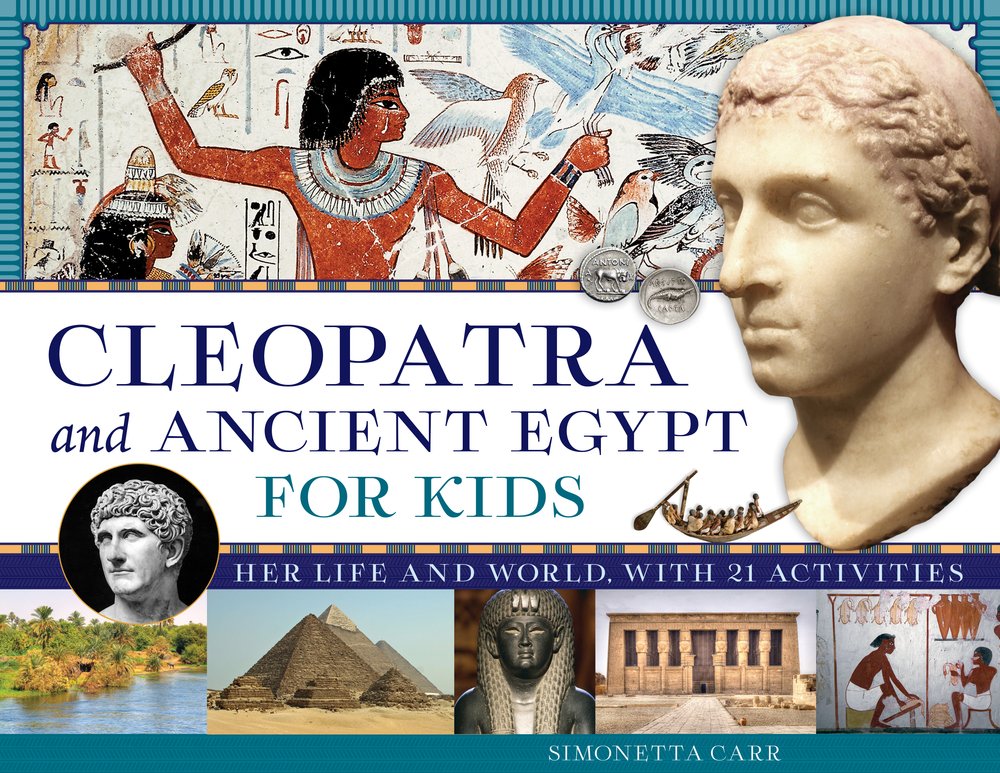
Cleopatra and Ancient Egypt for Kids: Her Life and World, with 21 Activities (69) (For Kids series)
$18.99
by Simonetta Carr



2018 San Diego Book Awards Finalist Cleopatra has been called intelligent and scheming, ambitious and ruthless, sensual and indulgent. This unique biography captures the excitement of her life story, including portions that have been largely neglected, such as her interest in literature and science and her role as a mother, and allows readers to draw their own conclusions. Cleopatra and Ancient Egypt for Kids also includes maps, time lines, online resources, a glossary, and 21 engaging hands-on activities to help readers better appreciate the ancient culture and era in which Cleopatra lived. Kids will: - Create a beaded Egyptian-style necklace - Build a simple Nile River boat - Prepare homemade yogurt - Construct a model shadoof, a tool used to raise water to higher ground for irrigation - Translate their names into hieroglyphs for a cartouche bookmark - "Mummify" a hot dog - Write an Egyptian love poem - And more! "By blending the facts and mythology of Cleopatra’s life with 21 varied, creative, and often STEM-based activities, this offers an intriguing, accessible glimpse into ancient Egypt." — Booklist Simonetta Carr is the author of Michelangelo for Kids and the award-winning Christian Biographies for Young Readers series, which includes John Calvin , Augustine of Hippo , and others. Cleopatra and Ancient Egypt for Kids Her Life and World, With 21 Activities By Simonetta Carr Chicago Review Press Incoporated Copyright © 2018 Simonetta Carr All rights reserved. ISBN: 978-1-61373-975-4 Contents Note to Readers, Time Line, Introduction: The Endless Search for the True Cleopatra, 1 A Young Princess of an Ancient Land, Create a Writing Tablet, Make an Archimedes Screw, Build an Egyptian-Style Column, 2 The Fight for the Throne, Make Egyptian Breath Fresheners, Make a Jack-o'-Lantern Lighthouse, Prepare Homemade Yogurt, 3 Cleopatra's Cruise, Mummify a Hot Dog, Make a Simple River Boat, Draw and Color Like an Ancient Egyptian, 4 The New Goddess Isis, Solve Egyptian Math Problems, Make an Egyptian-Style Wig, Create an Egyptian Relief Sculpture, 5 Cleopatra and Mark Antony, Build a Shadoof, Make a Mehen Board, Dissolve an Eggshell, 6 Queen of Kings, Make a Cartouche Bookmark with Your Egyptian Name, Write an Ancient Egyptian Love Poem, Make Egyptian Castanets, 7 The Sharers of Death, Make a Garland, 8 The End of an Era, Create an Egyptian-Style Necklace, Transport an Obelisk on Water, Acknowledgments, Glossary, Time Line of Egyptian Dynasties, Resources to Explore, Notes, Selected Bibliography, CHAPTER 1 A Young Princess of an Ancient Land There was sweetness also in the tones of her voice; and her tongue, like an instrument of many strings, she could readily turn to whatever language she pleased. — Plutarch * * * During the winter of 70 BC, in the ancient land of Egypt, a princess was born. She was called Cleopatra, a Greek name that had already graced other powerful royal women in her family. It had a promising meaning: "her father's fame." This sounds like the beginning of a beautiful fairy tale. In reality, life for a pharaoh 's daughter was marked by uncertainty and frequent threats to her life. Power was a highly desired prize and could move anyone, even a member of her own family, to go to any length to obtain it. A Greek Family on the Throne of Egypt Gruesome murders and puzzling mysteries already stained Cleopatra's family history. The Ptolemies were a tough and ambitious clan from the rough, mountainous region of Macedonia, in northern Greece. In nearly 300 years of their rule over Egypt, they had often proven themselves ruthless and cold blooded against both enemies and potential enemies — relatives included. To understand how a Greek family ended up on the Egyptian throne, one must go back to the year 323 BC, when Alexander the Great, the most powerful Greek ruler, died unexpectedly at the peak of his conquests, apparently using his last breath to bestow his massive empire on "the strongest." These words gave way to fierce power struggles. In the end, his territories were split among his generals, ending his dream of a universal empire. A general named Ptolemy took over Egypt and rose to its throne as Ptolemy I Soter (Savior). He also hijacked Alexander's funeral procession, stole his body, and brought it to the city Alexander had built on the Mediterranean coast of Egypt: Alexandria. This is the city where, about 350 years later, Cleopatra was born. Groomed for the Crown Cleopatra's Alexandria was a thriving metropolis. Thanks to the Ptolemies, it had become one of the most outstanding cities in the Mediterranean world — both as an active port and as a center of learning. It was also blatantly Greek, filled as it was with a large Greek population and a great number of Greek structures and facilities, such as an outdoor theater