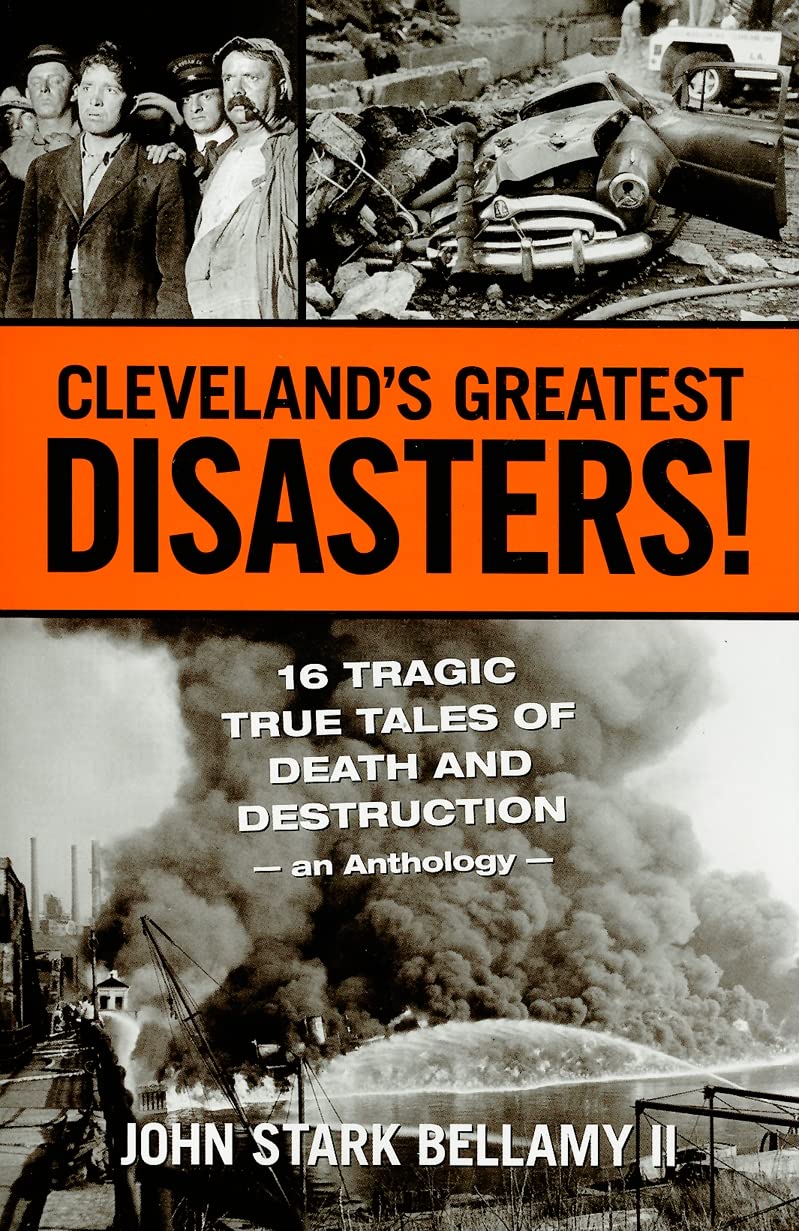
Cleveland's Greatest Disasters: Sixteen Tragic Tales of Death and Destruction—An Anthology (Cleveland Crime and Disaster Series by John Stark Bellamy
$16.95
by John Stark Bellamy II



Fifteen incredible true disaster stories from Cleveland history, including … The apocalyptic East Ohio Gas Company explosion and fire of 1944, which destroyed an entire east side neighborhood; - Genius inventor Garrett A. Morgan’s daring underground rescue efforts (using his recently invented gas mask) during the gruesome 1916 waterworks collaps e; - The unspeakably horrible Collinwood school fire of 1908, in which 172 schoolchildren perished in panic because of obstructed exits; - The Cleveland Clinic disaster of 1929, in which thousands of pounds of X-ray film exploded in flames, causing 123 deaths; - The grisly drama of two doomed workmen buried alive in the very concrete that became Cleveland’s celebrated landmark—the Terminal Tower. This anthology collects the very best disaster tales from John Stark Bellamy’s five-book Cleveland crime and disaster series. Bellamy sets the disasters in context and doesn’t skimp on details as he tells of 16 catastrophe―from natural-gas explosions, collapsing tunnels under Lake Erie, school fires, bridge collapses and even an explosion in a fireworks factory -- Michael Gill ― Cleveland Scene Published On: 2009-11-25 Bellamy knows the dark side of Cleveland better than anyone. ― WMJI FM Radio Published On: 2010-04-19 John Stark Bellamy II is the author of six books and two anthologies about Cleveland crime and disaster. The former history specialist for the Cuyahoga County Public Library, he comes by his taste for the sensational honestly, having grown up reading stories about Cleveland crime and disaster written by his grandfather, Paul, who was editor of the Plain Dealer, and his father, Peter, who wrote for the Cleveland News and the Plain Dealer. Chapter 1 Streets of Hell The East Ohio Gas Company Explosion and Fire (1944) It happens very suddenly, as you drive north through the neighborhood straddling St. Clair Avenue near East 55th Street on Cleveland’s northeast side. Where residential housing still persists in the upper 50s, there are mostly modest frame dwellings of turn-of-the-century vintage―small houses on postage-stamp lots, so crammed together as to give passersby claustrophobia just looking between them. Unless you know the dire history of this place, however, you aren’t prepared for the abrupt architectural change that begins north of St. Clair on East 63rd Street and persists westward to East 55th. Little by little, and then suddenly, the frame houses disappear and in their stead one finds modest, brick dwellings of a post–World War II character. And the closer you get to the property of the East Ohio Gas Company, the more modern brick homes you find―until residential housing ceases completely at the peaceful green border of Grdina Park, today the southern perimeter of the once-enormous gas company grounds. There’s a reason for that park, and there’s a reason for that eruption of modern, brick homes. For this is the Norwood–St. Clair neighborhood, once and still the heart of Cleveland’s Slovene community and the site of Cleveland’s worst industrial disaster: The East Ohio Gas Company Explosion and Fire of 1944. How bad was it? Well, in terms of the bald body count, it wasn’t the worst Cleveland area disaster: at 130 known dead it barely surpassed the Cleveland Clinic Fire of 1929―by a mere five corpses―and fell more than 40 short of the 1908 Collinwood School Fire death toll. But for sheer horror, its effect on a large community, and the physical destruction involved it would be hard to beat. Of its 130 dead, 61 were so badly burned or pulverized that identification, sometimes even as to the sex of the corpse, proved impossible. Seventy-three of the dead were employees of East Ohio Gas. The disaster injured 225 persons badly enough to require hospital treatment, 23 of them Cleveland firemen. It totally destroyed 79 houses, 2 factories, 217 automobiles, 7 trailers, and 1 tractor, and partially destroyed another 35 houses and 13 factories. It did extensive damage not only to the Gas Company #2 works but also to property or facilities owned by Bell Telephone, the Cleveland Transit System, the New York Central Railroad, the Pennsylvania Railroad, and Western Union. The total damage amounted to between $6 million and $8 million. Not to mention the cost of repairing the surrounding streets and sewer systems, largely smithereened into a splintered landscape of cavernous craters, and the promiscuous wreckage of subsidiary gas explosions. Dollars, of course, don’t tell the real story. The explosion and fire that turned most of East 61st, 62nd, 63rd, Lake Court, and Carry Avenue into neighborhood holocausts burnt out the heart of a deeply rooted, cohesive, supportive, ethnic community. That community would proudly recover and rebuild―but no one involved could ever pretend that things would be the same. Again, how bad was it? It was the force of 130 billion British Thermal Units (BTUs) unleashed within 30 minutes on a mere 160-acre area, much of it cong