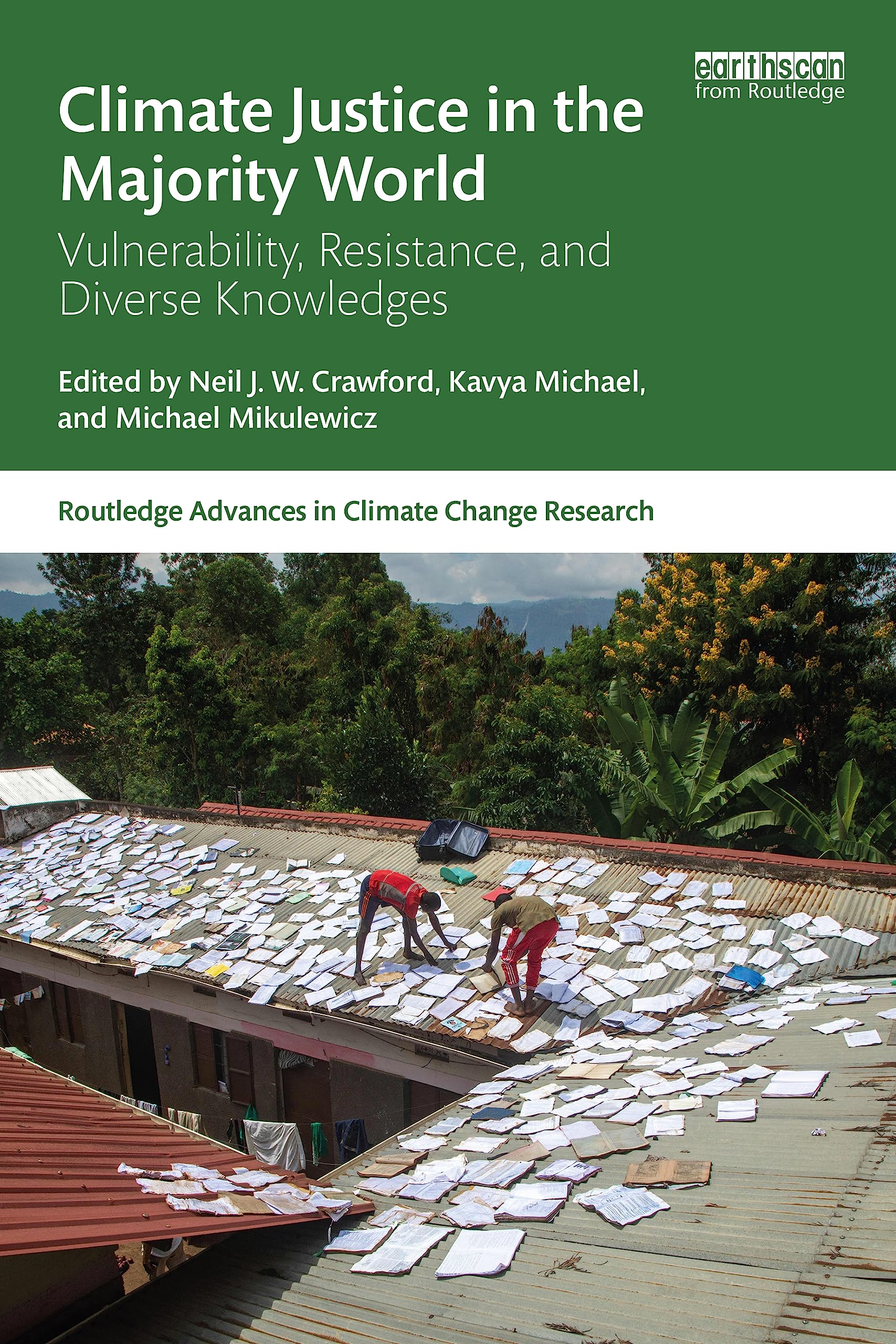
Climate Justice in the Majority World: Vulnerability, Resistance, and Diverse Knowledges (Routledge Advances in Climate Change Research)
$47.35
by Neil J.W. Crawford



This edited collection explores a diverse range of climate (in)justice case studies from the Majority World – where most of humans and non-humans live. It is also the site of the most severe impacts of climate change and home to some of the key solutions for the climate crisis. The collection brings together 12 chapters featuring the work of over 30 authors from around the globe. The impacts of climate change are disproportionately affecting individuals, communities, and countries in the Majority World who historically have contributed little to rising global temperatures. The 12 chapters focus on a range of cross-cutting themes, demonstrating both individual and collective experiences of climate change and struggles for achieving climate justice from the Majority World. This includes activism, resistance, and social movement organizing in India and Brazil; lived experiences and understandings of frontline communities in Bangladesh and South Africa; consequences of and responses to disasters in Mozambique and Puerto Rico; and contested accounts, narratives, and futures in the Maldives and Pakistan, among other topics. By adopting a decolonial lens, this book provides rich empirical content, insightful comparisons, and novel conceptual interventions. It foregrounds climate justice from an intersectional perspective and contributes to the ongoing efforts by scholars and activists to address epistemic injustice in climate change research, policy, and practice. It will appeal to undergraduate and graduate-level students, academics, activists, policymakers, and members of the public concerned with the impacts and inequalities of climate change in the Majority World. “An important book on climate justice where a majority of the world lives. It brings vital insights often lost in doomsday tales on climate change – on how people find ways to support each other in times of climate crisis, as in Bangladesh; digital advocacy of social movements in Brazil that shows us how to hold institutions accountable for disasters and how one may grieve, organize and resist in times of crisis. Across the world, these strategies are just as crucial in India where ‘climate friendly projects’ on the age-old-trope of ‘empty wasteland’ continue to threaten the lives of local populations.” Seema Arora-Jonsson , Professor in the Division of Rural Development, Department of Urban and Rural Development, Swedish University of Agricultural Sciences, Sweden “A wonderfully illuminating collection that diagnoses the structural drivers of climate injustice – by authors mostly from/of the Majority World. The book intricately weaves together diverse voices, identities, and sites of knowledge production to document the profound consequences of climate change on peoples, cultures, and communities. It asks us to confront the lived realities of neoliberal development, socioeconomic inequalities, and the ongoing trauma of colonization. The book offers an important advancement in our collective effort to decolonize climate justice research and to elevate the contestations, movements, and narratives from communities living on the frontlines of climate change.” Eric Chu , Assistant Professor, Department of Human Ecology, University of California, Davis, USA “Climate Justice in the Majority World opens new ground in the growing, and increasingly urgent literature on climate justice. Indeed, we cannot truly know what climate justice means without hearing from authors and places such as those represented, for the first time at such a broad scope, in this volume.” Brandon Barclay Derman , Assistant Professor in Environmental Studies, University of Illinois Springfield, USA. Author of Struggles for Climate Justice: Uneven Geographies and the Politics of Connection “Climate Justice in the Majority World comprises an eclectic collection of chapters that foreground scholarship from the Majority World. This volume challenges the perceived neutrality of climate change and disaster events, and analyses them through intersections with (neo)colonial extractivist models, neo-liberal development policies, institutional structures, social norms and social identities. It emphasizes the often muted voices in the struggle for climate justice through a depiction of the so-called alternate knowledge frames and innovative movements of resistance and struggles from the Majority World. This volume is an essential read for academics, students, policy makers and practitioners committed to decolonizing climate change and climate justice scholarship.” Saleemul Huq , OBE, Director, International Centre for Climate Change and Development (ICCCAD) and Professor, Independent University, Bangladesh “Climate Justice in the Majority World calls out the continuity of the colonial legacy in defining climate injustice in the majority world. The book builds on an interesting set of case studies with an intersectional perspective, representing multiple voices in the discourse - social movem