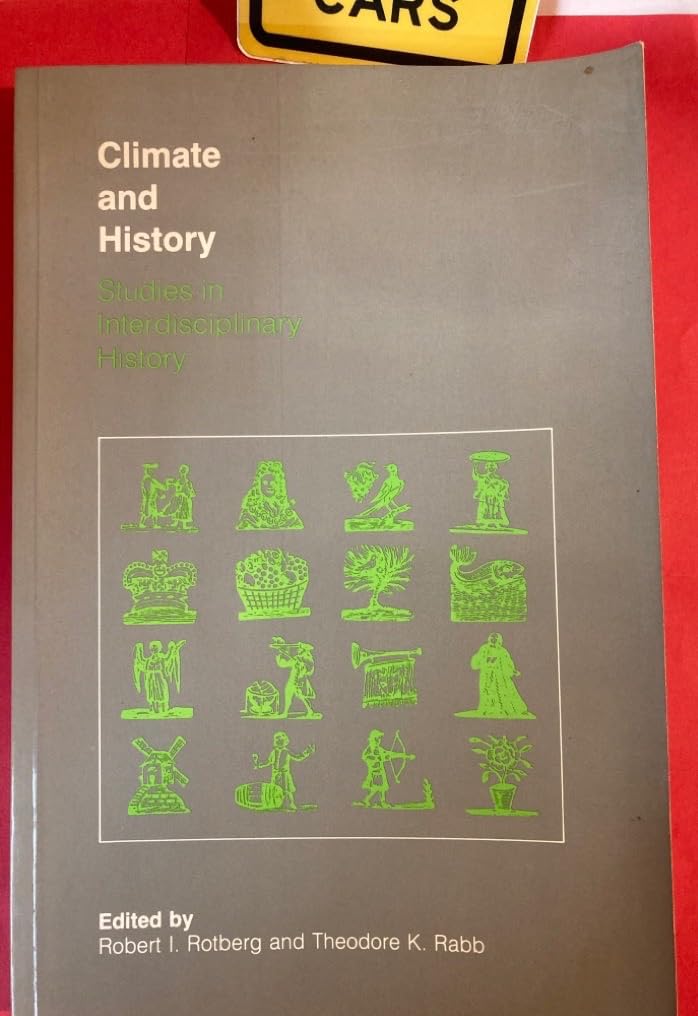



The effect of climate on historical change represents an exciting frontier for reading and research. In this volume scholars contribute to an area of interdisciplinary study which has not been systematically explored by climatologists and historians working together. Originally published in 1981. The Princeton Legacy Library uses the latest print-on-demand technology to again make available previously out-of-print books from the distinguished backlist of Princeton University Press. These editions preserve the original texts of these important books while presenting them in durable paperback and hardcover editions. The goal of the Princeton Legacy Library is to vastly increase access to the rich scholarly heritage found in the thousands of books published by Princeton University Press since its founding in 1905. Climate and History Studies in Interdisciplinary History By Robert I. Rotberg, Theodore K. Rabb PRINCETON UNIVERSITY PRESS Copyright © 1981 Princeton University Press All rights reserved. ISBN: 978-0-691-00787-8 Contents ROBERT I. ROTBERG and THEODORE K. RABB Introduction, ix, REID A. BRYSON and CHRISTINE PADOCH On the Climates of History, 3, JAN DE VRIES Measuring the Impact of Climate on History: The Search for Appropriate Methodologies, 19, HELMUT E. LANDSBERG Past Climates from Unexploited Written Sources, 51, ANDREW B. APPLEBY Epidemics and Famine in the Little Ice Age, 63, CHRISTIAN PFISTER The Little Ice Age: Thermal and Wetness Indices for Central Europe, 85, JEROME NAMIAS Severe Drought and Recent History, 117, DAVID HERLIHY Climate and Documentary Sources: A Comment, 133, JOHN D. POST The Impact of Climate on Political, Social, and Economic Change: A Comment, 139, JOHN A. EDDY Climate and the Role of the Sun, 145, THOMPSON WEBB III The Reconstruction of Climatic Sequences from Botanical Data, 169, HAROLD C. FRITTS, G. ROBERT LOFGREN, and GEOFFREY A. GORDON Past Climate Reconstructed from Tree Rings, 193, ALEXANDER T. WILSON Isotope Evidence from Past Climatic and Environmental Change, 215, DONALD G. BAKER Botanical and Chemical Evidence of Climatic Change: A Comment, 233, DAVID HACKETT FISCHER Climate and History: Priorities for Research, 241, THEODORE K. RABB The Historian and the Climatologist Research Notes, 251, EMMANUEL LE ROY LADURIE and MICHELINE BAULANT Grape Harvests from the Fifteenth through the Nineteenth Centuries, 259, BARBARA BELL Analysis of Viticultural Data by Cumulative Deviations, 271, The Contributors, 279, CHAPTER 1 Reid A. Bryson and Christine Padoch On the Climates of History The development of objective, quantitative evidence of how climates or climata, and the associated biota, have changed significantly (even during postglacial and historical times) has expanded the possibility of the rational inclusion of the climatic factor in the study of history. Climatic variation has produced variation in both the quantitative and qualitative character of the economic base of cultures, nations, and societies. This new recognition is not a revival of environmental determinism; it implies neither that all environmental changes have a climatic cause, nor that all cultural changes have an environmental cause, and it does not rest on an assumption that the links between climatic and human history are simple or straightforward. This new appreciation of the role of climates and climatic change is rather an extension of well-known ecological principles. One of these principles predicts that changes in community composition will result from shifts in relative competitive advantage when environmental factors change. In the human context, this principle suggests that the physical environment, and particularly the climate, gives a bias to the direction and success of the near-infinite series of decisions that make up the course of history. That is, with a shift in temperatures, or of amounts and timing of rainfall, the particular mix of resource use techniques characteristic of a population may well change, some occupations supplanting others as they become more profitable, less risky, and therefore more important. Clearly the size and rapidity of climatic change is crucial to the ability of societies to adapt or to cope. Another of these principles is that of limiting factors. To use an example from limnology, nitrogen may be limiting in one lake, phosphorus in another. Lack of heat is limiting in the Arctic, lack of water in the desert. Climatic fluctuations may move temperature, precipitation, or other climatic thresholds and change the absolute limits of particular economic activities, altering previous patterns. New possibilities may also be opened or old patterns eliminated. What then do we know about the climates of history? DOCUMENTARY EVIDENCE There are scattered references to climatic change, and its impact on human activities, that go back to Greek and Roman times. Cyprian, about 250 A.D., commented on the diminution