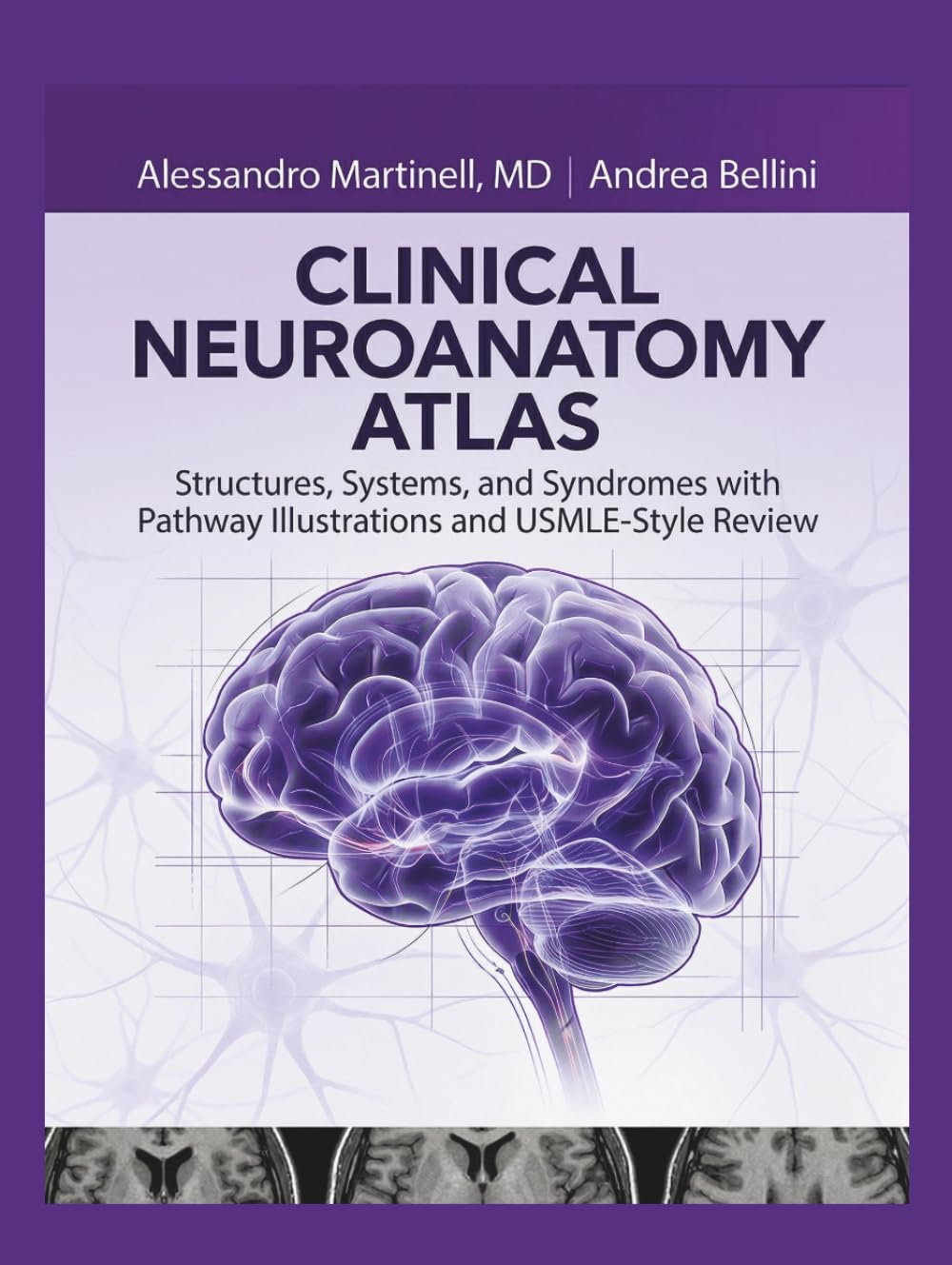
Clinical Neuroanatomy Atlas: Structures, Systems, and Syndromes with Pathway Illustrations and USMLE-Style Review
$120.00
by Alessandro Martinell MD



Clinical Neuroanatomy Atlas is a comprehensive, clinically integrated guide to the structure and function of the human nervous system, designed for medical students, healthcare trainees, and clinicians seeking mastery of neuroanatomical reasoning. This atlas goes beyond memorization to emphasize the core principle of clinical neuroscience: structure predicts function, and function predicts clinical presentation . Through a systematic, step-by-step approach, readers learn to: Understand the organization of the central and peripheral nervous systems - Trace major sensory and motor pathways from origin to termination - Interpret cross-sectional neuroanatomy with confidence - Correlate anatomical structures with real-world neurological syndromes - Apply lesion localization principles in clinical scenarios The book integrates: Clear structural explanations - Pathway-based illustrations - Developmental and functional context - High-yield clinical correlations - USMLE-style review questions for exam preparation From foundational concepts to advanced cerebrovascular localization, each chapter builds toward a unified framework for diagnosing neurological disease. Whether preparing for exams or clinical practice, this atlas provides the tools to think like a neurologist and localize lesions with precision. Clinical Neuroanatomy Atlas is a comprehensive, clinically integrated guide to the structure and function of the human nervous system, designed for medical students, healthcare trainees, and clinicians seeking mastery of neuroanatomical reasoning. This atlas goes beyond memorization to emphasize the core principle of clinical neuroscience: structure predicts function, and function predicts clinical presentation . Through a systematic, step-by-step approach, readers learn to: Understand the organization of the central and peripheral nervous systems - Trace major sensory and motor pathways from origin to termination - Interpret cross-sectional neuroanatomy with confidence - Correlate anatomical structures with real-world neurological syndromes - Apply lesion localization principles in clinical scenarios The book integrates: Clear structural explanations - Pathway-based illustrations - Developmental and functional context - High-yield clinical correlations - USMLE-style review questions for exam preparation From foundational concepts to advanced cerebrovascular localization, each chapter builds toward a unified framework for diagnosing neurological disease. Whether preparing for exams or clinical practice, this atlas provides the tools to think like a neurologist and localize lesions with precision.