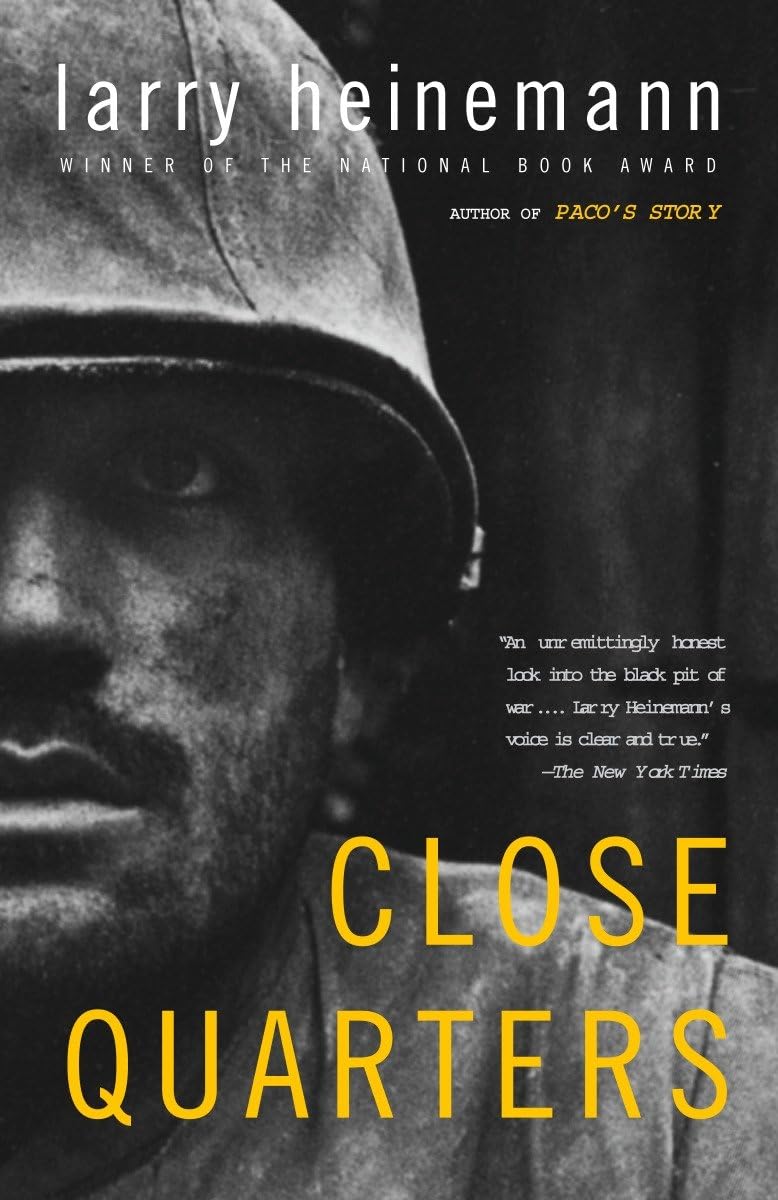



From the moment his first novel was published, Larry Heinemann joined the ranks of the great chroniclers of the Vietnam conflict--Philip Caputo, Tim O’Brien, and Gustav Hasford. In the stripped-down, unsullied patois of an ordinary soldier, draftee Philip Dosier tells the story of his war. Straight from high school, too young to vote or buy himself a drink, he enters a world of mud and heat, blood and body counts, ambushes and firefights. It is here that he embarks on the brutal downward path to wisdom that awaits every soldier. In the tradition of Naked and the Dead and The Thin Red Line , Close Quarters is the harrowing story of how a decent kid from Chicago endures an extraordinary trial-- and returns profoundly altered to a world on the threshold of change. "An unremittingly honest look into the black pit of war. . . . Larry Heinemann's voice is clear and true." — The New York Times "The best work of fiction to come out of the Vietnam War." — The Houston Chronicle " Close Quarters can stand with the finest Vietnam writing, fact or fiction." — Chicago Tribune “The most ambitious and substantial novel about the war in Vietnam . . . . the first one that people can read 75 years from now and gain an insight into how the war was truly fought . . . following the talk of the soldiers, you feel more like an eavesdropper than a reader.” — Kansas City Star From the moment his first novel was published, Larry Heinemann joined the ranks of the great chroniclers of the Vietnam conflict--Philip Caputo, Tim O'Brien, and Gustav Hasford. In the stripped-down, unsullied patois of an ordinary soldier, draftee Philip Dosier tells the story of his war. Straight from high school, too young to vote or buy himself a drink, he enters a world of mud and heat, blood and body counts, ambushes and firefights. It is here that he embarks on the brutal downward path to wisdom that awaits every soldier. In the tradition of Naked and the Dead and The Thin Red Line, Close Quarters is the harrowing story of how a decent kid from Chicago endures an extraordinary trial-- and returns profoundly altered to a world on the threshold of change. Larry Heinemann was born and raised in Chicago, and served a tour of duty with the 25th Division in Vietnam. He has received fellowships from the National Endowment for the Arts, the Guggenheim Foundation, and the William Fulbright Scholarship Program. He is the author of three novels: Close Quarters , Paco's Story , and Cooler by the Lake , as well as a memoir about his return visits to Vietnam since 1990, Black Virgin Mountain . His writing has received many honors, including the National Book Award and the Carl Sandburg Award. Mr. Heinemann is the writer-in-residence at Texas A&M University. UGLYDEADLYMUSICI stood stiffly with my feet well apart, parade-rest fashion, at the break in the barbed-wire fence between the officers' country tents and the battalion motor pool. My feet and legs itched with sweat. My shirt clung to my back. My shaving cuts burned. I watched, astonished, as the battalion Reconnaissance Platoon, thirty-some men and ten boxy squat-looking armored personnel carriers--tracks, we called them--cranked in from two months in the field, trailing a rank stink and stirring a cloud of dust that left a tingle in the air. One man slowly dismounted from each track and led it up the sloped path from the perimeter road, ground-guiding it, walking with a stumbling hangdog gait. Each man wore a sleeveless flak jacket hung with grenades, and baggy jungle trousers, the ones with large thigh pockets and drawstrings at the cuffs. The tracks followed behind like stupid, obedient draft horses, creaking and clacking along, and scraping over rocks hidden in the dust. There were sharp squeaks and irritating scratching noises, slow slack grindings, and the throttled rap of straight-pipe mufflers, all at once. And the talk, what there was, came shouted and snappy--easy obscenities and shit laughs. It was an ugly deadly music, the jerky bitter echoes of machines out of sync. A shudder went through me, as if someone were scratching his nails on a blackboard.The men walking and the men mounted passed not fifteen feet in front of me. A moult, a smudge of dirt, and a sweat and grit and grease stink covered everything and everyone--the smell of a junkyard in a driving rainstorm. Each man looked over, looked down at me with the blandest, blankest sort of glance--almost painful to watch--neither welcome nor distance. This one or that one did signify with a slow nod of the head or an arch of the brows or a close-mouthed sigh, and I nodded or smiled back, but most glanced over dreamily and blinked a puff-eyed blink and glanced forward again.The tracks, flat-decked affairs with sharply slanted fronts and armor-shielded machine guns (one fifty-caliber and two smaller M-60s), were painted o.d.--olive drab, a dark tallow shade of green--with large dun-colored numerals, faint and scratched but plain. Th