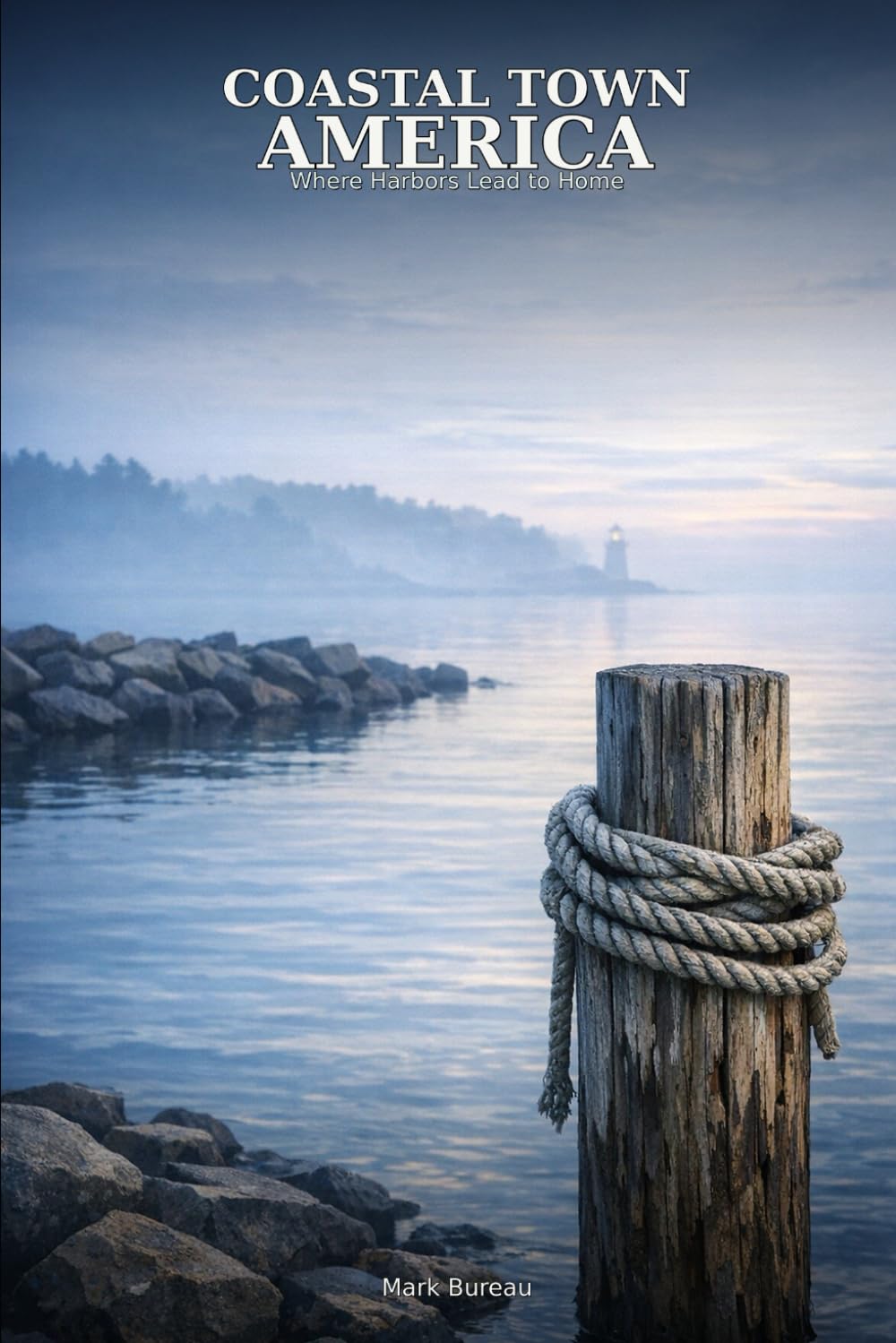



Harbors built these towns before beauty did. Coastal Town America: Where Harbors Lead to Home is a place-based journey through thirty coastal communities across the United States, from the weathered edges of New England and the working bays of the Gulf to the inland seas of the Great Lakes, the fog-soft Pacific, and the far outer reach of Alaska. This is not a tour of famous names. It is a portrait of places where water still shapes the day, where weather still has authority, and where a shoreline is not scenery, it is structure. These chapters are not checklists and they are not itineraries. You will not find top ten lists, restaurant directories, or quick-hit trivia. Instead, each town is written as an arrival. You step into a harbor street, feel the shift in air, notice what work still shapes the waterfront, and learn how geography quietly decides what a place becomes. Each chapter moves with the same steady rhythm: a sense of entry, the town’s physical shape, the working logic under the surface, and the calm truth that remains when you leave. The writing is practical first and poetic second, built to be readable and memorable without turning towns into slogans. Across five sections, you will meet rocky peninsulas where lighthouses still mean something, marsh towns where tides set timing, lake ports where freighters move like slow buildings on the horizon, and Pacific headlands where fog edits the coastline down to essentials. You will walk through Castine’s long memory and Stonington’s working docks, read Marblehead’s moorings like punctuation, and feel Watch Hill narrowing into sand and open water. You will follow the Southern Coast through live oaks and shrimp boats, Bay St. Louis rebuilding its calm, and Cedar Key living close to a shallow Gulf that never stops rearranging the edge. Then the book turns north again into Lakeshore towns where freshwater behaves like an ocean, and the coast is made of stone, ice, and long horizons. The Pacific chapters bring cliffs, redwoods, river mouths, moonstones, and basalt. The final section reaches the most exposed places, barrier islands and coral keys, gravel spits and working Alaskan bays, where distance is measured in crossings and weather windows. The towns were chosen for clarity, not fame. They are places you can read if you slow down. A harbor tells you what kind of town you are in. A breakwater tells you what the coast demanded. A river mouth tells you what work once mattered. A boardwalk, a bridge, a narrow lane of shops, a stretch of driftwood, a field of stones at the tide line, these are the details that hold a town together and make it distinct from every other place on the map. This book is for readers who want more than a vacation fantasy. It is for anyone who has ever wondered why certain towns feel anchored while others feel temporary, why some places endure storms and seasons without losing themselves, and why water seems to pull history forward even when the streets look quiet. Read it straight through and you trace a long edge of the country. Open at random and you still find a town that stands on its own. The promise is simple: a better way of seeing the coast, one harbor at a time.