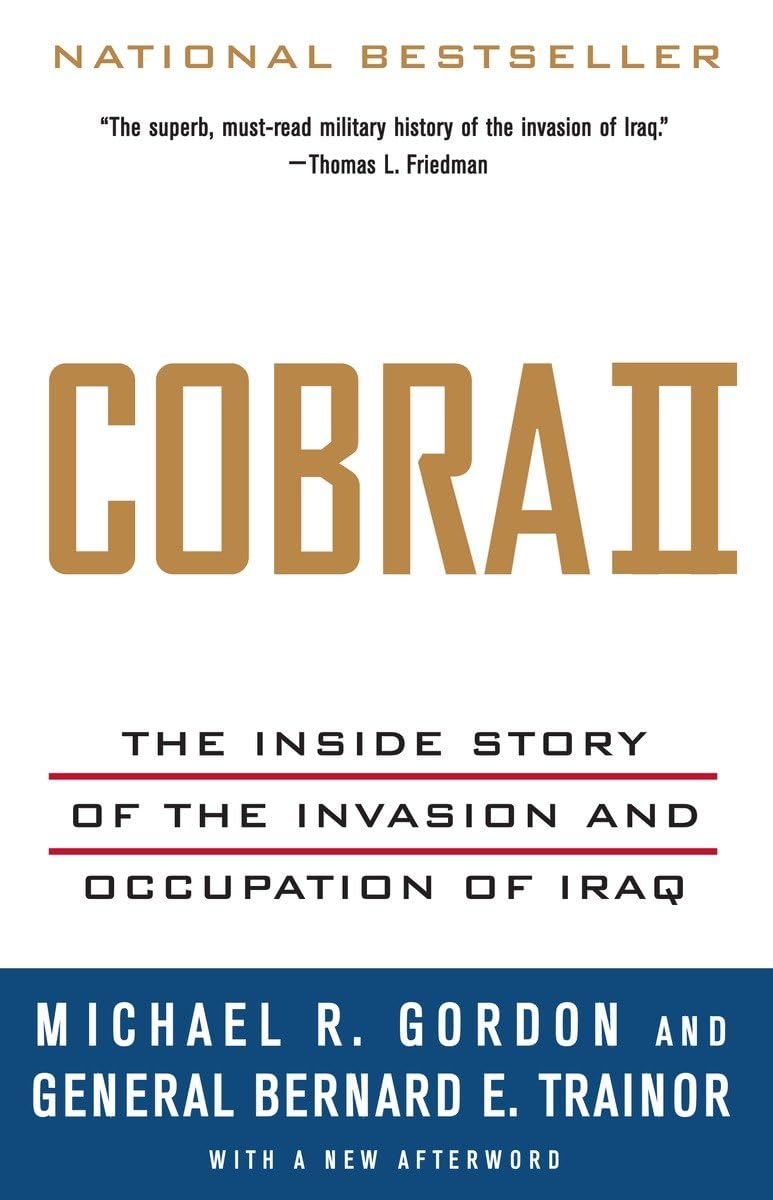
Cobra II: The Inside Story of the Invasion and Occupation of Iraq
$14.10
by Michael R. Gordon



Written by the chief military correspondent of the New York Times and a prominent retired Marine general, this is the definitive account of the invasion of Iraq. A stunning work of investigative journalism, Cobra II describes in riveting detail how the American rush to Baghdad provided the opportunity for the virulent insurgency that followed. As Gordon and Trainor show, the brutal aftermath was not inevitable and was a surprise to the generals on both sides. Based on access to unseen documents and exclusive interviews with the men and women at the heart of the war, Cobra II provides firsthand accounts of the fighting on the ground and the high-level planning behind the scenes. Now with a new afterword that addresses what transpired after the fateful events of the summer of 2003, this is a peerless re-creation and analysis of the central event of our times. “A work of prodigious research, Cobra II will likely become the benchmark by which other histories of the Iraq invasion are measured.”— The New York Times “Magisterial . . . With mountains of fresh detail on the war’s planning and progress with judicious analysis, Cobra II . . . will be hard to improve upon.” — The Economist “Stands as the best account of the war to dateÉoffers an instructive lesson on the consequences of inadequate strategic planning.”— The Washington Post Book World “ExcellentÉ Cobra II is everything that the Bush administration's plan for the war was not. It is meticulously organized, shuns bluff and bombast for lapidary statements, and is largely impervious to attack.”— The New York Times Book Review “RemarkableÉ a classic military history of the blow-by-blow fighting to Baghdad. Cobra II makes an irrefutable case for where the laurels lay for the victors and where the blame lies for the defeats.”— The Portland Oregonian Michael R. Gordon is the chief military correspondent for The New York Times, where he has worked since 1985. He is the coauthor, with Lieutenant General Bernard E. Trainor, of The Generals’ War. He has covered the Iraq War, the American intervention in Afghanistan, the Kosovo conflict, the Russian war in Chechnya, the 1991 Persian Gulf War, and the American invasion of Panama. He lives in the Washington, D.C., area. Bernard E. Trainor, a retired Marine Corps lieutenant general, was a military correspondent for The New York Times from 1986 to 1990. He was director of the National Security Program at Harvard University’s John F. Kennedy School of Government from 1990 to 1996. Currently a military analyst for NBC, Trainor lives in Potomac Falls, Virginia. Chapter 1 Snowflakes from the Secretary In late 2001, Secretary of Defense Donald H. Rumsfeld summoned the senior military leadership to his office on the E-ring of the Pentagon. It had been an extraordinarily eventful period for the administration of George W. Bush. Kabul had recently fallen. U.S. commandos and Pashtun commanders in southern Afghanistan were on the hunt for Osama bin Laden. In Bonn, Germany, the United States and diplomats from allied nations were prepared to anoint a new group of Afghan leaders. During his short tenure at the Pentagon, Rumsfeld had established himself as an indomitable bureaucratic presence. It was a commonplace among the Bush team that the military needed stronger civilian oversight, and Rumsfeld exercised control with the iron determination of a former corporate executive. He had a restless mind and was given to boast that he was genetically impatient. When he arrived at the Pentagon, Rumsfeld made clear that his goal was nothing less than to remake the U.S. military to fashion a leaner and more lethal force. Notepads were strewn throughout his outsized office. When the defense secretary had an idea he scribbled it down. Four-star generals and high-ranking aides were accustomed to receiving snowflakes: terse memos that captured his latest brainstorm or query and that landed with a thud. Rusmsfeld had been receiving his daily CIA briefing shortly before the American Airlines plane plowed into the building on September 11. Afterward, he had staked out a clear position on how the Bush team should respond. The United States should take the fight to the Taliban and Al Qaeda camps in Afghanistan, but it would not end there. The Pentagon needed to take an even more forceful step that would let its enemies know that the United States was now involved in a global war against the terrorists and the renegade states that helped them. The U.S. needed to land a series of blows well beyond Afghanistan. The question was where and when to strike. The defense secretary’s meeting had been called to ponder the war plan for another potential adversary. General Richard B. Myers, the pliable chairman of the Joint Chiefs of Staff (JCS) who was picked by Rumsfeld because of his reputation as a team player, was there. So was Peter Pace, the ambitious vice chairman who was already being talked about as an officer who might fo