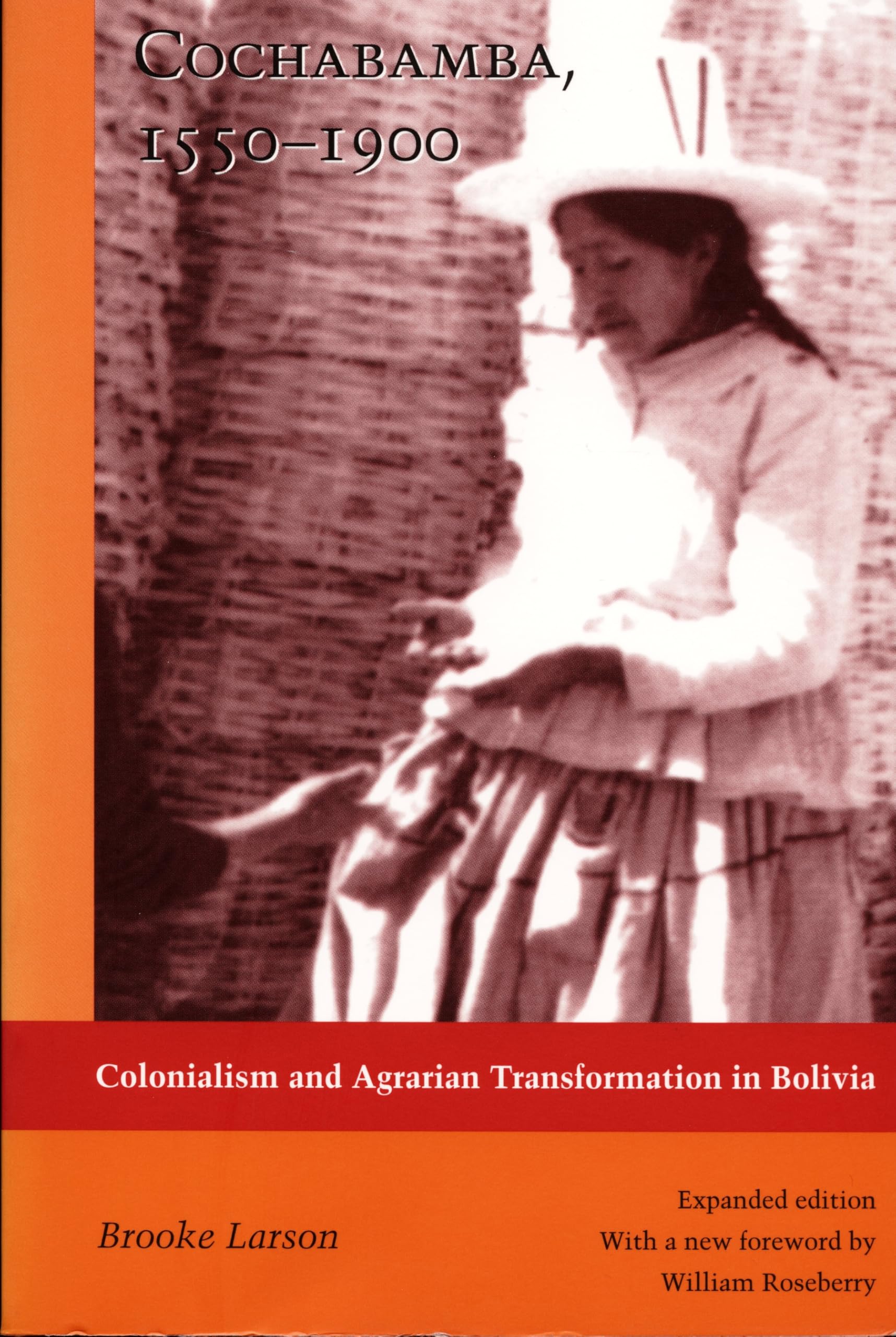
Cochabamba, 1550-1900: Colonialism and Agrarian Transformation in Bolivia
$20.98
by Brooke Larson



Winner of the 1990 Best Book Award from the New England Council on Latin American Studies This study of Bolivia uses Cochabamba as a laboratory to examine the long-term transformation of native Andean society into a vibrant Quechua-Spanish-mestizo region of haciendas and smallholdings, towns and villages, peasant markets and migratory networks caught in the web of Spanish imperial politics and economics. Combining economic, social, and ethnohistory, Brooke Larson shows how the contradictions of class and colonialism eventually gave rise to new peasant, artisan, and laboring groups that challenged the evolving structures of colonial domination. Originally published in 1988, this expanded edition includes a new final chapter that explores the book’s implications for understanding the formation of a distinctive peasant political culture in the Cochabamba valleys over the eighteenth and nineteenth centuries. “In light of the important reflections on the book by Roseberry and the author herself, and the quality and relevance of Cochabamba, 1550–1990 , the decision to reissue it is clearly a good one.” - Colonial Latin American Historical Review “This book makes it clear that the history of these valleys is unique, with its large forastero , cholo , and mestizo populations, who worked for the haciendas, supplied grain to the silver miners, and evolved into a commercially vibrant, bilingual people with a rich ethnic heritage.” - Agriculture and Human Values “[A] magnificent work in social history. In terms of its historical scope, rich detail, and theoretical sophistication, [Larson’s] work represents a model for social historians.” - Erwin P. Grieshaber, The Americas “[ Cochabamba ] stands as an impressive and theoretically engaging study in historical anthropology and the political economy of colonialism.” - Mark T. Berger, Latin American Research Review "Larson’s work is a major study in the Latin American field . . . magnificent and original. . . . ‘Must’ reading for all agrarian and social historians of Latin America."—Steve J. Stern, University of Wisconsin "[T]he work of a master historian, finding, analyzing, and interpreting archival sources with both discipline and insight."—William Roseberry, from the Foreword “[ Cochabamba ] stands as an impressive and theoretically engaging study in historical anthropology and the political economy of colonialism.” -- Mark T. Berger ― Latin American Research Review “[A] magnificent work in social history. In terms of its historical scope, rich detail, and theoretical sophistication, [Larson’s] work represents a model for social historians.” -- Erwin P. Grieshaber ― The Americas “In light of the important reflections on the book by Roseberry and the author herself, and the quality and relevance of Cochabamba, 1550–1990 , the decision to reissue it is clearly a good one.” ― Colonial Latin American Historical Review “This book makes it clear that the history of these valleys is unique, with its large forastero , cholo , and mestizo populations, who worked for the haciendas, supplied grain to the silver miners, and evolved into a commercially vibrant, bilingual people with a rich ethnic heritage.” ― Agriculture and Human Values "[T]he work of a master historian, finding, analyzing, and interpreting archival sources with both discipline and insight."--William Roseberry, from the Foreword Brooke Larson is Professor of History and Director of Latin American Center, State University of New York, Stony Brook. She is the coeditor of Ethnicity, Markets, and Migration in the Andes , also published by Duke University Press. Cochabamba, 1550-1900 Colonialism and Agrarian Transformation in Bolivia By Brooke Larson Duke University Press Copyright © 1998 Duke University Press All rights reserved. ISBN: 978-0-8223-2088-3 Contents List of Illustrations, List of Tables, Foreword, Preface to the Duke Edition, Acknowledgments, Abbreviations, Introduction, Chapter One Along the Inca Frontier, Chapter Two The Emergence of a Market Economy, Chapter Three Declining State Power and the Struggle over Labor, Chapter Four Andean Village Society, Chapter Five Haciendas and the Rival Peasant Economy, Chapter Six The Landowning Class: Hard Times and Windfall Profits, Chapter Seven The Spirit and Limits of Enterprise, Chapter Eight The Ebb Tide of Colonial Rule, Chapter Nine Colonial Legacies and Class Formation, Chapter Ten Cochabamba: (Re)constructing a History, Appendix, Glossary, Archival Material, Manuscript Collections, Index, About the Author, CHAPTER 1 Along the Inca Frontier The traveler in the sixteenth century who set off southward from the shores of Lake Titicaca on a journey through Alto Perú (today Bolivia) left behind him one of the world's most arresting lacustrine landscapes. Pausing a moment in the hot morning sun to contemplate the landscape, a European traveler must have been struck by the la