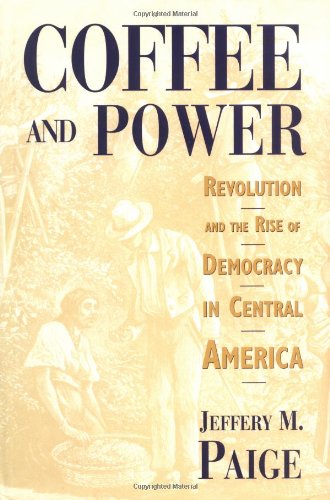
Coffee and Power: Revolution and the Rise of Democracy in Central America
$213.95
by Jeffery M. Paige



In the revolutionary decade between 1979 and 1992, it would have been difficult to find three political systems as different as death-squad-dominated El Salvador, peaceful social-democratic Costa Rica, and revolutionary Sandinista Nicaragua. Yet when the fighting was finally ended by a peace plan initiated by Costa Rica's President Oscar Arias, all three had found a common destination in democracy and free markets. To explain this extraordinary turn of events is the task of this landmark book, which fuses political economy and cultural analysis. Both the divergent political histories and their convergent outcome were shaped by a single commodity that has dominated these export economies from the nineteenth century to the present--coffee. Jeffery Paige shows that the crises of the 1980s had their roots in the economic and political crises of the 1930s, when the revolutionary left challenged the ruling coffee elites of all three countries. He interweaves and compares the history, economics, and class structures of the three countries, thus clarifying the course of recent struggles. The heart of the book is his conversations with sixty-two leaders of fifty-eight elite dynasties, who for the first time tell their own stories of the experience of Central American revolution. Paige's analysis challenges not only Barrington Moore's influential theory of dictatorship and democracy but also contemporary approaches to "transitions to democracy." It also shows that a focus on either political economy or culture alone cannot account for the transformation of elite ideology, and that revolution in Central America is deeply rooted in the personal, familial, and class histories of the coffee elites. Over the past three decades, nearly every Central American nation has been at some stage of revolution, and understanding the numerous conflicts required a keen grasp of local politics. The facts were especially hard to discern because other countries, principally the United States, were throwing their weight around and muddying the political water. Now with a nascent peace shakily in place in Guatemala, the last conflict has come to an end, and Jeffrey M. Paige sheds some necessary light on the issues without lumping the entire region together. By focusing on the lucrative and influential business of coffee production and its connection to politics, Coffee and Power: Revolution and the Rise of Democracy in Central America looks at the shift toward democracy from the perspective of the elite class of coffee growers. Though the different nations share a common agricultural mainstay, the socioeconomic realities vary greatly, and Paige expertly negotiates the subtleties of each. A sweeping historical analysis of the encouraging yet still fragile emergence of democracy in Central America...Through exhaustive historical research and enterprising interviews, [the author] penetrates the worlds of the most powerful families of El Salvador, Nicaragua and Costa Rica...Paige has illuminated a path for comprehending countries whose histories have often been caricatured by polemicists and ignored by policy makers. --Thomas Carothers ( New York Times Book Review ) A detailed, comprehensive work on the complex relationship between coffee and political and financial might in this region...Coffee is evidently not the sole influence propelling these nations along the democratic path, but this volume demonstrates how ideologies and crises are interrelated, an important factor for a region with such an uncertain political future. ( British Bulletin of Publications on Latin America, the Caribbean, Portugal and Spain ) The main lesson from this thoughtful, well-written book: if coffee is grown with less repression, with social welfare programs, with more owned by small-holders, then the poor are less likely to join revolutions...[Paige's conclusions] are reasonable and it is important to have them documented in this fair, well-researched book. This book will appeal to people interested in the history of Central America, to students of peace and war, to scholars of coffee economics and politics, and to political ecologists. --Jeffery W. Bentley ( Agriculture and Human Values ) Coffee and Power makes an important contribution to the literature on transitions to democracy. Paige notes with irony that the establishment of parliamentary democracies may represent the most important achievement of the Salvadoran and Nicaraguan Left of the 1980s, as it was for the Costa Rican Left of the 1930s and 1940s. --Laurie Medina ( American Anthropologist ) Jeffery M. Paige is Professor of Sociology at the University of Michigan, Ann Arbor.