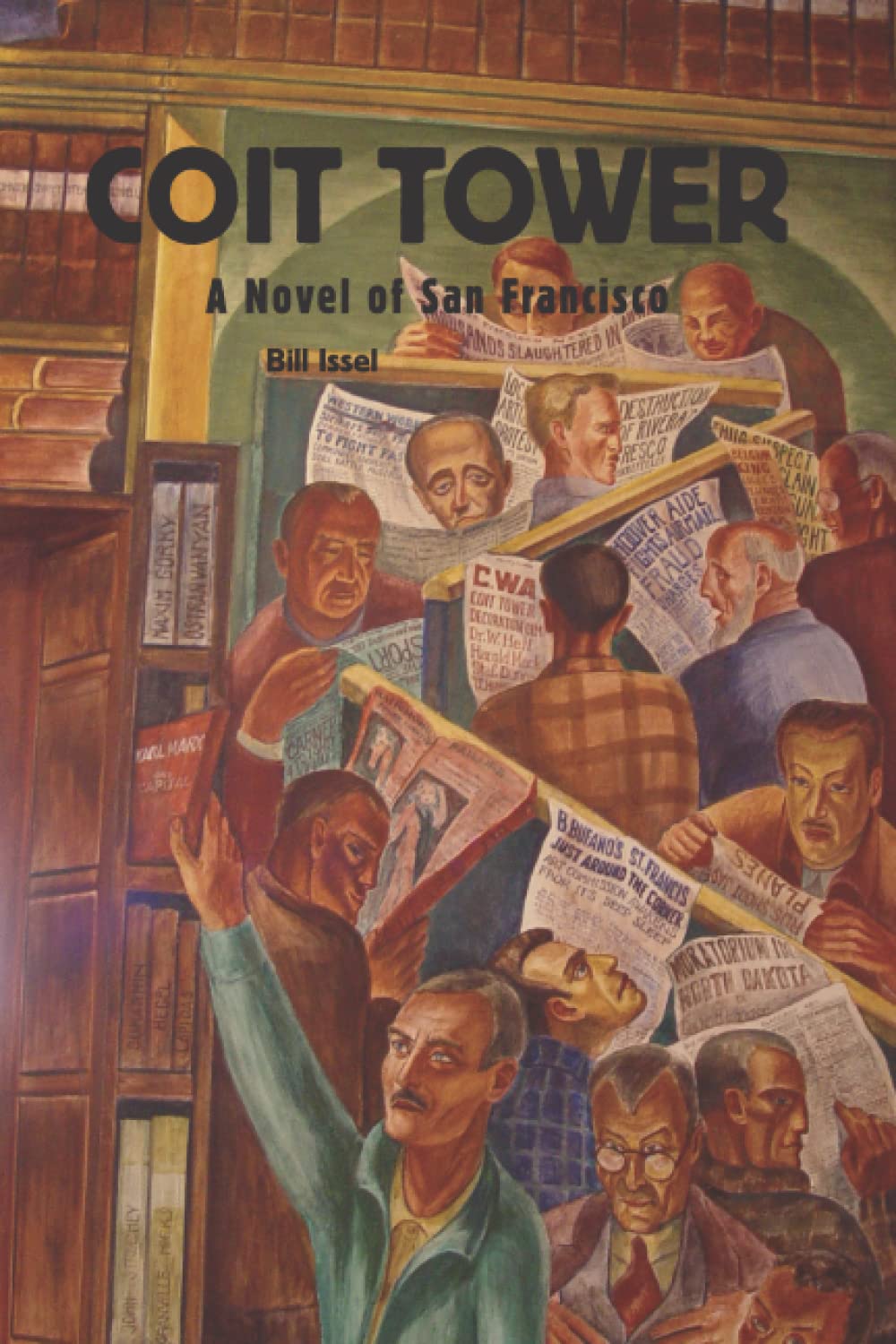



San Francisco, 1942. Four months after Pearl Harbor. No one knows if the Japanese will invade California and occupy San Francisco. Harlan Winthrop, a high society banker who heads the city’s war bonds campaign is stabbed to death. The pro-Axis greeting “RoBerTo” is painted on the wall next to the body in Coit Tower. Is this killing part of a plot to weaken morale by creating even more anxiety among San Franciscans? Police Chief Gerald O’Reilly keeps the murder from the press and the public. He’s afraid the dramatic circumstances of the crime could aggravate the deep divisions in the city. Residents are tense and split into factions. Many feel torn between their American patriotism and their Irish, Italian, German, and Japanese ancestral ties. Former Police Commissioner Tony Bosco is pressed into service. Bosco works behind the scenes to find the killer aided by detective Dennis Sullivan and Ruthie Fuller, Chief O’Reilly’s special assistant. They work to identify and arrest the killer in a city changing before their eyes. Tens of thousands of war workers, sailors, and soldiers flood into San Francisco; the Army removes the city’s Japanese Americans from their homes and businesses; white racism and sexism are challenged by racial justice activists and feminists; the powerful Catholic Church is challenged by the radical Communist Party; the war tests old friendships and political alliances as never before.Bill Issel is an award winning historian and author of many books and articles on US Social History, US Political History, US Labor History, and San Francisco history. This is his first novel. "Reminiscent of Dragnet . . . with the color and ambiance of Chinatown . . . historical fiction that expertly renders its setting." --- Kirkus Reviews "In early 1942 San Francisco was a city on the precipice. As residents mobilized for war in the Pacific, elites and activists battled one another for power at home. Coit Tower's gripping story of a North Beach murder and its investigation takes readers on a panoramic tour of this city at war. Filled with evocative, surprising details of everyday life in 1940s San Francisco, Coit Tower transports readers back to a moment when clashing values and interests threatened to topple the city's old order." Christopher Lowen Agee, author of The Streets of San Francisco "Bill Issel has given us the best San Francisco novel in a decade. Filled with political intrigue, interesting characters, and a mesmerizing story line, this is the novel all fans of 'the cool grey city' have been awaiting for a long time." Rodger Birt, author of Envisioning the City: Photography in the History of San Francisco "It was a delight to read this novel. I didn't want to put it down. I loved all the historical detail and dpth and felt I was in the city at that time. The characters are well developed. Ruthie is a really strong and complex character." Rochelle Gatlin, author of American Women Since 1945 "A real thriller, with lots of twists and turns and a great sense of wartime San Francisco and its issues." Zeese Papanikolos, author of Buried Unsung: Louis Tikas and the Ludlow Massacre "A riveting murder mystery that takes you into a time and place that is both familiar and strikingly different from today. Set in the months after the bombing of Pearl Harbor, Coit Tower unflinchingly captures the zeitgeist of 1940s San Francisco." Barbara Berglund Sokolov, author of Making San Francisco American: Cultural Frontiers in the Urban West, 1846-1906 Very few authors write fiction about Asian-Americans in San Francisco. Scholar Bill Issel has done so, utilizing his extensive knowledge of San Francisco history and his acute psychological intuition. The result is an exciting vision of San Francisco in the late 1930s and the early 1940s. Issel picks two subjects to explore: 1) Asian communities in San Francisco and California, and 2) the police department and the politics surrounding it. What he produces is a gripping drama and one that will excite readers of this novel. Charles Fracchia, in The San Francisco Historical Society Newsletter "A suspenseful murder mystery and a highly effective evocation of San Francisco four months after the US entered World War II." Robert W. Cherny, author of Victor Arnautoff and the Politics of Art Bill Issel is an award winning historian and author of many books and articles on US Social History, US Political History, US Labor History, and San Francisco history.