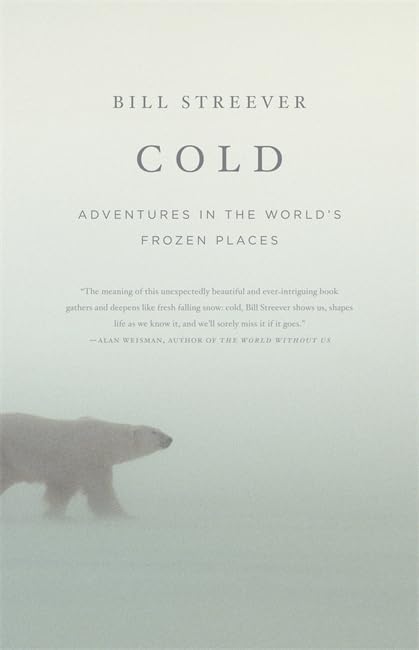



From avalanches to glaciers, from seals to snowflakes, and from Shackleton's expedition to "The Year Without Summer," Bill Streever journeys through history, myth, geography, and ecology in a year-long search for cold--real, icy, 40-below cold. In July he finds it while taking a dip in a 35-degree Arctic swimming hole; in September while excavating our planet's ancient and not so ancient ice ages; and in October while exploring hibernation habits in animals, from humans to wood frogs to bears. A scientist whose passion for cold runs red hot, Streever is a wondrous guide: he conjures woolly mammoth carcasses and the ice-age Clovis tribe from melting glaciers, and he evokes blizzards so wild readers may freeze--limb by vicarious limb. Cold , filled with obscure facts and fascinating anecdotes, is both entertaining and enlightening, and Streever's crisp, articulate writing style and easy-to-understand scientific explanations yield a compulsively readable book. However, Streever's loosely organized chapters and stream-of-consciousness, bloglike narrative keep him from dwelling for long on any single topic, and the Dallas Morning News took issue with his single-minded focus on the northern hemisphere. Some critics also objected to his views on climate change, but these complaints stemmed from differences of opinion. Streever's breezy, captivating romp through the frozen North reminds readers "that cold shapes continents, wins and loses wars, fuels madmen, inspires Nobel Prize–winning work, challenges us, curses us and blesses us" ( Cleveland Plain Dealer ). This is a rumination on what cold is—“the absence of heat, the slowing of molecular motion, a sensation, a perception, a driving force.” Its sections proceed by months and seasons, beginning in July, when it is 51 degrees Fahrenheit on the western edge of Alaska’s Prudhoe Bay, 300 miles north of the Arctic Circle. Subsequent stops include the highest mountain in Britain; York, Pennsylvania; and San Francisco. Streever amiably discusses various aspects of cold: the measuring of temperature and the people behind it (the German Daniel Fahrenheit; the Swede Anders Celsius; the Scot Lord Kelvin); the cold weather explorers (Adolphus Greely, Richard Byrd, Robert Falcon Scott); Charles Darwin’s explorations in the southern hemisphere; and reflections on hibernation and helium, among many other topics. Even Frankenstein finds its way into these pages (Mary Shelley’s novel, after all, begins with letters from an Arctic explorer). Streever’s peripatetic meditation ranges widely over its fascinating subject. --June Sawyers "Streever's prose does what E. L. Doctorow said good writing is supposed to do, which is to evoke sensation in the reader ... This book is chilling in too many ways to count." ( Dwight Garner, The New York Times ) "The meaning of this unexpectedly beautiful and ever-intriguing book gathers and deepens like fresh falling snow: Cold, Bill Streever shows us, shapes life as we know it, and we'll sorely miss it if it goes." ( Alan Weisman, author of THE WORLD WITHOUT US ) " Cold is a love song to science and scientists, to Earth and everything that lives on and flies over and tunnels under it. It's impossible to read the book and not fully realize that our planet must be protected." ( Mary Roach, The New York Times Book Review ) "[Streever] demonstrates an amazing zeal for collecting cold facts...his voice is so engaging and his writing so crisp...Streever has style and curiosity to spare." ( The Washington Post ) "Briskly refreshing...if your own soul's compass points north, you'll enjoy snuggling down with Cold ." ( The Cleveland Plain Dealer ) Bill Streever chairs the North Slope Science Initiative's Science Technical Advisory Panel in Alaska and serves on many related committees, including a climate change advisory panel. A biologist, he lives with his son in Anchorage, where he hikes, bikes, camps, scuba dives, and cross country skies, as often as the weather allows. From The Washington Post's Book World/washingtonpost.com Reviewed by David Laskin "The world warms, awash in greenhouse gases," Bill Streever notes in the first line of this fascinating contemplation of all things frozen, "but forty below remains forty below." He should know. By Page 3, he has stripped down to his swim trunks and stands poised for a summertime plunge in the icy waters of Prudhoe Bay, well north of the Arctic Circle: "I go in headfirst. . . . The water stings, as if I am rolling naked through a field of nettles. . . . My skin tightens around my body. . . . I feel as if I am being shrink-wrapped, like a slab of salmon just before it is tossed into the Deepfreeze." Going in headfirst is Streever's preferred approach. An Anchorage-based biologist and outdoorsman, Streever demonstrates an amazing zeal for collecting cold facts. If it hibernates, shivers, glaciates, migrates to the poles, skis, feels compelled to reach Ultima Thule or absolute zero, Streever is hot o