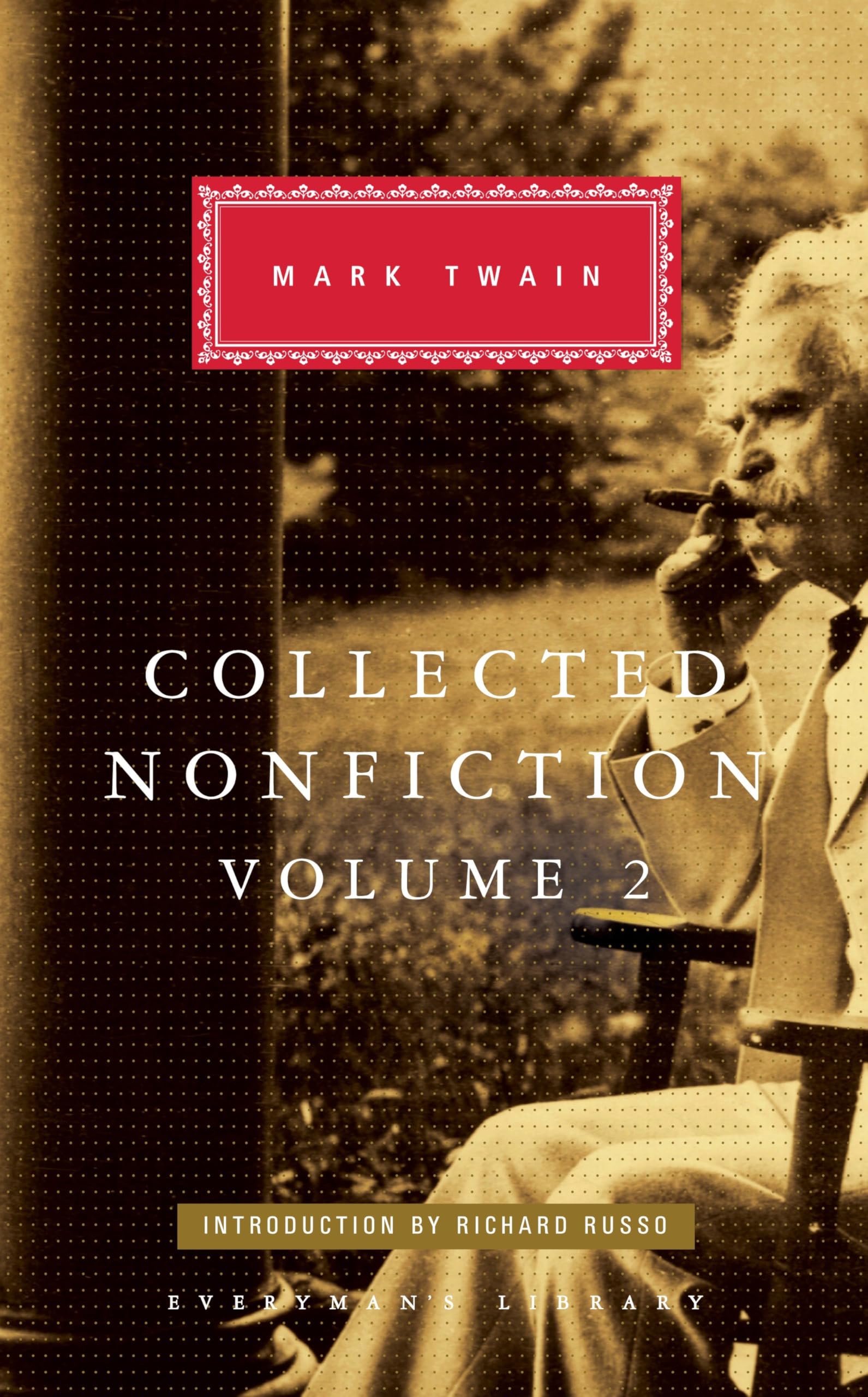
Collected Nonfiction of Mark Twain, Volume 2: Selections from the Memoirs and Travel Writings; Introduction by Richard Russo (Everyman's Library
$18.97
by Mark Twain



The second of two hardcover volumes collecting the major nonfiction by the "father of American literature," including excerpts from The Innocents Abroad, Roughing It, A Tramp Abroad, and Life on the Mississippi. Twain’s playful exuberance and remarkable storytelling gifts are on full display as he regales readers with real-life adventures in these rollicking, shrewd, and hilarious autobiographical works. In these pages, we follow him through his stint as a fledgling reporter out West to his attempt to navigate a steamboat on the Mississippi River, and all during his experiences as an irreverent and skeptical traveler through Europe and the Holy Land. Gleefully iconoclastic, whether he is puncturing the pretensions of others or aiming his satirical barbs squarely at himself, Twain also proves to be deeply compassionate, as fierce in his condemnation of injustice as he is skillful in mining the humor in human folly. Long hailed as “the Lincoln of our literature,” Twain harbored as rich and fertile a blend of contradictions as the dynamic nation he came to embody—and define. MARK TWAIN was born in Missouri in 1835 and died in Connecticut in 1910. RICHARD RUSSO is the author of eight novels, two collections of stories, and a memoir. His novel, Nobody's Fool , was made into a movie staring Paul Newman. In 2002 he received the Pulitzer Prize for Empire Falls, which was adapted to a multiple-award-winning HBO mini-series. Introduction by Richard Russo The novelist William Dean Howells once famously remarked that his friend Mark Twain was not a writer who performed so much as a performer who wrote. Perhaps surprisingly, this astute observation also holds true in Twain’s nonfiction, a form that would seem to put less of a premium on both invention and performance. To read the passages from The Innocents Abroad , Roughing It , A Tramp Abroad , and Life on the Mississippi collected in this volume is to understand that Twain didn’t lose much sleep over the idiosyncratic demands of fiction versus nonfiction. Both offered numerous and varied opportunities to an inspired, indeed unparalleled, bullshitter. To be sure, many of the set pieces that are included in the Everyman’s Library volume of Twain’s Complete Short Stories – “Buck Fanshaw’s Funeral,” “The Story of the Old Ram” – turn up in this volume as well. Classifying Twain’s work into fiction or nonfiction is something we do for our own convenience; it was his own convenience to ignore ours. So, are the events chronicled in Roughing It – which details Twain’s journey by stagecoach to the Nevada territory, his stint there as a silver miner, and his apprenticeship to the newspaper trade – true? Once asked that same question about one of his own stories, David Sedaris replied, “They’re true enough,” and it’s easy to imagine Twain saying the same thing about his youthful adventures in the American West. We know he traveled to Europe and the Holy Land as a correspondent, so it’s not unreasonable to suppose that at least some of what he reports in The Innocents Abroad actually happened. I suspect, however, that the literally true parts are those he wasn’t able to improve on through embellishment or outright invention. For Twain, “truth” was not just elastic but indeed designed to be stretched. He learned this lesson early on, writing for western newspapers. He explains the job to great comic effect in Roughing It , where, as a cub reporter, he wrote a story about a wagon full of immigrants attacked by Indians. At first, fearing that other reporters might recount the same story, he sticks pretty close to the facts, despite his conviction that the story could be improved upon by straying from them. Later, though, when he learns that the owner of the wagon meant to continue his journey the following morning (leaving no one to contradict Twain’s account), all bets are off. His next draft describes an Indian fight that “to this day has no parallel in history.” This is Twain we’re talking about, so it’s likely that he also exaggerated the extent of his exaggerations, but still. Buoyed by praise from the paper’s editor, he expresses a willingness to murder every immigrant on the plains with his pen if “the interests of the paper demanded it.” Thus the low bar of truth is established: true enough . For him. For his editor. For the paper’s readership. His approach to fiction was basically the same. At the beginning of the Adventures of Huckleberry Finn , Huck says that readers may have heard of him if they’ve read The Adventures of Tom Sawyer , which “was made by Mr. Mark Twain, and he told the truth, mainly. There were things which he stretched, but mainly he told the truth.” That first assertion, it’s worth remembering, was both the truth and a lie. The book was actually “made” by Samuel Clemens, and the parts Mr. Clemens “stretched” were the parts that needed stretching, beginning with his own identity as Mark Twain. Again, Twain is not so much