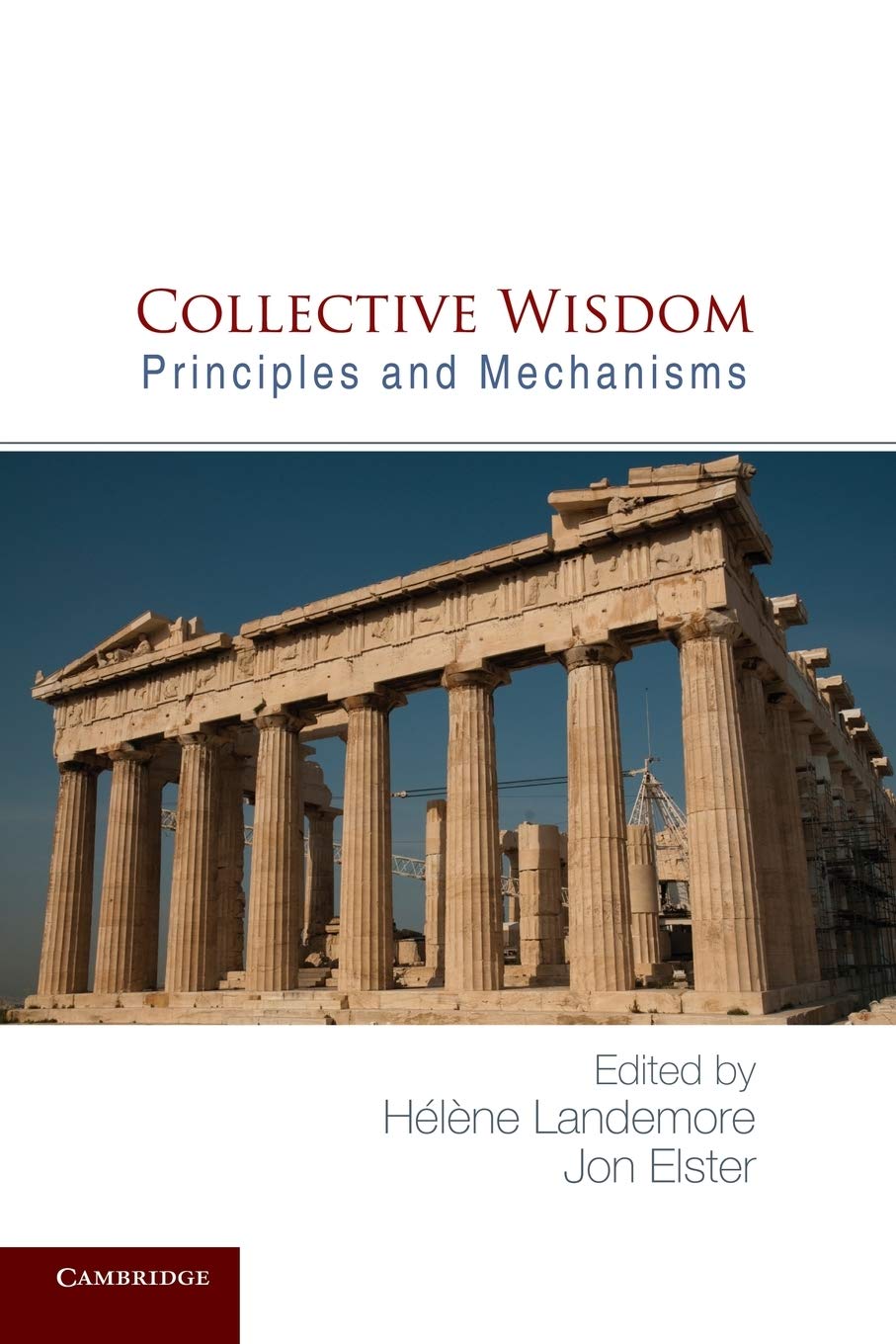



James Madison wrote, “Had every Athenian citizen been a Socrates, every Athenian assembly would still have been a mob.” The contributors to this volume discuss and for the most part challenge this claim by considering conditions under which many minds can be wiser than one. With backgrounds in economics, cognitive science, political science, law, and history, the authors consider information markets, the Internet, jury debates, democratic deliberation, and the use of diversity as mechanisms for improving collective decisions. At the same time, they consider voter irrationality and paradoxes of aggregation as possibly undermining the wisdom of groups. Implicitly or explicitly, the volume also offers guidance and warnings to institutional designers. “In bringing together essays by students of politics, economics, philosophy, history, and cognitive science – disciplines that have much to say to each other but engage in joint conversation too rarely – Landemore and Elster make a significant contribution. Many of the individual articles are by scholars working at the frontiers of their respective fields. No work on collective intelligence has covered the subject with such breadth, scope, or wisdom.” – Robert Laubacher, Center for Collective Intelligence, MIT Sloan School of Management “This cutting-edge collection shows that in the last decade human beings have attained a genuinely new understanding of how and why collective wisdom can surpass that of any individual. Each essay adds subtlety, theoretical insight, or a telling example. Together they build to a compelling conclusion: societies succeed when they organize themselves to think better collectively. They can do this consciously through institutions whose principles and mechanisms are laid out in this book.” – Jane Mansbridge, Adams Professor, Kennedy School of Government, Harvard University “For more than two decades, the ideas of participatory democracy and later on of deliberative democracy have stimulated the debate on the various forms of democratic development. Collective Wisdom opens a new cycle with the notion of epistemic democracy, renewing the very meaning of universal suffrage. This pathbreaking book brings together a series of contributions that define a promising field of research.” – Pierre Rosanvallon, Chair in Modern and Contemporary History of Politics, Collège de France “Can crowds be anything but unwise? Is there any reason to suppose that collective judgments could be accurate? The papers gathered in this volume suggest some stimulating ways to claim that those questions could be answered affirmatively and that the so called ‘mob’ might sometimes be less foolish and less unreliable than it has commonly been taken to be. Very rewarding in times when democracy is so frequently deemed unable to cope with complex questions.” – Jean-Fabien Spitz, Professor of Political Philosophy, University of Paris I Panthéon Sorbonne The contributors to this volume discuss and for the most part challenge whether many minds can be wiser than one. Hélène Landemore is a graduate from the Ecole Normale Supérieure in Paris, Sciences Po-Paris, and Harvard University (PhD, 2008). She is currently an associate professor of Political Science at Yale University. She is the author of Hume: probabilité et choix raisonnable (2004) and Democratic Reason: Politics, Collective Intelligence, and the Rule of the Many (2013, David and Elaine Spitz Prize 2015). Her work has appeared among others in Journal of Moral Philosophy , Journal of Political Philosophy , Political Theory , Raison Publique , Journal of Public Deliberation , Synthese , Critical Review , and Political Psychology . Jon Elster is a Norwegian born social scientistand political theorist, author of many books in the philosophy of social sciences and rational choice theory, and an important contributor to fields as diverse as political theory, political science, social science, and political psychology. He is also famous for his defense of Analytical Marxism and his critique of neoclassical economics and public choice theory, largely on behavioral and psychological grounds. He is currently Professor of Social Sciences at the University of Columbia in New York. From 2005 to 2011, he was also professeur titulaire at the Collège de France in Paris. Among his landmark books are Ulysses and the Sirens (1979), Making Sense of Marx (1985), Alchemies of the Mind (1999), Closing the Books (2004), Explaining Social Behavior (2007, 2015), and Securities Against Misrule (2013).