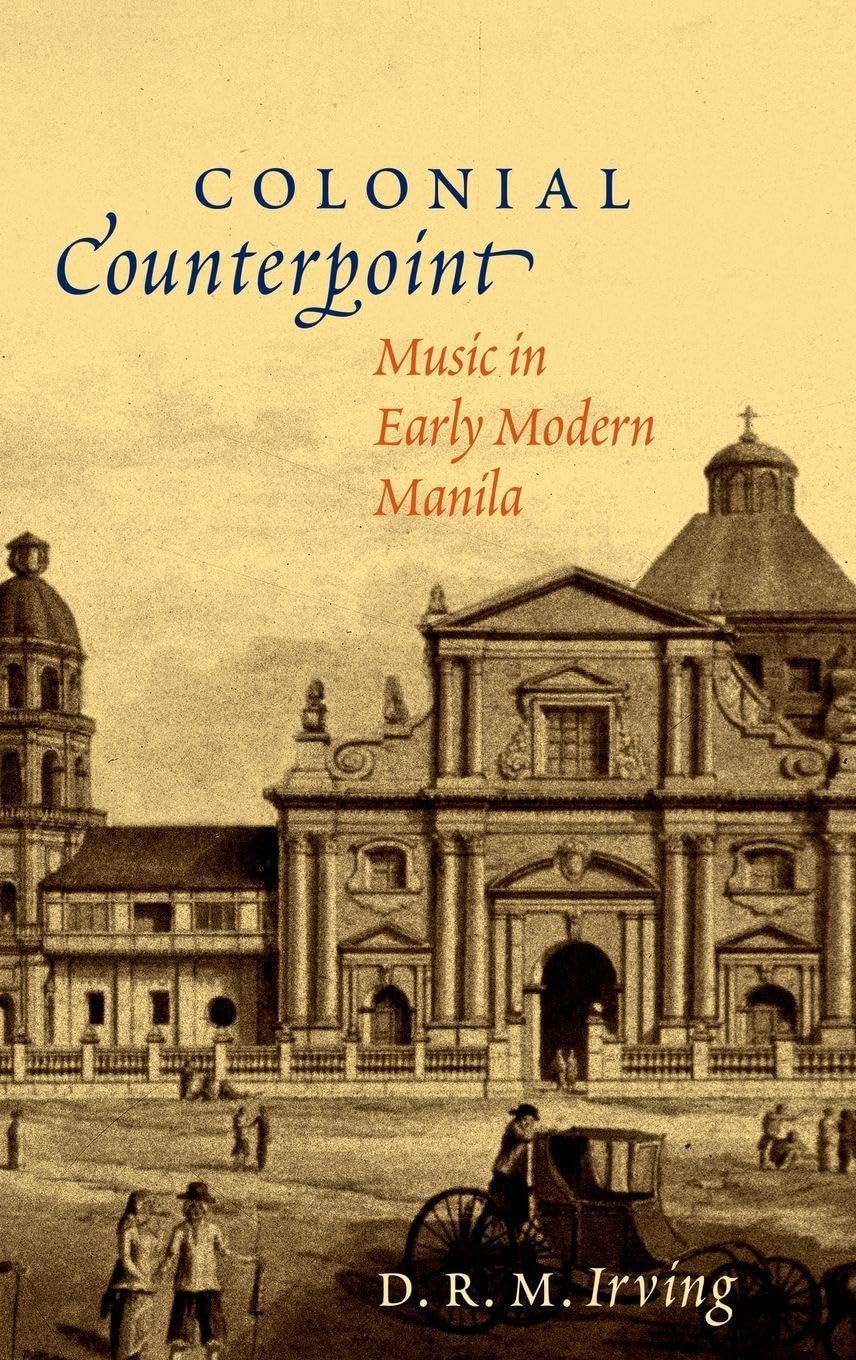
Colonial Counterpoint: Music in Early Modern Manila (Currents in Latin American and Iberian Music)
$64.89
by D. R. M. Irving



Named one of BBC History Magazine's "Books of the Year" in 2010 In this groundbreaking study, D. R. M. Irving reconnects the Philippines to current musicological discourse on the early modern Hispanic world. For some two and a half centuries, the Philippine Islands were firmly interlinked to Latin America and Spain through transoceanic relationships of politics, religion, trade, and culture. The city of Manila, founded in 1571, represented a vital intercultural nexus and a significant conduit for the regional diffusion of Western music. Within its ethnically diverse society, imported and local musics played a crucial role in the establishment of ecclesiastical hierarchies in the Philippines and in propelling the work of Roman Catholic missionaries in neighboring territories. Manila's religious institutions resounded with sumptuous vocal and instrumental performances, while an annual calendar of festivities brought together many musical traditions of the indigenous and immigrant populations in complex forms of artistic interaction and opposition. Multiple styles and genres coexisted according to strict regulations enforced by state and ecclesiastical authorities, and Irving uses the metaphors of European counterpoint and enharmony to critique musical practices within the colonial milieu. He argues that the introduction and institutionalization of counterpoint acted as a powerful agent of colonialism throughout the Philippine Archipelago, and that contrapuntal structures were reflected in the social and cultural reorganization of Filipino communities under Spanish rule. He also contends that the active appropriation of music and dance by the indigenous population constituted a significant contribution to the process of hispanization. Sustained "enharmonic engagement" between Filipinos and Spaniards led to the synthesis of hybrid, syncretic genres and the emergence of performance styles that could contest and subvert hegemony. Throwing new light on a virtually unknown area of music history, this book contributes to current understanding of the globalization of music, and repositions the Philippines at the frontiers of research into early modern intercultural exchange. Named one of BBC History Magazine's "Books of the Year" in 2010 "Music history and colonial encounter converge in a counterpoint of metaphors, richly yielding an historical stretto resounding the multiple voices of music in early modern Manila as Filipino and local, European and global."-Philip V. Bohlman, Mary Werkman Distinguished Service Professor of the Humanities and of Music, The University of Chicago "This book is a milestone in the historiography of Philippine music. Written in lucid prose with a delightful tone, the work is remarkable for its critique of colonialism and is a must-read for anyone who cares to contemplate the "contrapuntal" effects of social power in music."-Jose Semblante Buenconsejo, Associate Professor, Music Research Department, University of the Philippines "D.R.M. Irving's pioneering work exhibits his perseverance in pursuit of recondite sources, a deep understanding of the processes of cultural transmission, and a talent for writing about music in ways that everyone can understand. This book helps us understand the formation of colonial society in the Philippines and sets the standard for a new kind of cultural history."-Felipe Fernández-Armesto, William P. Reynolds Professor of History, University of Notre Dame "A well-documented study...The theoretical underpinnings successfully shape and focus the presentation, engage the reader, and provoke thoughtful consideration of claims and research. This book is an impressive piece of scholarship, enjoyable on a multiplicity of levels, and deserves placement on the shelf of essential works in Philippine historiography." -- American Historical Review "A groundbreaking study...The scope of this excellently written book should be of interest to a variety of scholars in both historical musicology and Asian, Iberian, and Latin American ethnomusicology, and is accessible to those who are not experts in those fields. Because Irving's book touches upon some theatrical and poetic genres, it should be of notable interest to those focusing on Spanish and Latin American history, literatures, and cultures." -- Hispanic Review "A virtuosic contrapuntal analysis of musical practices and social interaction in a time of rapid and irreversible globalization. It will appeal to musicologists, ethnomusicologists, historians and those interested in post-colonial studies of any region, and inspire more work in this field." -- Early Music "A model of rigorous and meticulous research, and an exemplary testament to its rewards...Irving has set a standard for research and provided an inspiration for the next generation of Philippine and Filipino scholars. Happily for the non-specialist, it is also a good read." -- Ethnomusicology Forum "By far the best work on Philippine hist