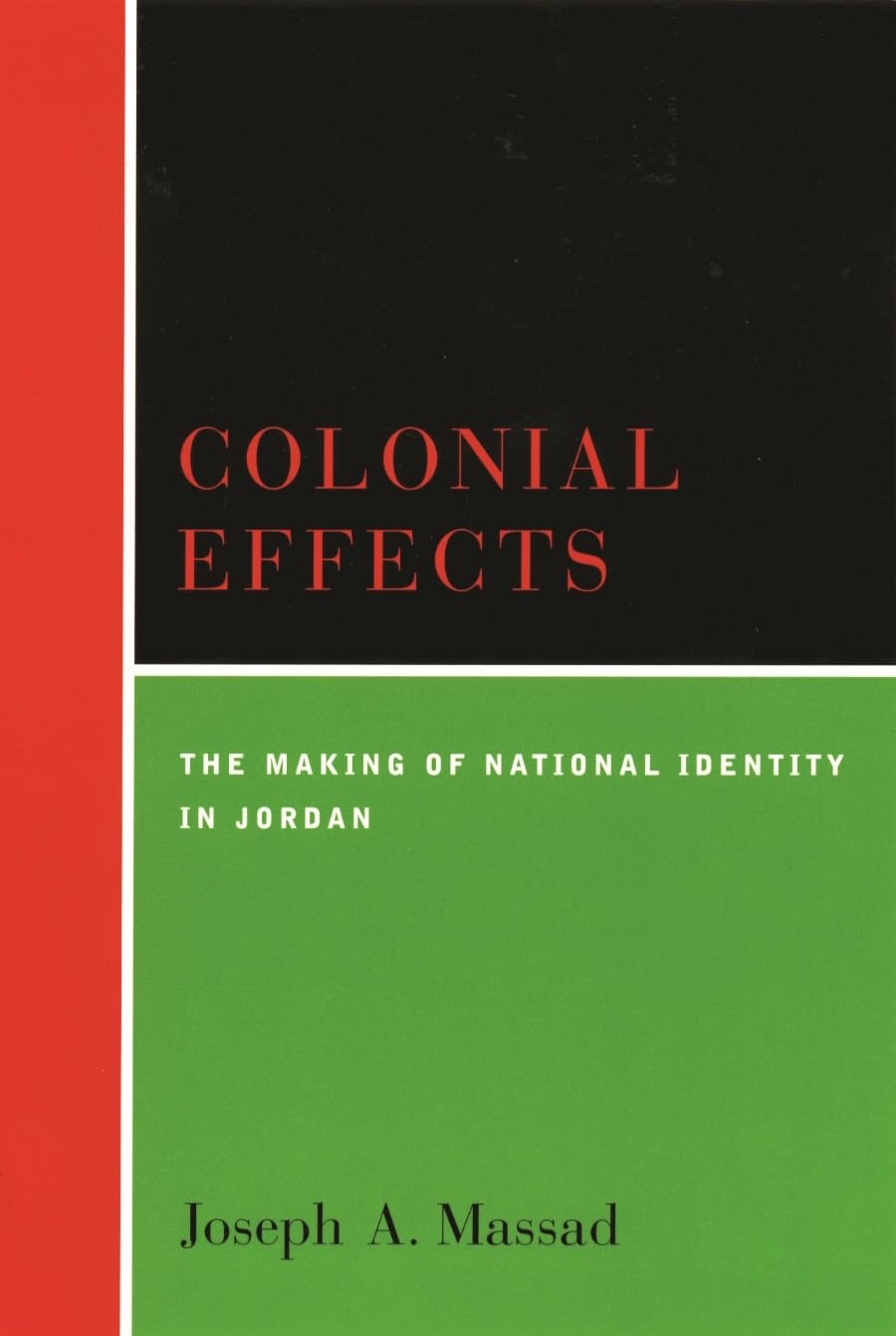



Colonial Effects analyzes the creation and definition of modern Jordanian identity. Massad studies two key institutions-- the law and the military--and uses them to create an original and precise analysis of the development of Jordanian national identity in the postcolonial period. Joseph A. Massad engages recent scholarly debates on nationalism and richly fulfills the analytical promise of Michel Foucault's insight that modern institutions and their power to have productive, not merely repressive or coercive, capacities―though Massad also stresses their continued repressive function. His argument is advanced by a consideration of evidence, including images produced by state tourist agencies aimed at attracting Western visitors, the changing and precarious position of women in the newly constructed national space, and such practices as soccer games, music, songs, food, clothing, and shifting accents and dialects. A work of genuine brilliance, as much for its searing insights into Jordanian history and culture as for its extraordinary mastery of the vast material it deploys. It is rare to encounter a pathbreaking book: this is certainly one. -- Edward Said The thesis of this important and profound book transcends the Jordanian case and reaches into the heart of the debate about the formation of national identities, the idea of the nation, and the effect of the colonial context in shaping identities and nationalities. The [analytic and historical] benefits that this book contributes surpass those provided by many other books on the topic, and it will surely occupy a central place in the literature about the modern history of Jordan. ― Al-Jazeera (translated from the Arabic) Massad offers not the usual political history but a study of legal changes and the use of the military for nation-building. ― Foreign Affairs By focusing on the actions and motivations of the British Colonial administrators―in codifying laws and defining the national culture―Massad provides an excellent analysis of state construction in the colonial realm. For this reason, his work is poised for use by scholars and teachers in a number of fields far beyond Jordanian and Middle Eastern studies... Massad beautifully expands the breadth of Jordanian studies by examining issues thus far neglected in all studies of the country... In a classroom setting... the thematic organizational structure means that students do not have to know very much about Jordanian history to be able to understand the main points. The chapters on the role of gender, law, and the military in nationalist construction can be read easily as case studies of national identity throughout the region and the world. A search of any Web engine will show how very popular this book has become for a range of disciplines and class types... As many scholars and teachers have discovered already, the book provides questions and answers about nationalism that few writers have posed before. -- Betty S. Anderson ― Critique: Critical Middle Eastern Studies Massad offers a theoretically informed and highly interesting analysis of the construction of national identity in Jordan... [ Colonial Effects ] is full of fascinating information and an analysis of the colonial and postcolonial state's production of national identity that should invigorate the field. -- Mary C. Wilson ― Journal of Palestine Studies Massad adopts an innovative approach by examining the effects of juridical and military institutions on the shaping of Jordan's national culture... [He] devotes very tangible attention to Bedouins, women, and Palestinians and their incorporation into the invented national culture of Jordan... [in a] sophisticated analysis. ― Choice Massad's book will occupy an important place in the literature on the modern history of Jordan, not only due to its unique and pioneering topic, but also due to its remarkably encyclopedic range. It is a book that engages the fields of politics, history, sociology, as well as popular culture... This is a great and distinguished book. ― Al-Hayat (translated from the Arabic) This is an important book.... It is against the background of Massad's study that one will have to judge... current and forthcoming works. -- Laurie Brand ― Middle East Journal Historians interested in the emergence of national identities in other colonial and postcolonial countries and societies would do well to examine Massad's book. Reading it will require considerable concentration and patience, but the rewards should be substantial. -- Philip S. Khoury ― American Historical Review This is a potent, suggestive, and original work, based on extensive research including archival material and newspapers. It is a major contribution to the literature on Jordanian nationalism, anticolonial nationalism, and the wider field of postcolonial studies. It will be widely read and stir important debates. ― Electronic Journal of Middle East Studies Massad's book is informative,