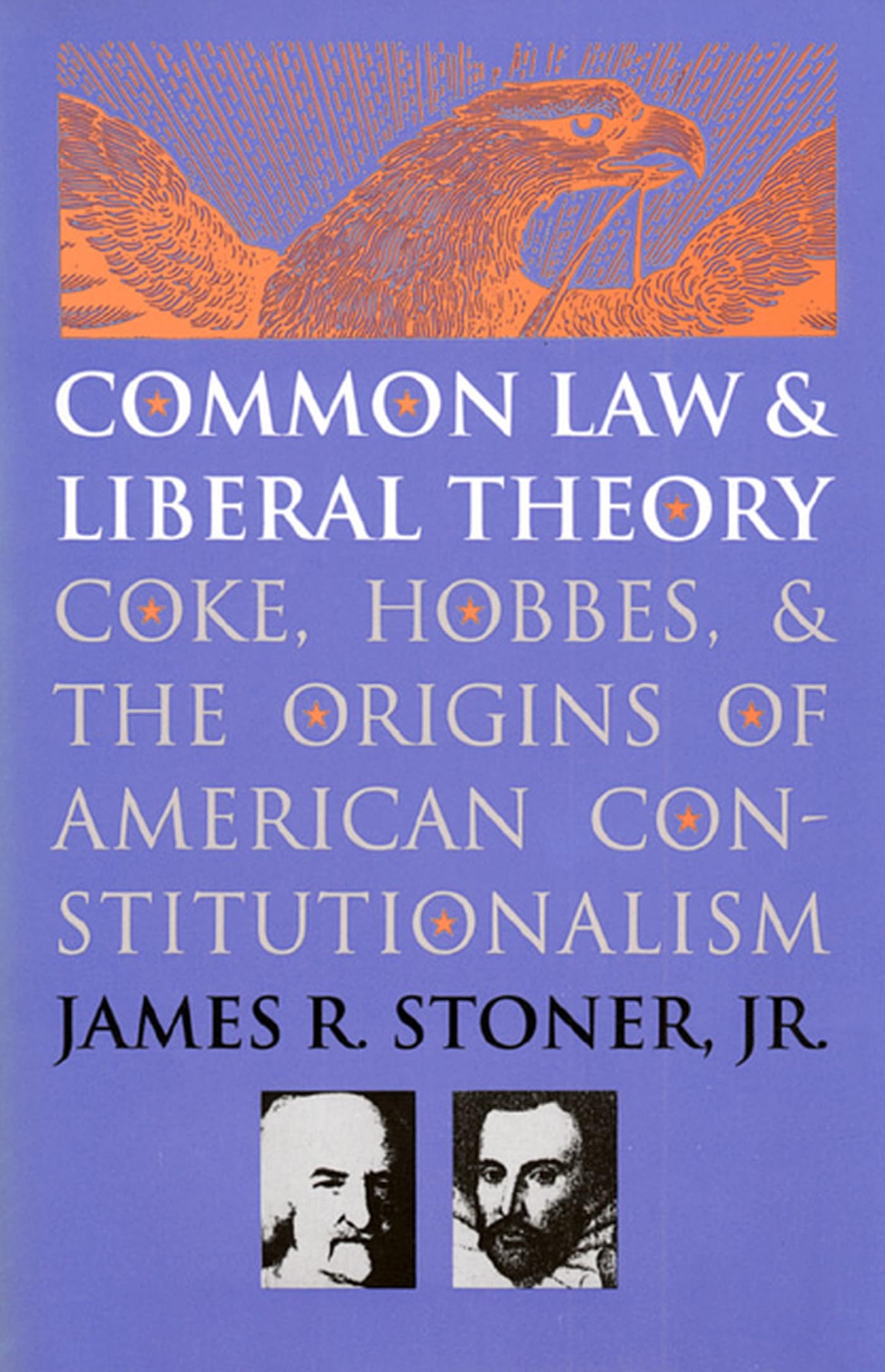
Common Law and Liberal Theory: Coke, Hobbes, and the Origins of American Constitutionalism
$29.99
by James R. Stoner Jr



James Stoner's purpose is an ambitious one: to recover the common law basis of American constitutionalism. American constitutionalism in general, he argues, and judicial review in particular, cannot be fully understood without acknowledging their roots in both common law and liberal political theory. But for the most part, the common law underpinnings of constitutionalism have received short shrift. Through close study of liberal political philosopher Thomas Hobbes and the writings of Edward Coke, a seventeenth-century judge and parliamentarian whose opinion in Doctor Bonham's Case (1610) was once viewed as a precedent for the modern practice of judicial review, Stoner establishes a dialogue between two schools of thought. The contrast that emerges between liberalism, with its scientific ambitions, and common law opens up a fresh perspective on the foundations of the American regime. Common law is grounded in precedent and local tradition as well as reason; it stresses community. Liberal political theory is based on abstract, rational principles; it stresses individualism. To overlook the common law roots of American constitutionalism, then, is to ignore a tradition that is more contextual and historical, more flexible yet more respectful of the wisdom of tradition or experience, less individualistic and more emphatic about responsibility than is the liberal philosophic tradition. In Common Law and Liberal Theory , Stoner reexamines the sources of judicial review and the American founding. He focuses on Hobbes and Coke as representative of the two traditions, but also includes chapters on Locke, Montesquieu, Blackstone, and the Federalists. His careful reading of the influences of and conflicts between liberalism and common law will cast new light on the controversy over the origins of American constitutionalism. "Forceful and wise. Stoner suggests that American constitutionalism is the product of a strange mixture of two opposing schools of thought: the English common law tradition as exemplified by the work of Edward Coke and early liberal political philosophy as seen in the work of Thomas Hobbes. His argument is powerful and convincing."— Journal of American History "Stoner effectively addresses the badly neglected question of what we expect of judges in a political system that rests on popular sovereignty and a legal order committed to the idea of fundamental law. This is a welcome addition to the literature that offers a fresh perspective, for we have something to learn about the beginnings of judicial review by seeing it within the common law tradition."— American Political Science Review "The origin, nature, and validity of judicial review in American politics have for years been debated not only in modern political science but in legal scholarship as well as judicial politics. With this book, Stoner moves the debate to a new, and indeed higher, plane. . . . It’s a stunning achievement."— Journal of Politics "This book is based on impressively wide and deep erudition. The style is lucid and graceful, often witty. . . . [It] will stir reconsideration of a neglected and important dimension of the history of modern political thought and the intellectual background to the American Constitution."— Thomas Pangle , author of The Spirit of Modern Republicanism: The Moral Vision of the American Founders and the Philosophy of Locke "Stoner has a breathtaking grasp of the powerful thinkers whose works he surveys, and a sharp focus of his own which pulls the material together. . . . A major contribution to several ongoing debates in academic circles. This is ‘a whale of a book’ (pun intended)."— Robert Lowry Clinton , author of Marbury v. Madison and Judicial Review "Stoner has immersed himself in the thought and practice of the common law and in early liberal political thought, and he opens new vistas for modern readers on each of them and on the sometimes fruitful tension between them. This is an invaluable book for those who wish to understand these essential elements of the very foundation of our Constitution and polity."— Christopher Wolfe , author of The Rise of Modern Judicial Review: From Constitutional Interpretation to Judge-Made Law "This book is based on impressively wide and deep erudition. The style is lucid and graceful, often witty. . . . [It] will stir reconsideration of a neglected and important dimension of the history of modern political thought and the intellectual background to the American Constitution."--Thomas Pangle, author of The Spirit of Modern Republicanism: The Moral Vision of the American Founders and the Philosophy of Locke "Stoner has a breathtaking grasp of the powerful thinkers whose works he surveys, and a sharp focus of his own which pulls the material together. . . . A major contribution to several ongoing debates in academic circles. This is 'a whale of a book' (pun intended)."--Robert Lowry Clinton, author of Marbury v. Madison and Judicial Review "Stoner has