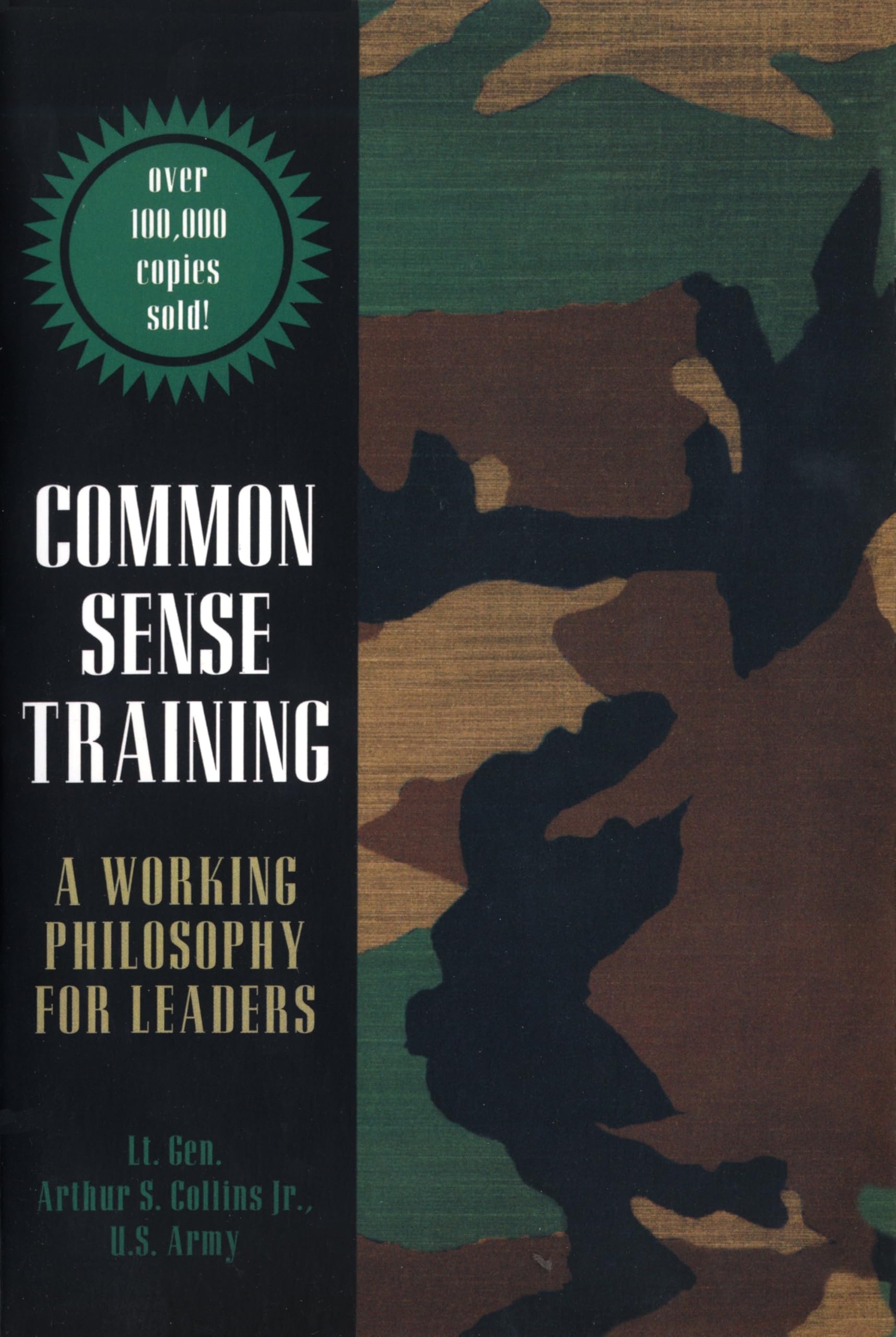
Common Sense Training: A Working Philosophy for Leaders
$17.00
by Lt. Gen. Arthur S. Collins Jr



Leadership is so much a part of the conduct of training that at times it is difficult to tell where one stops and the other starts. . . . “The best book on military training from platoon to division level that has been published in any army.” — Army magazine “His message is that whatever works and gets results by the most direct and efficient means is good. All else should be eliminated.” — Air University Review “A utilitarian book that talks intelligently of leadership, management and common sense.” — ARMOR magazine “A hardhitting and unvarnished . . . authoritative work that should be read and reread by everyone who aspires to be a truly professional soldier.” —General Bruce Palmer, U.S. Army (Ret.) “A gem, with few peers, invaluable . . . [Arthur Collins'] advice is always performance oriented. Don't talk so much about it, he says, Don't make so many fancy charts about training. Instead, do it. Teach it. Perform it.” — Parameters Lt. Gen. Arthur S. Collins, Jr., (1915–1984) graduated from West Point in 1938 and received an MA from George Washington University. He served in the U.S. Army for 40 years and was a combat veteran of World War II, Korea, and Vietnam. Collins commanded at every level from platoon to field army, before his 1974 retirement. This is more than just a book on training. The ideal treatise on training would be shorter by a third—better still by a half—and would contain only suggestions to stimulate thought and action by commanders in the field of training. But the training environment that now exists is not conducive to good training. This environment must be analyzed critically, and this book attempts to do so. Two major themes predominate in this work: first, that training is the number one business of a peacetime army but that it has suffered neglect; and, second, that the senior commander sets the tone on training in an army organization. The training atmosphere the commander creates prevails over all the efforts of his subordinates. This book is aimed at him and those who respond to his orders and attitudes. There is a message here for all levels of the chain of command, from the civilian secretaries who influence the quality of the soldier to the noncommissioned officer who is involved in most of his training. The focus is on training at battalion level and below with major emphasis on company/battery/troop level.1 Although many suggestions on practical down-to-earth training techniques are to be found here, few detailed charts or specific programs are included. In every unit, conditions vary with respect to training areas, experience, and a host of other variables, not the least of which is the commander’s attitude. Therefore, training guidance from a distance is not much help to the trainer at the unit level. The details of particular training programs are spelled out in appropriate field and technical manuals. But no matter what is in the manuals, junior leaders cannot be effective trainers if a healthy atmosphere is not created where the training takes place. Training flourishes only in an atmosphere that invites it to do so, and only the generals and the colonels can extend that invitation. If the senior commanders improve the training environment, training will improve rapidly. Ideas and attitudes conducive to good training are pervasive since they come from a true recognition of the importance of training to an army. All ranks, from the general officer to the NCO, can use these ideas and attitudes within the scope of their respective responsibilities. These ideas on training are internally consistent, and the basic themes apply to the National Guard and Reserves as well as to the active Army. The most notable training achievement in Army history was the creation of a great Army and Air Force between 1940 and 1945. Churchill said, “The rate at which the small American Army of only a few hundred thousand men, not long before the war, created the mighty force of millions of soldiers is a wonder of military history … This is an achievement which the soldiers of every other nation will always study with admiration and envy.” The pre-World War II Army that accomplished that feat did not have nearly the capability or expertise that today’s Army has. The leaders of that Army, however, had a training knack that has been lost. The task at hand is to recapture the art. In addressing a new generation of leaders, I cannot emphasize too strongly that the fundamentals of training do not change. Weapons change, technology advances, and tactics adjust to what is new. The fundamentals of training, however—to prepare an army to fight in some national crisis with whatever means are at hand—change but little. The major changes in training come from the social changes that affect the human condition. The enlightened trainer takes advantage of these changes to forge a better fighting force. This book is a dialogue with my fellow soldiers on a subject vital to