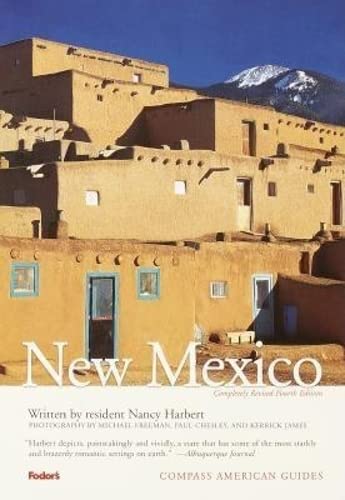
Compass American Guides: New Mexico, 4th Edition (Full-color Travel Guide)
$34.23
by Nancy Harbert



Compass American Guides New Mexico 4ed.Created by local writers and photographers, Compass American Guides are the ultimate insider's guides, providing in-depth coverage of the history, culture, and character of America's most spectacular destinations. Covering everything there is to see and do as well as choice lodging and dining, these gorgeous full-color guides are perfect for new and longtime residents as well as vacationers who want a deep understanding of the region they're visiting. Outstanding color photography, plus a wealth of archival imagesTopical essays and literary extractsDetailed color mapsGreat ideas for things to see and doCapsule reviews of hotels and restaurants ican Guides New Mexico 4ed.Created by local writers and photographers, Compass American Guides are the ultimate insider's guides, providing in-depth coverage of the history, culture, and character of America's most spectacular destinations. Covering everything there is to see and do as well as choice lodging and dining, these gorgeous full-color guides are perfect for new and longtime residents as well as vacationers who want a deep understanding of the region they're visiting. Outstanding color photography, plus a wealth of archival imagesTopical essays and literary extractsDetailed color mapsGreat ideas for things to see and doCapsule reviews of hotels and restaurants INTRODUCTION New Mexico's magic has been intriguing visitors for centuries. Its natural beauty immediately captivates those who see it, and its elusive, indefinable character enriches all those who let it in. Spacious skies and vistas, magical light, and the sense of this place's purity have all been named as the latent quality that has attracted travelers and settlers, artists and scientists, who've come in search of treasure, tangible and intangible. In prehistoric times, Native Americans hunted game in New Mexico's mountains and farmed along its river banks. Pueblo Indians expressed their reverential relationship with the land through flat-roofed earthen architecture, drawings on rock faces, and rhythmic chants and dances. Spanish explorers followed, first in search of gold, then souls. The two cultures clashed, often violently. But eventually they came to tolerate each other and even to share their traditions. Pueblo Indians passed on their innovative uses for chile, beans, and corn, the main ingredients of what ironically has come to be known as Mexican food. The Spanish passed on their skill at metal work, which the Indians incorporated into intricate jewelry. In the later half of the nineteenth century, determined groups of "Anglo" settlers began arriving via the Santa Fe Trail, bringing to New Mexico a third culture -- Victorian, technologically emerging. In the early twentieth century, a new wave of immigrants of Italian, Lebanese, German, Irish, and Russian descent -- also "Anglos" in New Mexican parlance -- came to set up shops or work in coal, silver, and gold mines across the state. The Anglos may have been the last of the three main cultural groups to arrive, but they became the most influential. They mined the mountains for gold and precious metals, and uncovered vast deposits of coal, oil, and natural gas. They brought the railroad, the highway, and the atomic bomb. They came to capture the state's magic -- on canvas, in photographs, in their souls. The state's landscape is as varied as its cultures. The Rio Grande is the lifeblood for much of this arid land, and it serves as the natural east-west dividing line as it snakes through the mountainous north, skirting Albuquerque and providing the lifeline for the agricultural southwest before flowing into Texas at El Paso. Away from the river, pine and spruce forests blanket much of northern New Mexico. There you'll find pristine trout streams, bountiful hunting grounds, and world-class ski slopes. A small section of the vast Navajo Reservation covers the northwestern corner of the state, and continues into neighboring Arizona. In the southwest is the 3.3-million-acre Gila National Forest, once home to the Mimbres Indians, known for their distinctive black-on-white pottery. East of the mountains lies the irrigated Mesilla Valley, with acres of green chile, cotton, and onions. On the vast plains of eastern New Mexico, lumbering herds of cattle and bands of sheep share windswept grasslands. Dryland farming has prospered in pockets of the Llano Estacado (Staked Plain), a western extension of the Great Plains that covers much of eastern New Mexico. To the west rise the Sacramento Mountains, home to the Mescalero Apaches. One of the world's greatest natural wonders spreads out in massive rooms beneath a limestone ridge at Carlsbad Caverns. New Mexico's cities are small, with the exception of Albuquerque, which holds one-third of the state's people and serves as its economic and education center. A cursory glance might fail to distinguish it from any other spread-out Western metropolis, but most