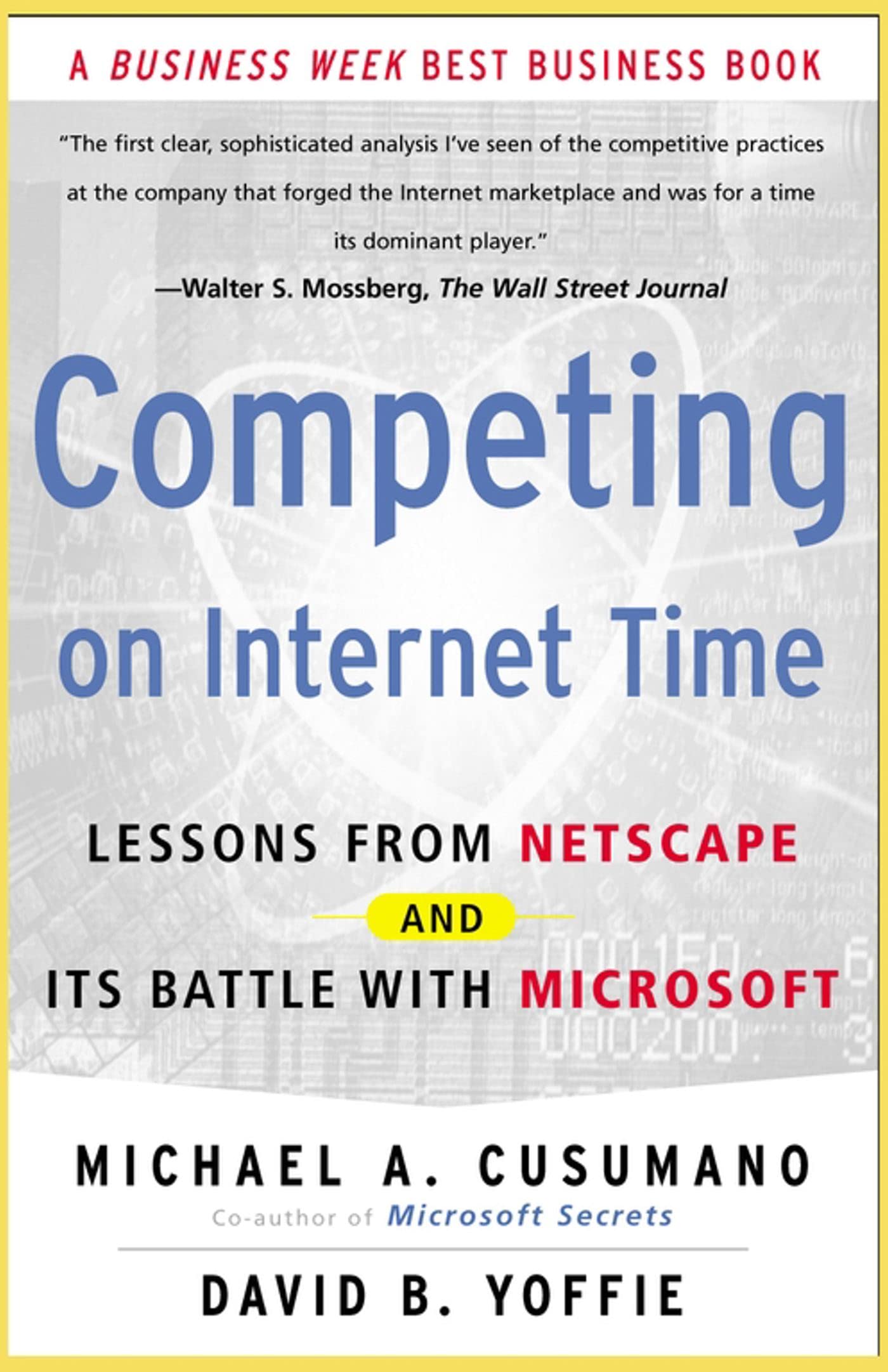
Competing On Internet Time: Lessons From Netscape And Its Battle With Microsoft
$22.90
by Michael A. Cusumano



Competing on Internet time means competitive advantage can be won and lost overnight. In this penetrating analysis of strategy-making and product innovation in the dynamic markets of commercial cyberspace, bestselling Microsoft Secrets co-author Michael Cusumano and top competitive strategy expert David Yoffie draw vital lessons from Netscape, the first pure Internet company, and show how it employs the techniques of "judo strategy" in its pitched battle with Microsoft, the world's largest software producer. With a new afterword updating the events of the year following publication of the hardcover edition, Competing on Internet Time is essential and instructive reading for all managers, engineers, and entrepreneurs who want to succeed in ultra-fast-paced markets. Managers in every high-tech industry will discover a wealth of new ideas on how to create and scale up a new company quickly; how to compete in fast-paced, unpredictable industries; and how to design products for rapidly evolving markets. Walter S. Mossberg The Wall Street Journal The first clear, sophisticated analysis I've seen of the competitive practices at the company that forged the Internet marketplace and was for a time its dominant player. Steve Hamm Business Week A marvelous, detailed account and analysis of Netscape's rocket-launch rise and mid-flight corrections. Katherine Mieszkowski Fast Company A rarity: a serious book by serious professors that is timely, engaging, and fun to read....The book is smart. Teresa McUsic The Miami Herald Few books deliver the goods quite as effectively as this insightful, crisp and highly readable account. Michael A. Cusumano, co-author of the newly published Thinking Beyond Lean and the international bestseller Microsoft Secrets, is the Sloan Distinguished Professor of Management at MIT's Sloan School of Management. He is also the author of The Japanese Automobile Industry and Japan's Software Factories. Chapter One: Introduction Competing in the Age of the Internet Occasionally, the world experiences a technological revolution that changes the way people live and interact. Ancient peoples experienced the emergence of agriculture, irrigation, and civil engineering. These developments led to the creation of cities and urban culture. Medieval peoples experienced the invention of the printing press. This technology gradually made books, magazines, newspapers, and the printed word -- information -- ubiquitous. Early modern Europeans championed the Industrial Revolution and new fields of science and engineering. New inventions, such as engines and factories, substituted mechanical devices and inanimate power for animal and human labor. Technology then progressed dramatically after the mid-19th century. The world has recently seen, in relatively rapid succession, the emergence of the telegraph, the telephone, radio, automobiles, airplanes, television, and the computer -- to name the better-known inventions in communications and transportation. And now we have the Internet. The Internet is a network of computers, tens of millions of them, large and small, around the world. More accurately, it is a network of networks, based on a set of software technologies that drive computer hardware to send, receive, and locate "packets" of information traveling a worldwide electronic highway at lightning speed.1 The Internet has launched a technological revolution that is changing the way individuals, as well as organizations, live and interact. Imagine combining the power of the printing press (and most of the newspapers and magazines on earth) with the power and speed of the telegraph, telephone, radio, television, and computer. Then make this package easy to use and cheap enough for the mass market. You would then have the potential of the Internet in its most usable form, the World Wide Web (known as "the Web" for short). We are not exaggerating when we say that the Internet and the World Wide Web, with the browser as its user interface, are revolutionizing mass communications, as well as mass networking technology. It is unlike anything we have seen before. The Internet has the potential to link easily and almost instantaneously every computing device with every database with every person who has access to a communications device (telephone, cable, satellite, etc.). As a consequence, the Internet is recasting the most traditional organizations, ranging from the U.S. Internal Revenue Service to your local grocery store. Tens of thousands of companies, both large and small, have created Web sites through which you can purchase goods and services or receive valuable (and not so valuable) information. This means that consumers can do common tasks on the Internet, such as ordering groceries or books and searching for stock prices. They can also do far more complex tasks, such as creating ideal travel itineraries, getting investment or medical advice, or holding a videoconference while s