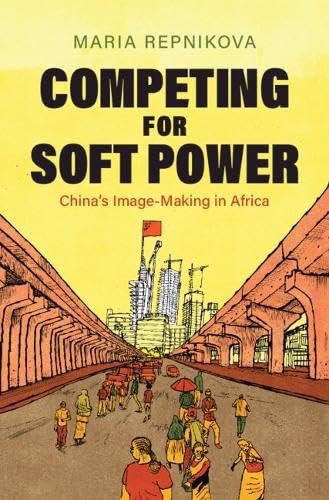



Through the critical case study of Ethiopia, Maria Repnikova examines the ambitious but disjointed display of Chinese diplomatic influence in Africa. In doing so, she develops a new theoretical approach to understanding China's practice of soft power, identifying the core mechanisms as tangible enticement with material and experiential offerings, ideational promotion of values, visions, and governance practices, and censorial power over the production and dissemination of China narratives. Through in-depth field work, including interviews and focus groups, Repnikova builds a clear picture of the uneven implementation and reception of this image-making, in which Chinese messengers can improvise official agendas, and Ethiopian recipients can strategically appropriate and negotiate Chinese power. Contrary to popular claims about China replacing the West in the Global South, this innovative research reveals the successes, but also the inconsistencies and limitations of Chinese influence, as well as the ever-present shadow of the West in mediating soft-power encounters. ‘As western leaders fret over China’s growing global influence, Maria Repnikova provides a pioneering study of one key case: China’s approach to Ethiopia. With insight and clarity Repnikova reveals a multifaceted picture of what she terms ‘China’s image-making’. An important book for all seeking to understand our century.’ Nicholas J. Cull, USC Annenberg ‘Cutting through the hype and hyperbole of Chinese soft power, this incisive and eloquent book reveals its mechanisms and receptions in Africa. An exemplary study that demonstrates the power and necessity of rigorous scholarship for understanding global China.’ Ching Kwan Lee, University of California-Los Angeles ‘Repnikova challenges existing notions of ‘soft power’ based on incredibly rich fieldwork in both Ethiopia and China interviewing and observing the interactions of politicians, bureaucrats, business leaders, and ordinary people. This book not only delivers provocative new theoretical ideas but generates innovative methodologies for a rigorous comparative study of a transnational political economy.’ Lauren M. MacLean, Northeastern University ‘Competing for Soft Power rethinks how China seeks global influence. Drawing on extensive fieldwork in Ethiopia and China, Maria Repnikova introduces ‘image-making’ to explain how material inducements, political narratives, and information control shape China’s contested and uneven engagement with Africa.’ Xiaoyu Pu, University of Nevada Repnikova examines China's ambitious but uneven image-making in Africa, and the role of the West in mediating this encounter. Maria Repnikova is associate professor in Global Communication and the William C. Pate Endowed Chair in Strategic Communication at Georgia State University.