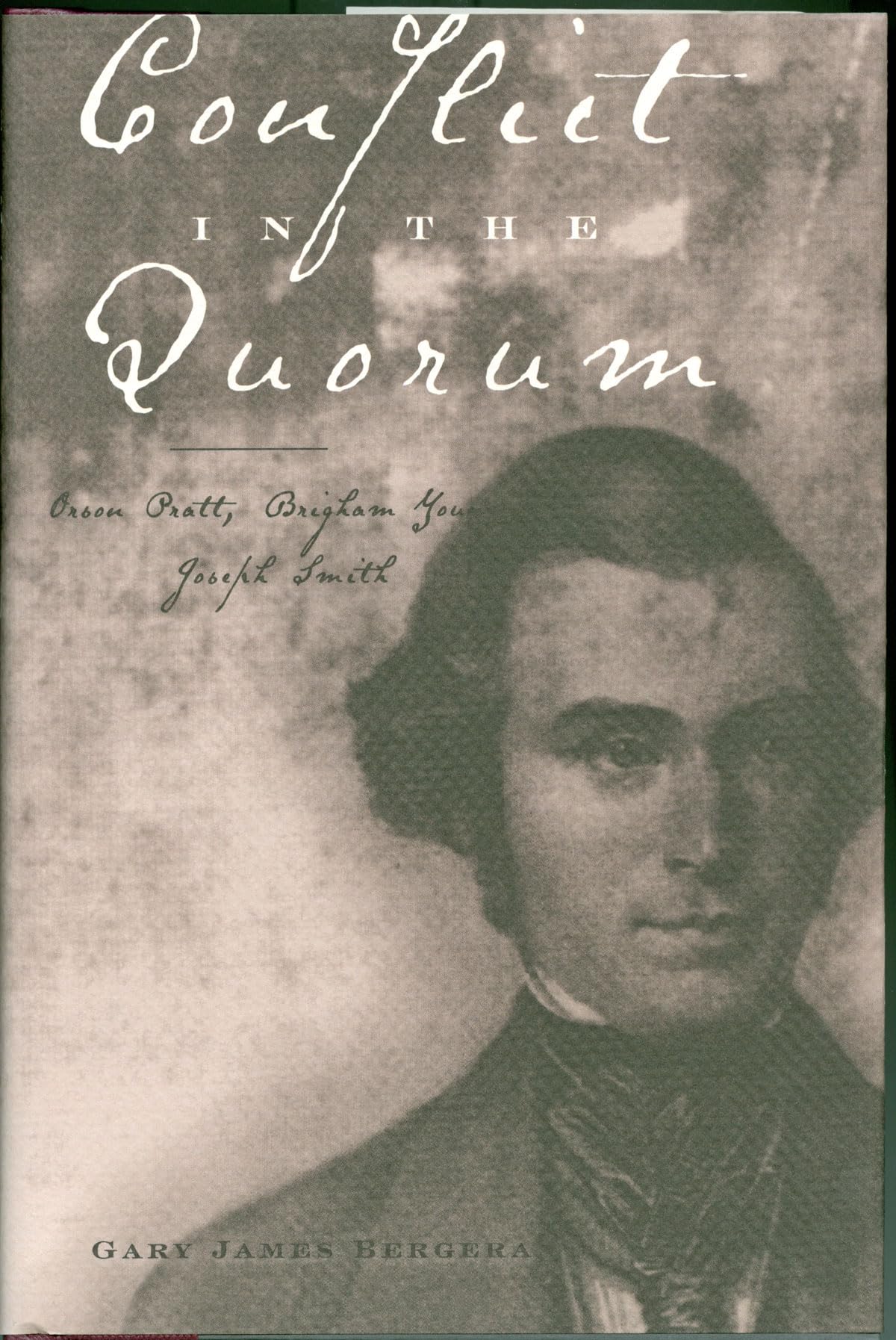
Conflict in the Quorum: Orson Pratt, Brigham Young, Joseph Smith (Volume 1)
$15.00
by Gary J. Bergera



At a meeting of the LDS Quorum of the Twelve in 1860, one of the church’s senior apostles, Elder Heber C. Kimball, complained that “Brother Orson Pratt has withstood Joseph [Smith] and he has withstood Brother Brigham [Young] many times and he has done it tonight and it made my blood chill. It is not for you to lead [the prophet],” Kimball continued, “but to be led by him. You have not the power to dictate but [only] to be dictated [to].” Whenever the quorum discussed Elder Pratt’s controversial sermons and writings and his streak of independent thinking, the conversation could become heated. As documented by Gary James Bergera in this surprisingly suspenseful account, Pratt’s encounters with his brethren ultimately affected not only his seniority in the Quorum of the Twelve but also had a lasting impact on LDS doctrine, policy, and organizational structure. “There is not a man in the church that can preach better than Orson Pratt,” Brigham Young told the twelve apostles on another occasion. “It is music to hear him. But the trouble is, he will … preach false doctrine.” Pratt responded that he was “not a man to make a confession of what I do not believe. I am not going to crawl to Brigham Young and act the hypocrite. I will be a free man,” he insisted. “It may cost me my fellowship, but I will stick to it. If I die tonight, I would say, O Lord God Almighty, I believe what I say.” “You have been a mad stubborn mule,” Young replied. “[You] have taken a false position … It is [as] false as hell and you will not hear the last of it soon.” Not infrequently, these two strong-willed, deeply religious men argued. Part of their difficulty was that they saw the world from opposing perspectives—Pratt’s a rational, independent-minded stance and Young’s a more intuitive and authoritarian position. “We have hitherto acted too much as machines … as to following the Spirit,” Pratt explained in a quorum meeting in 1847. “I will confess to my own shame [that] I have decided contrary to my own [judgment] many times. … I mean hereafter not to demean myself as to let my feelings run contrary to my own judgment.” He issued a warning to the other apostles: “When [President Young] says that the Spirit of the Lord says thus and so, I don’t consider [that] … all we should do is to say let it be so.” For his part, Young quipped that Pratt exhibited the same “ignorance … as any philosopher,” telling him “it would be a great blessing to him to lay aside his books.” When Pratt appealed to logic, Young would say, “Oh dear, granny, what a long tail our puss has got.” Ironically, Orson Pratt would have the last word both because Young preceded him in death and because several of Young’s teachings and policies had proven unpopular among the other apostles. One of Young’s counselors said shortly after the president’s death that “some of my brethren … even feel that in the promulgation of doctrine he [Young] took liberties beyond those to which he was legitimately entitled.” Meanwhile, Pratt continued to hold sway with some of his colleagues. His thoughtful—if ultra-literalistic—interpretations of scripture would also influence such later church leaders as Joseph Fielding Smith and Bruce R. McConkie. Bergera’s nuanced approach avoids caricatures in favor of the many complexities of personalities and circumstances. It becomes clear that the conflict in which these men found themselves enmeshed had no easy, foreseeable resolution. Historians of the American West who include the Mormon experience in their studies usually focus on settlement patterns, water rights, relationships with Native Americans, the Mountain Meadows Massacre, church and state conflicts, and plural marriage. Mormonism is depicted as a monolithic corporate structure that leaves little room for theological speculation and freedom of thought. Writers tend to believe that when the Lion of the Lord (Brigham Young) roared, all the thinking had been done and Utah grew silent. Only the sounds of church members rushing to fall into step filled the mountain air. Gary James Bergera relates a different story as he details the theological conflicts that raged between Brigham Young and Orson Pratt. Was Mormonism, according to Pratt's argument, to become a religion primarily bound to scripture or would it continue to find its fundamental strength in the living oracles who led the church, the position espoused by Brigham Young? Church members were aware of many of these conflicts. Accounts were published in Mormon newspapers and church leaders addressed subjects regarding Pratt's and Young's disagreements in public meetings as well as in the private gatherings of the Council of the Twelve Apostles. At the time, more church members sided with Young than Pratt, but in the twentieth century, Mormon leaders found many of the theories of Pratt more acceptable than those of Young. As Bergera points out, "reliance on Pratt has continued to be pervasive and unmistakable in Mormonism to the present"