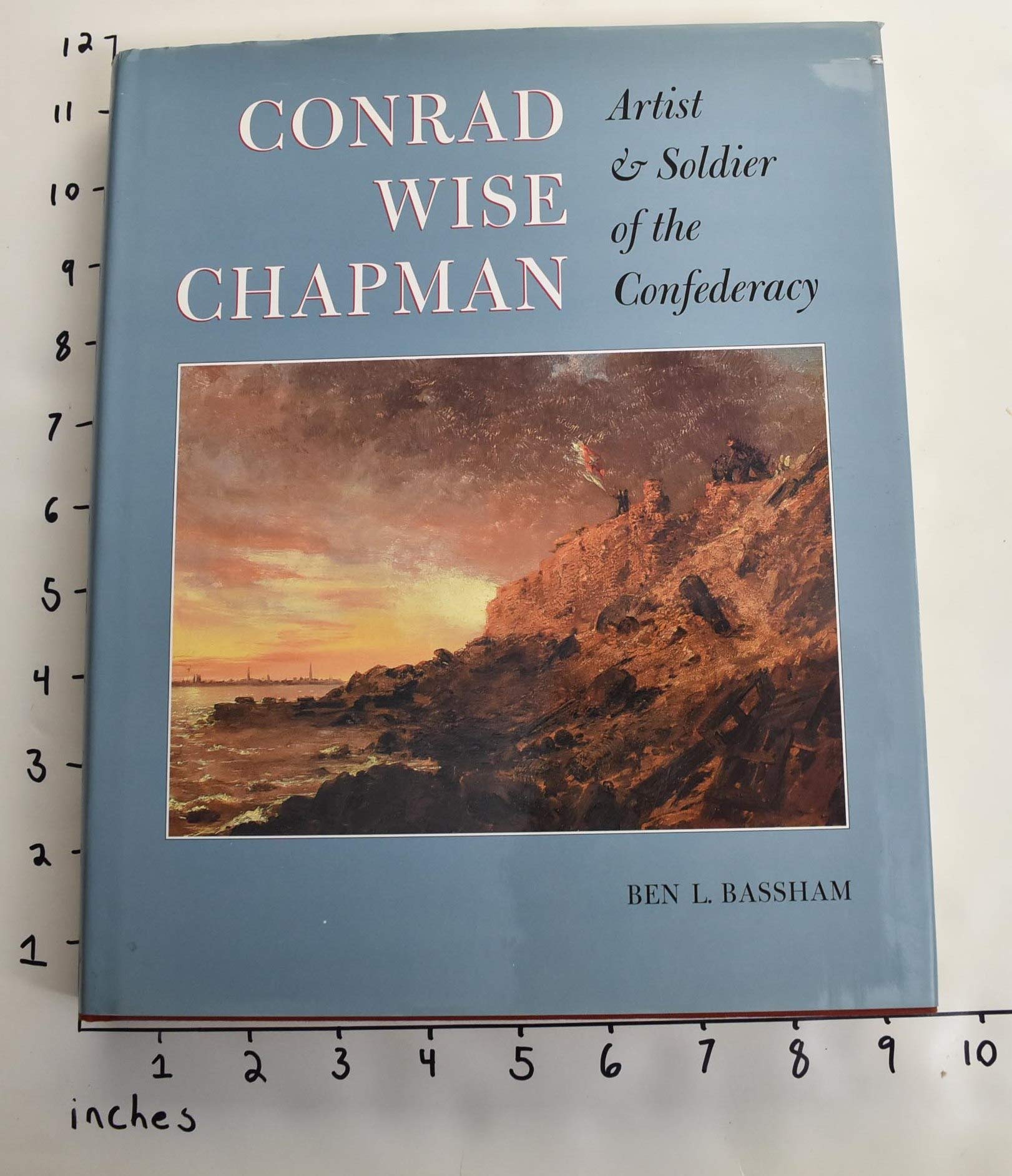



Conrad Wise Chapman (1842-1910) is unique among Civil War artists: he painted and sketched while on duty as a Confederate soldier who served in three theaters of the war. Chapman’s first-hand knowledge is evident in his work. Ben Bassham has written both a critical study of Chapman’s art and a biography, incorporating Chapman’s correspondence and Civil War memoirs. Conrad’s father, artist and teacher John Gadsby Chapman, moved his family from the U.S. to Italy in 1850. In 1861, Conrad returned to enlist in the Confederate Army. He served for a year in the West and was wounded at Shiloh. Following his recovery, he was transferred to a regiment in Virginia, and a year later he went to Charleston, where he was ordered by General Pierre G. T. Beauregard to create a pictorial record of the Confederate Army’s defense of Charleston harbor. Chapman completed a series of 31 paintings of Charleston as well as many other Civil War-related pictures familiar to historians. In 1867 he wrote his memoirs of his days as a soldier, a record that contains vivid descriptions of camp life, his first taste of battle, and his weeks in Confederate hospitals. After the war, Chapman spent eighteen months in Mexico, becoming the first American artist to paint that country’s landscape. He lived the remainder of his life in Europe, Mexico, and the United States. The historical importance of Chapman’s paintings as a record of the Civil War cannot be overemphasized, but this study also places Chapman’s art for the first time in the context of Southern as well as American art. The son of the artist John Gadsby Chapman, Conrad Wise Chapman became one of the most important artists of the Confederacy. Living with his parents in Rome at the start of the Civil War, Conrad sailed for America to defend his native Virginia. He served in the Confederate army in the western theater and then in Virginia. Finally, when he was stationed in Charleston, General Beauregard ordered him to make detailed drawings of the defenses surrounding Charleston. From these drawings came his famous Charleston series of paintings. After the war, he returned to Rome and then back to America again, eventually settling in Mexico. There he painted his landscape "Valley in Mexico," which he reproduced in smaller versions in later years. He died in poverty in Virginia in 1910. This first full-length biography draws on Chapman's memoirs. Civil War buffs should like the illustrations, but there is little detail of Chapman's war experiences. It will probably appeal more to art historians specializing in that era.?Grant A. Fredericksen, Illinois Prairie Dist. P.L., Metamora Copyright 1998 Reed Business Information, Inc. Conrad Wise Chapman (1842-1910) is unique among Civil War artists: he painted and sketched while on duty as a Confederate soldier and served in three theaters of the war. Chapman's firsthand knowledge is evident in his work. Ben Bassham has written both a critical study of Chapman's art and a biography, incorporating Chapman's correspondence and Civil War memoirs. The historical importance of Chapman's paintings as a record of the Civil War cannot be overemphasized, but this study also places Chapman's art for the first time in the context of Southern as well as American art. Ben Bassham is a professor of art history at Kent State University. He is the author of The Lithographs of Robert Riggs , The Theatrical Photographs of Napoleon Sarony and editor of Memories of an American Impressionist by Abel G. Warshawsky (The Kent State University Press, 1980), and Ten Months in the “Orphan Brigade” : Conrad Wise Chapman’s Civil War Memoir (The Kent State University Press, 1999). Used Book in Good Condition