Constitutive Modeling of Frictional Materials: The Advantage, Simplicity and Elegance of Using Stress Invariants
$83.00
by Poul V. Lade



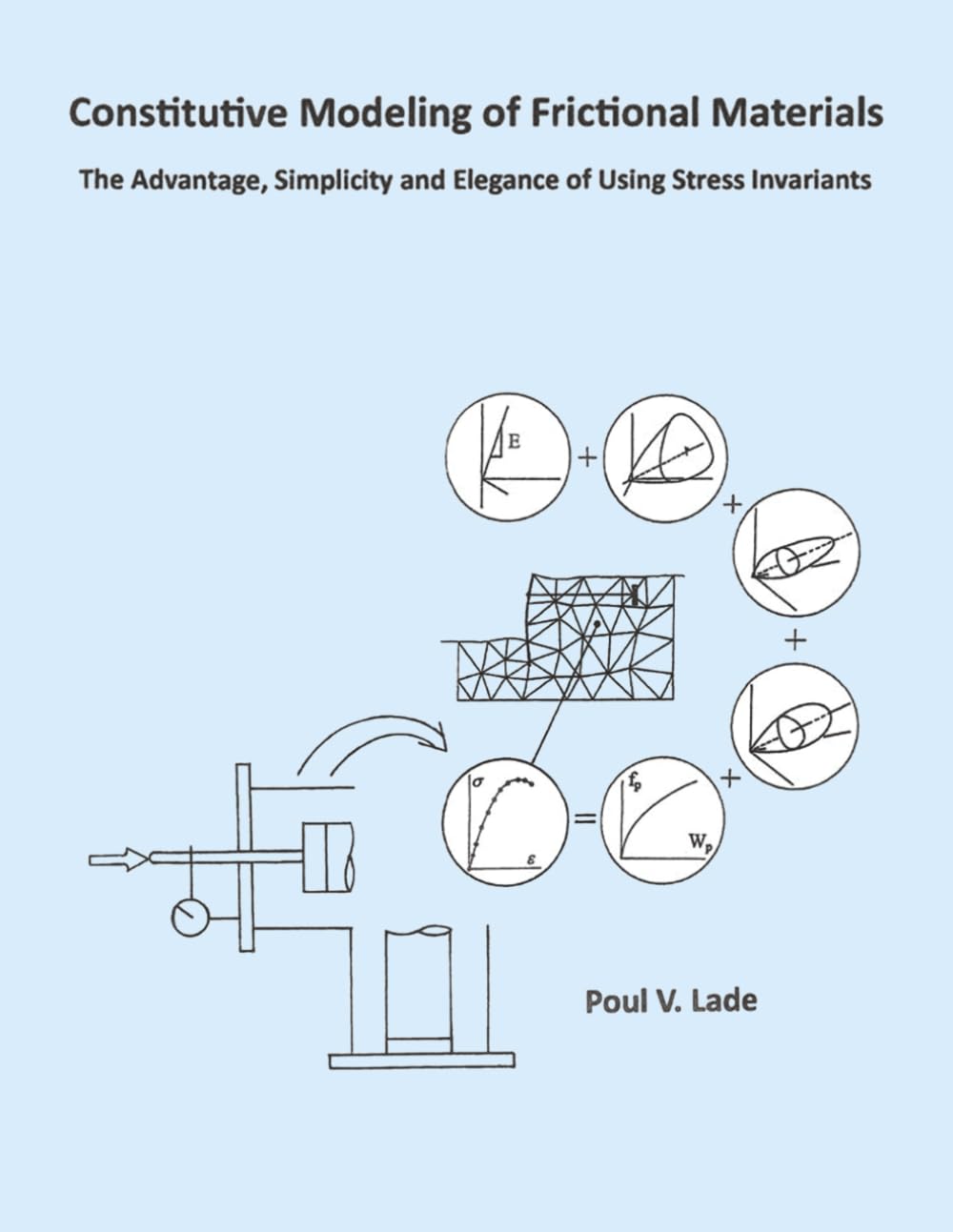
The book presents the development of a realistic, three-dimensional constitutive model for frictional materials as required in finite element and/or finite difference computations performed for advanced analysis, predictions and design of large civil engineering structures. The threedimensional work-hardening plasticity theory for frictional materials is based on advanced experimental evidence as produced by the author and presented in the literature. The book contains detailed explanations of each component of the model including the general framework for work-hardening plasticity theory, the generation of stress invariants, a model for the elastic behavior, the three-dimensional failure criterion, the yield surface as a surface of constant plastic work, the use of non-associated (rather than associated) plastic flow generated from a plastic potential (different from the yield surface), determination of material parameters from simple triaxial compression tests, incrementalization and implementation of the model, and effects of stress rotation, time effects, and cross-anisotropy. The Book Explains the development of a realistic constitutive model for the behavior of frictional materials. - Expresses all components of the work-hardening elastoplastic model in term of stress invariants. - Presents results where all material parameters for the model can be obtained from triaxial compression tests.