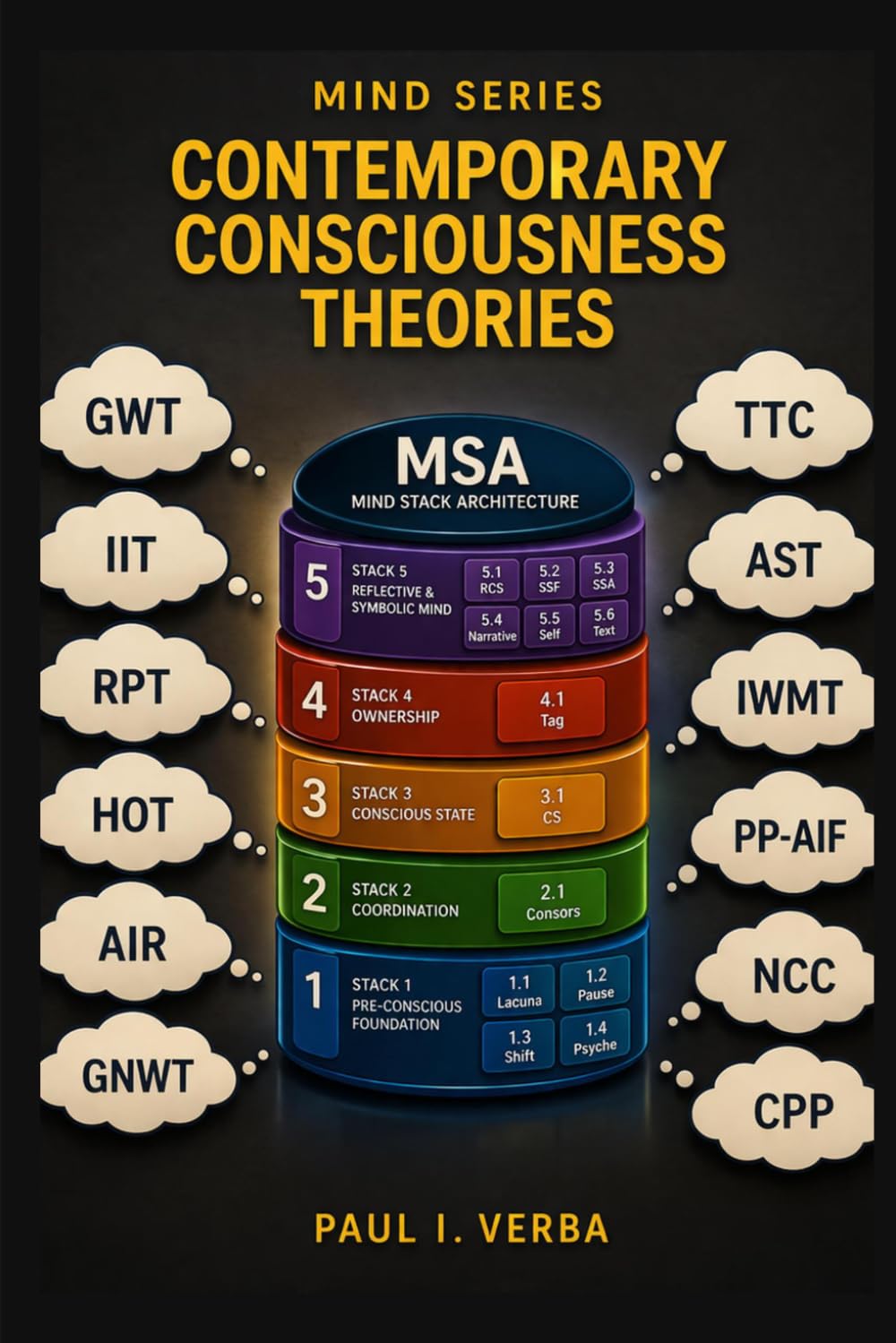
Contemporary Consciousness Theories: From Vagueness to Structure: Mind Stack Architecture (MSA) (Mind Studies)
$19.95
by Paul Verba



Consciousness has long been treated as the most intimate of possessions and the least obedient of objects. It is the one phenomenon from which no inquiry can depart, yet the one most stubbornly resistant to explanation. The modern field has responded to this difficulty not with silence, but with an exuberance of theories: global workspaces, recurrent loops, higher-order thoughts, predictive hierarchies, integrated information, temporo-spatial alignments, and even metaphysical reversals in which consciousness is restored to the throne as prima materia . Each theory captures something. None captures enough. This book argues that the principal weakness of contemporary consciousness theory is not empirical poverty, but structural misplacement. Theories begin too late. They describe the properties of consciousness once already formed—unity, accessibility, reportability, self-reference, differentiation—without showing how a system first becomes capable of interiority, retention, and lived presence. In effect, they explain the adult while presupposing the birth. Post festum comes the explanation, and too often explanation arrives only to discover that the decisive event has already been smuggled in. Against this tendency, the present work proposes a different demand: consciousness must be reconstructed architecturally. It must be shown to arise through ordered thresholds rather than invoked as a primitive, reduced to a correlate, or embalmed in abstraction. To that end, this study surveys the major contemporary theories of consciousness, evaluates their explanatory power against the principal features of conscious life, and demonstrates their patterned insufficiency. Their error is rarely absolute falsehood. It is more often partial truth inflated into sovereignty. In response, the book introduces Mind Stack Architecture (MSA), a layered theory of mind that begins below consciousness and proceeds upward through necessary structural achievements. Rather than asking which single property consciousness “is,” MSA asks what must first be built for consciousness to become possible at all. The result is a developmental architecture extending from non-coincidence and retention to psyche, consciousness proper, ownership, reflexivity, symbolic organization, narrative continuity, selfhood, and text. Consciousness thus appears not as the origin of mind, nor as its terminus, but as one decisive threshold in a larger ascent. The wager of this book is therefore severe but simple: if consciousness is approached only where it shines, it will remain mysterious; if it is approached where it begins, it may finally become intelligible. Ex lacuna ad mentem : from gap to mind. Or, to put the matter in a more Freudian register, what the field has too often taken as essence may prove to be only symptom