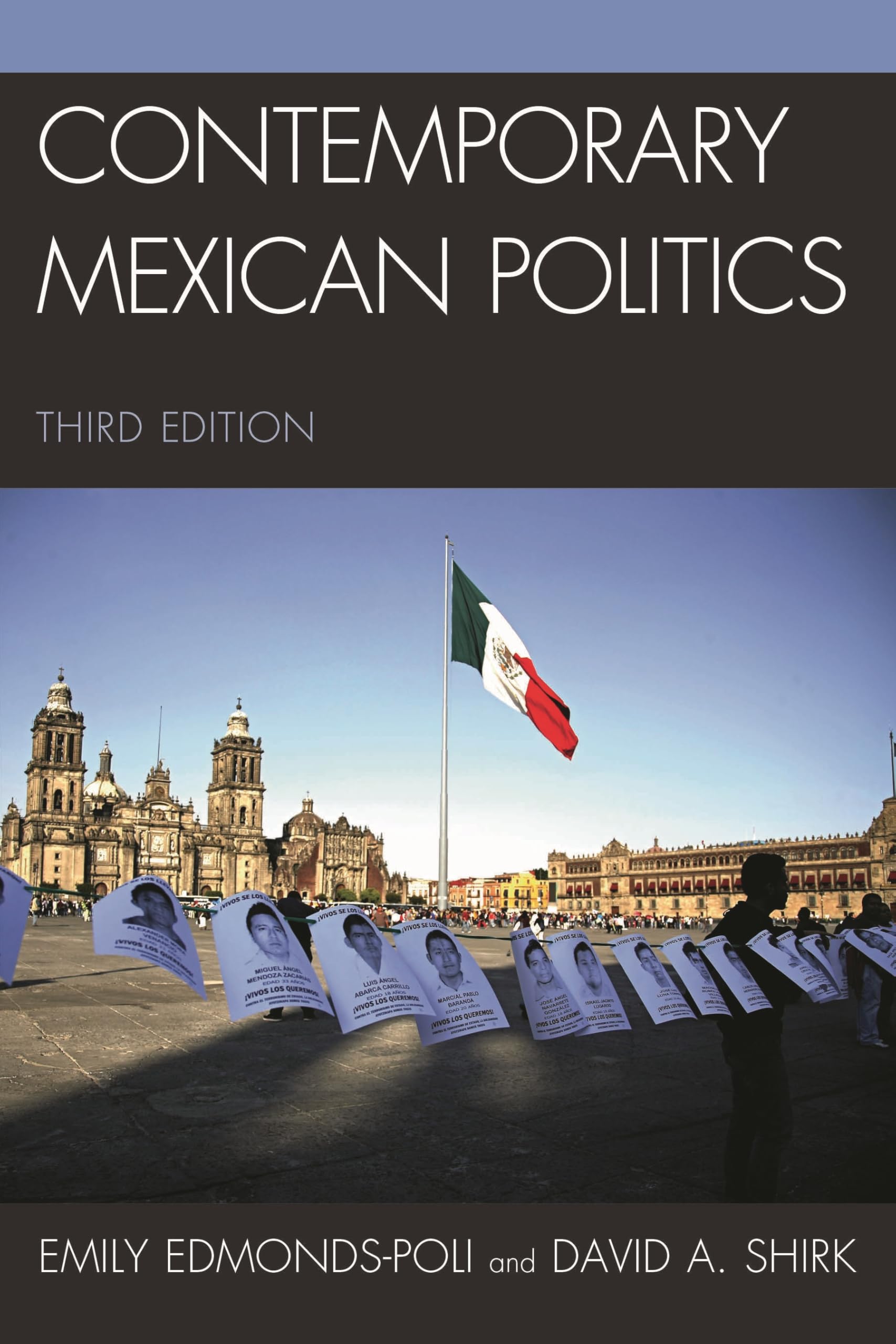



Now in a thoroughly updated edition, this comprehensive and engaging text explores contemporary Mexico’s political development and examines the most important policy issues facing Mexico in the twenty-first century. The first half of the book traces Mexican political development after the 1910 Revolution and the creation of a single-party dominant system headed by the PRI (Institutional Revolutionary Party). It includes detailed treatment of the “classic” PRI system’s characteristics, as well as a thorough account of the PRI’s demise and an insightful examination of how the country’s institutions evolved under two successive PAN (National Action Party) presidential administrations before returning to PRI rule. The second half of the book analyzes the most pressing policy issues confronting Mexican society today―including macroeconomic growth and stability, poverty and inequality, the development of civil society, combating drug trafficking, strengthening the rule of law, and migration―and weighs their influence on the future of democracy in Mexico. The text to this revised edition is richly supplemented by new figures and tables that illustrate broad political, social, and economic trends and by boxes that provide in-depth treatment of a variety of subjects and concepts. Readers will find this widely praised book continues to be the most current and accessible work available on Mexico's politics and policy. A test bank for instructors is available through textbooks@rowman.com. A website with study guides and links to online resources is available at https://contemporarymexicanpolitics.wordpress.com “This third edition of Contemporary Mexican Politics traces Mexico's history from pre-Columbian times to Spanish colonial rule, independence, US conquests of Mexican territory, the Mexican Revolution, and a slow transition to current democratic government. Considerable focus is on the Institutional Revolutionary Party (PRI), the party that became the embodiment of the 1910 Mexican Revolution and governed through co-opting opposition forces and repression, under the facade of a democracy. Edmonds-Poli and Shirk describe how economic crisis and government corruption cost the PRI public support, leading it to allow free elections and victory for the opposition National Action Party in 2000. When the PRI regained power in 2012, it signed the Pact for Mexico with the other two major parties in a spirit of cooperation. The authors, nonetheless, cite a 2014 study revealing that only one in five Mexicans was satisfied with the political and economic situation. Continued corruption and violence―greatly related to drug trafficking―and a huge gap between rich and poor tarnish the democratic system. However, the authors express some admiration, saying that ‘Mexico's ability to move, in one generation, from a single-party-dominant system to one with vibrant competition is remarkable.’ Summing Up: Recommended. Upper-division undergraduate and graduate collections.” ― Choice Reviews “Now in its second decade of a complex transition to democracy, Mexico confronts significant challenges to achieve economic growth with equity, along with rule of law. With a well-considered selection of topics, this current, concise, clearly written introduction to the government and politics of Mexico serves as both a comparative politics text as well as a reference guide for the interested public.” ―John Bailey, emeritus professor of government, Georgetown University “Contemporary Mexican Politics is the ideal book for introducing undergraduate and graduate students to Mexico―I use it in all my classes―and it's one of only two books I always recommend to any English speaker who wants to have a comprehensive understanding of how Mexico works today with a sense of the history that has shaped today's realities.” ―Andrew Selee, Mexico Institute, Woodrow Wilson Center “Contemporary Mexican Politics does an excellent job of laying out the foundations of the Mexican political system, leaving little of relevance out of the picture. For students of comparative politics, it is an excellent entry-level volume, which elegantly brings together the complex intricacies of one of the world's most unique political systems. . . . For everyone else with an interest in Mexican history, politics, or current affairs, a recommendation is no less valid.” ― International Affairs “Contemporary Mexican Politics offers a serious and systematic accounting of one of the world's most complex and interesting governing systems. . . . The autocracy of the PRI ultimately gave way in 2000 to a full multi-party state which had been gestating for the previous decade. Edmonds-Poli and Shirk offer illuminating insights into both the one party state and its democratic heir in this valuable volume.” ―Jeffrey Davidow, president, Institute of the Americas and U.S. ambassador to Mexico (1998–2002) “Edmonds-Poli and Shirk do a masterful job of making the Mexican political system―on