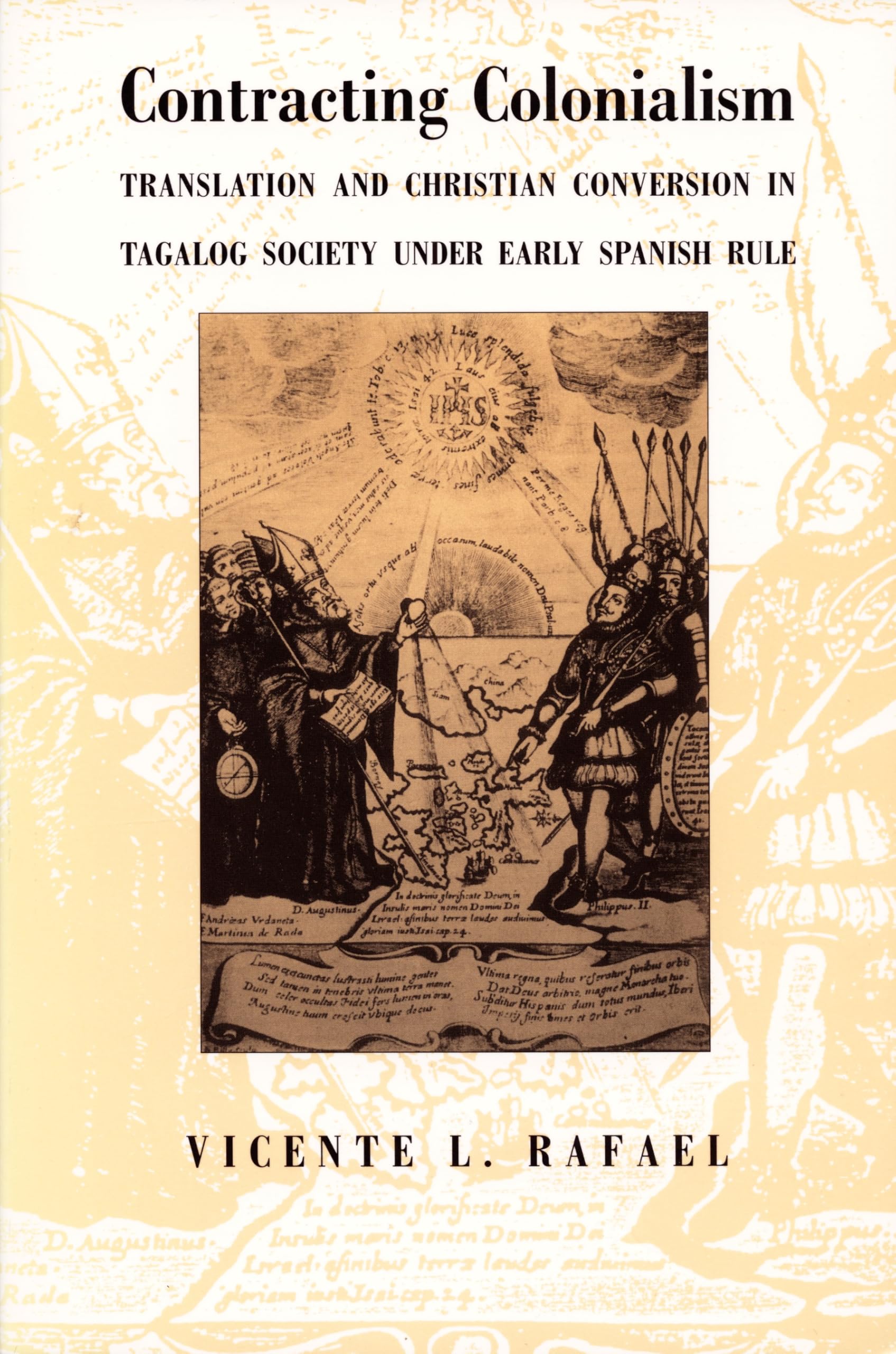
Contracting Colonialism: Translation and Christian Conversion in Tagalog Society Under Early Spanish Rule
$34.95
by Vicente L. Rafael



In an innovative mix of history, anthropology, and post-colonial theory, Vicente L. Rafael examines the role of language in the religious conversion of the Tagalogs to Catholicism and their subsequent colonization during the early period (1580–1705) of Spanish rule in the Philippines. By tracing this history of communication between Spaniards and Tagalogs, Rafael maps the conditions that made possible both the emergence of a colonial regime and resistance to it. Originally published in 1988, this new paperback edition contains an updated preface that places the book in theoretical relation to other recent works in cultural studies and comparative colonialism. "This is a significant, original, and engaging book that should find an audience among those concerned with colonialism, discourse, and ideology."—Renato Rosaldo, Stanford University "This is a significant, original, and engaging book that should find an audience among those concerned with colonialism, discourse, and ideology."--Renato Rosaldo, Stanford University Vicente L. Rafael is Professor of History at the University of Washington. He is the author of The Promise of the Foreign: Nationalism and the Technics of Translation in the Spanish Philippines and White Love and Other Events in Filipino History , both also published by Duke University Press. Contracting Colonialism Translation and Christian Conversion in Tagalog Society under Early Spanish Rule By Vicente L. Rafael Duke University Press Copyright © 1993 Duke University Press All rights reserved. ISBN: 978-0-8223-1341-0 Contents Preface to the Paperback Edition, Preface (1988), Introduction: Fishing Out the Past, Chapter 1: The Politics of Translation, Chapter 2: Tomas Pinpin and the Shock of Castilian, Chapter 3: Conversion and the Demands of Confession, Chapter 4: Untranslatability and the Terms of Reciprocity, Chapter 5: Translating Submission, Chapter 6: Paradise and the Reinvention of Death, Afterword: Translation and the Colonial Legacy, Bibliography, Index, CHAPTER 1 The Politics of Translation Language and Empire When we try to understand the relationship between language and colonial politics, it helps to recall that the beginnings of the Spanish empire in the last decade of the fifteenth century coincided with the first attempt to install Castilian as the dominant language of the emergent Spanish state. In 1492, the Spanish humanist Antonio de Nebrija published his Gramática de la lengua castellana in Salamanca. Dedicating his work to Queen Isabella, Nebrija claimed that "language is the perfect instrument of empire." Surveying the record of antiquity, Nebrija writes in his Prólogo that "one thing I discovered and concluded with certainty is that language was always the companion of empire; therefore it follows that together they begin, grow, and flourish, and together they fall" (p. 3). The history of classical antiquity, particularly that of the Roman Empire, provides Nebrija with the basis for asserting the crucial role of the Castilian vernacular in the establishment of Castilian hegemony over the Iberian Peninsula. In the tradition of Spanish Renaissance humanism, he assumes a natural connection between language and politics: the assertion of one is accompanied by the spread of the other. The ability of Castilian to play such a role was due to its genealogy. Nebrija and the Spanish philologists who followed in his wake held to the belief that the vernacular was derived from Latin—but Latin of a corrupted sort rather than that of classical authors. In order to legitimize the Castilian vernacular and make it into a suitable language of the state, it was necessary to order it, to harmonize its parts, to standardize its orthography: in short, to endow it with a grammar. It would thus come to possess a value analogous to its "proper" precursor, classical Latin, whose immutability rested on the fact that its form had been fixed by grammatical laws. Castilian, therefore, had not only to represent the power of those who spoke it but also to reflect its structural origin. The spread of the vernacular, aided significantly by the rise of print capitalism in Spain, made it imperative to reformulate the status of Castilian in relation to the language it was usurping. By establishing the vernacular on the foundations—grammatical as well as mythological— of classical Latin, such Spanish philologists as Nebrija could put forth this linguistic transgression as a natural succession of languages and empires. The reconstruction of Castilian on the basis of Latin grammatical theory and the use of the rules of classical rhetoric in its literary productions made it possible to negate the past while simultaneously preserving its authority. Indeed, Nebrija asserts that the proper learning of Castilian led not to a forgetting of Latin but to its more efficient appropriation, "because after one has learned Castilian grammar well—which is not very diffic