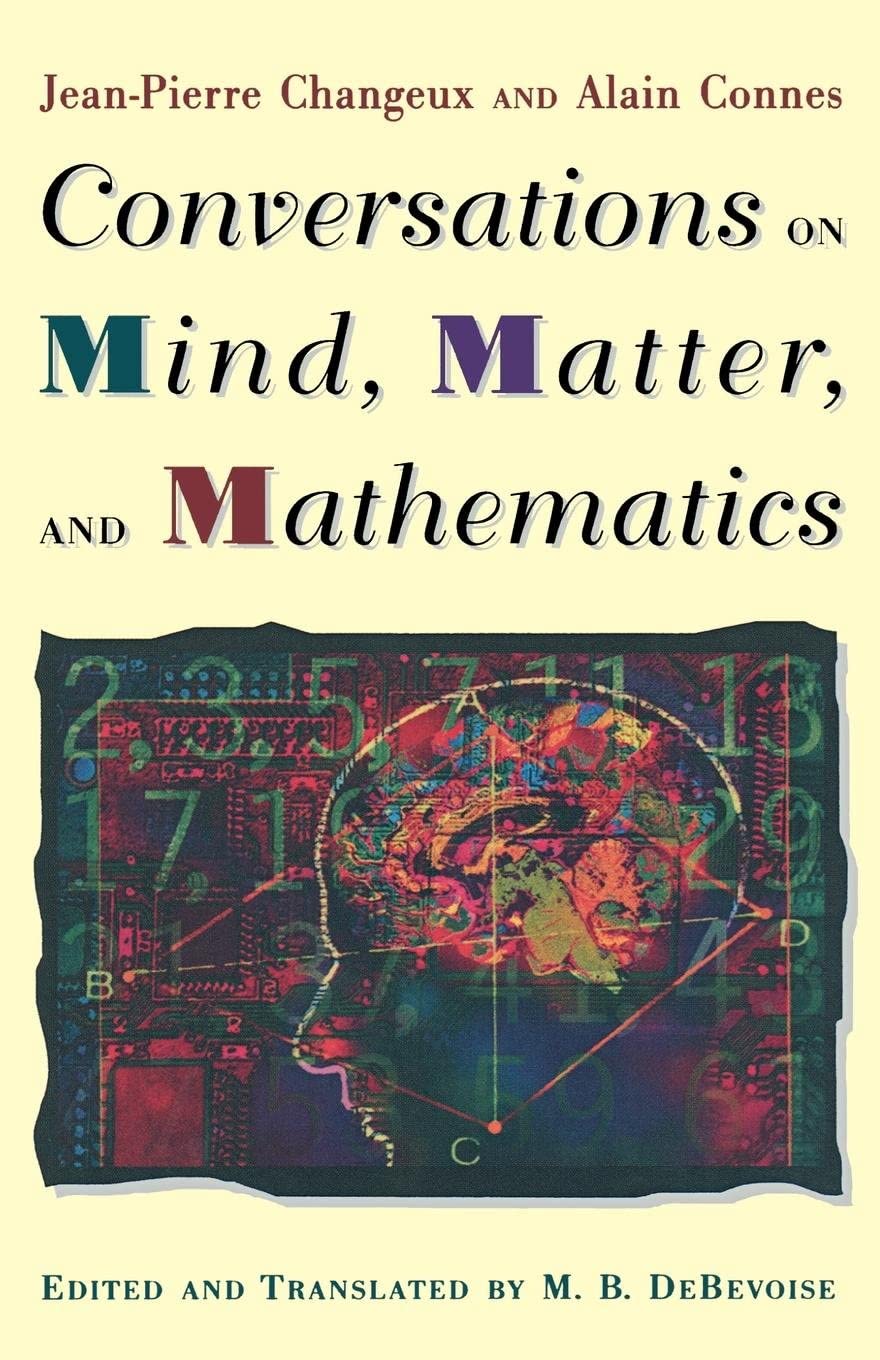



Do numbers and the other objects of mathematics enjoy a timeless existence independent of human minds, or are they the products of cerebral invention? Do we discover them, as Plato supposed and many others have believed since, or do we construct them? Does mathematics constitute a universal language that in principle would permit human beings to communicate with extraterrestrial civilizations elsewhere in the universe, or is it merely an earthly language that owes its accidental existence to the peculiar evolution of neuronal networks in our brains? Does the physical world actually obey mathematical laws, or does it seem to conform to them simply because physicists have increasingly been able to make mathematical sense of it? Jean-Pierre Changeux, an internationally renowned neurobiologist, and Alain Connes, one of the most eminent living mathematicians, find themselves deeply divided by these questions. The problematic status of mathematical objects leads Changeux and Connes to the organization and function of the brain, the ways in which its embryonic and post-natal development influences the unfolding of mathematical reasoning and other kinds of thinking, and whether human intelligence can be simulated, modeled,--or actually reproduced-- by mechanical means. The two men go on to pose ethical questions, inquiring into the natural foundations of morality and the possibility that it may have a neural basis underlying its social manifestations. This vivid record of profound disagreement and, at the same time, sincere search for mutual understanding, follows in the tradition of Poincaré, Hadamard, and von Neumann in probing the limits of human experience and intellectual possibility. Why order should exist in the world at all, and why it should be comprehensible to human beings, is the question that lies at the heart of these remarkable dialogues. "One of Choice's Outstanding Academic Titles for 1995" "[The authors'] passion for discerning the truth about important issues and for formulating thoughts as precisely as possible shines through these conversations.... A stimulating and illuminating book." ---Philip Kitcher, The New York Times Book Review "A stimulating and illuminating book. . . . Mr. Changeux and Mr. Connes might best be characterized by reviving an old term. They are natural philosophers, concerned with large questions about the world and our place in it, who confront those questions with intelligence and lively imagination." ---Philip Kitcher, New York Times Book Review "The original Socratic dialogues were artificially constructed to present a coherent view. The dialogue between Connes and Changeux is quite different. It is the recording of real-life arguments where the speakers are frequently at cross-purposes and operate in different planes. For the reader this can be irritating but it also encourages him to become involved and frame his own answers. . . ." ---Sir Michael Atiyah, The Times Higher Education Supplement "A highly entertaining and erudite read, this conversation between two renowned scientists . . . is at all times informative, lively, and thought provoking. The reader is drawn into the argument and left pondering the issues well after the last page has been turned." ― Choice "A delight to read, and highly informative." ---Keith Devlin, Nature "The record of an intellectual encounter between two of Franco's leading scientific figures. . . . The result is a smooth, easy-to-read representation of a protracted, interesting . . . exchange between Alain Connes, an eminent mathematician, . . . and Jean-Pierre Changeux, a distinguished biologist." ---Brian Rotman, Times Literary Supplement "This wonderfully eloquent and playful colloquy of two brilliant minds gives new life to the old notion of Dialogue, a sadly forgotten form now.... I love this book!" ―Oliver Sacks, M.D "English-speaking readers can now benefit from the philosophical insights of two outstanding intellects―each a leader in his own field, each bringing his own distinctive perspective to deep and challenging issues. Conversations on Mind, Matter, and Mathematics is fascinating." ―Roger Penrose "It is a privilege to be permitted to eavesdrop on this fascinating conversation between two gifted individuals: a conversation that is remarkable for its erudition and that puts some very old questions into a very modern context." ―Leon Cooper, Nobel Laureate in Physics "This book is a superb guide to the philosophical ambiguities and contradictions that lie beneath the surface of science. Looking at the world as though 'through a glass darkly,' Changeux and Connes wind up seeing apparently irreconcilable realities. Their debate is likely to become a classic." ―David Ruelle, Institut des Hautes études Scientifiques, Paris "The concluding remarks on ethics, setting out the credo of the neuroscientist, are the highpoints of a quite remarkable book. I do not think this has ever been done in quite the