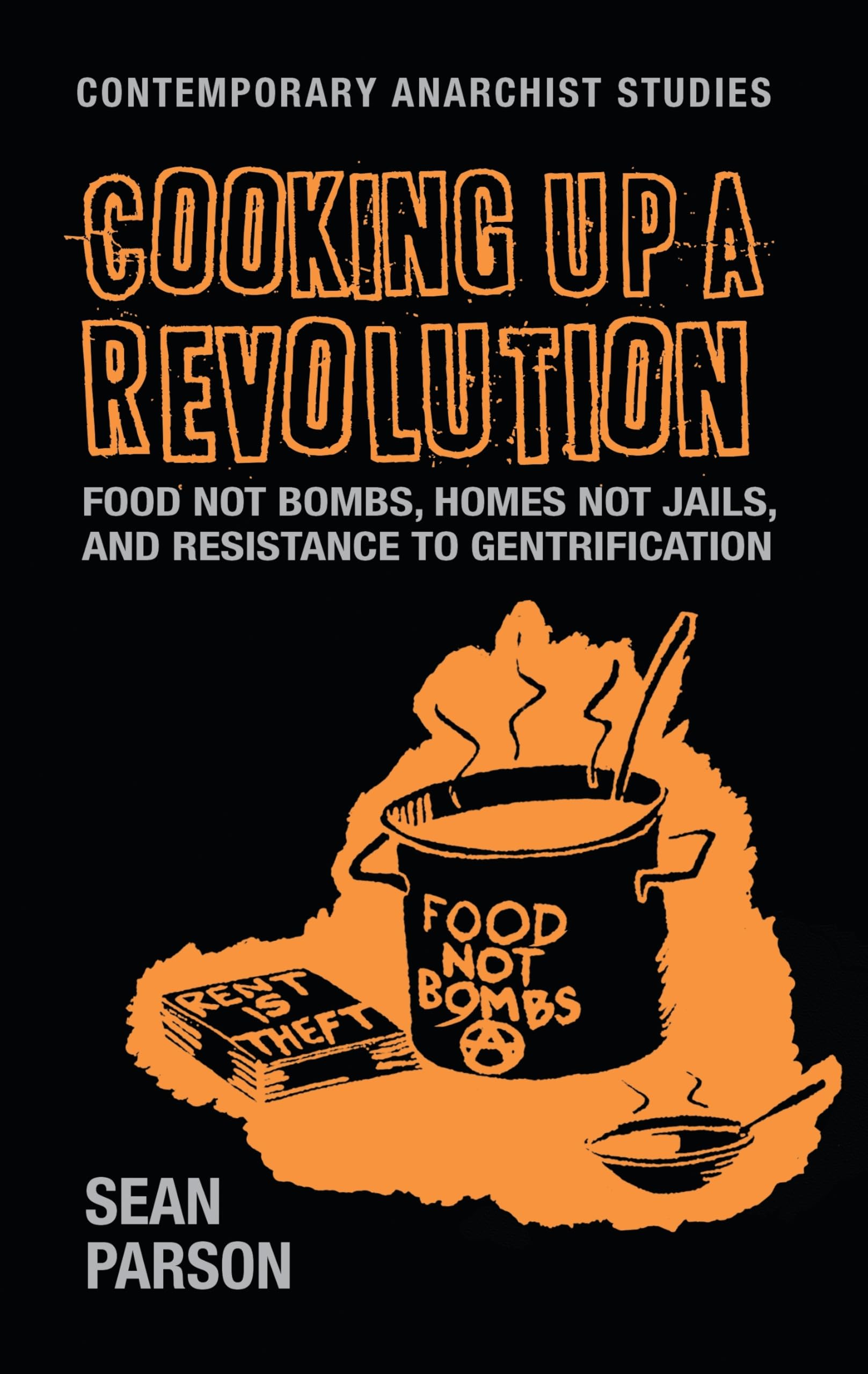
Cooking up a revolution: Food Not Bombs, Homes Not Jails, and resistance to gentrification (Contemporary Anarchist Studies)
$35.16
by Sean Parson



During the late 1980s and early 1990s the city of San Francisco waged a war against the homeless. Over 1,000 arrests and citations where handed out by the police to activists for simply distributing free food in public parks. Why would a liberal city arrest activists helping the homeless? In exploring this question, the book treats the conflict between the city and activists as a unique opportunity to examine the contested nature of homelessness and public space while developing an anarchist alternative to liberal urban politics that is rooted in mutual aid, solidarity, and anti-capitalism. In addition to exploring theoretical and political issues related to gentrification, broken-windows policing, and anti-homeless laws, this book provides activists, students and scholars, examples of how anarchist homeless activists in San Francisco resisted these processes. This book is relevant to United Nations Sustainable Development Goal 2, Zero hunger. 'Cooking up a revolution is an inspiring David and Goliath story that details the significance of remaining true to your values when standing up to overwhelming state violence. Parson’s well researched book should be read by anyone interested in seeking lasting social change. This book taught me a great deal and I was there.' Keith McHenry, Co-founder of Food Not Bombs 'Sean Parson mines the history of San Francisco Food Not Bombs to theorize a politics of the city. He kicks over the table of orthodox urbanism and proposes one rooted in solidarity, equity and mutual aid. Thoroughly researched and precisely argued, this book belongs on the same shelf as the works of David Harvey, Saskia Sassen and Neil Smith.' James Tracy, Author of Dispatches Against Displacement: Field Notes from the San Francisco Housing Wars ‘What does one do in a country where it’s illegal to dumpster dive for discarded food but perfectly legal to throw out food while millions go hungry, or where it’s illegal to live in parks or abandoned buildings while gentrification pushes more people to the brink of homelessness? Using applied political theory and exploring the radical politics of the historically dubbed lumpen proletariat, Parson (Northern Arizona Univ.) outlines the anarchist politics of Food Not Bombs and Homes Not Jails in San Francisco from 1988 to 1995. For FNB and HNJ, a combination of state policies and dehumanizing capitalism, not mental illness, caused homelessness. Through direct action working with homeless populations in mutual aid and solidarity rather than charity, activists confronted the city’s neoliberal politics in a time of growing homelessness and rapid gentrification of the Bay Area. By engaging with the homeless by providing free food, squatting, and demonstrating, FNB and HNJ politicized these victims of neoliberalism to “create temporary autonomous zones where we are able to foreshadow the world we want to see.” Parson’s sympathetic account is a welcome critique of neoliberal America, when issues like gentrification again are making cities more unlivable for marginalized people.’ K. R. Shaffer, Penn State University, Berks College, Choice Vol. 56, No. 12 (August 2019) On Labor Day in 1988, two-hundred hungry and homeless people went to Golden Gate Park in search of a hot meal. There, fifty-four activists from Food Not Bombs, surrounded by riot police, lined up to serve them food. The following arrests proceeded like an assembly line; an activist would scoop a bowl of food and hand it to a hungry homeless person, a police officer would handcuff and arrest that activist, immediately the next activist in line would take up the ladle, scoop and be promptly arrested. By the end of the day all fifty-four activists had been arrested for providing food without a permit. These arrests were not an aberration but part of a multi-year campaign by the City of San Francisco against radical homeless activists in an attempt to remake the city. These actions beg the question: why would a liberal city arrest activists helping the homeless? In exploring the answers, the book uses the conflict between the city and activists as a unique opportunity to examine the contested nature of urban politics, homelessness and public space while developing an anarchist alternative to liberal urban politics that is rooted in mutual aid, solidarity and anti-capitalism. In addition to exploring theoretical and political issues related to gentrification, broken-windows policing and anti-homeless laws, this book provides both activists, students and scholars, examples of how anarchist homeless activists in San Francisco resisted these process. On Labor Day in 1988, two-hundred hungry and homeless people went to Golden Gate Park in search of a hot meal. There, fifty-four activists from Food Not Bombs, surrounded by riot police, lined up to serve them food. The following arrests proceeded like an assembly line; an activist would scoop a bowl of food and hand it to a hungry homeless person, a police officer