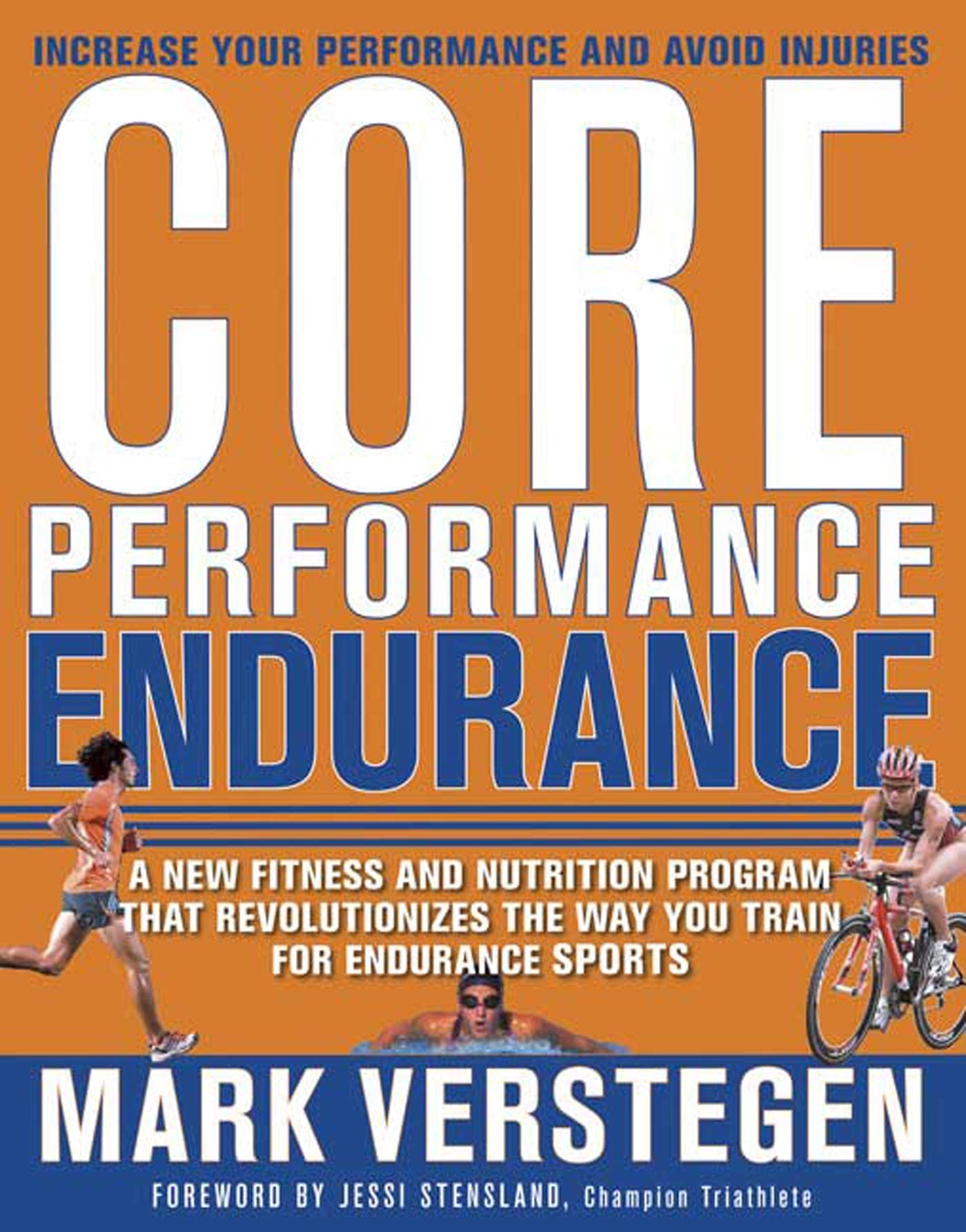
Core Performance Endurance: A New Fitness and Nutrition Program That Revolutionizes the Way You Train for Endurance Sports
$9.14
by Mark Verstegen



The third book in the breakout Core Performance series offers cutting-edge training for the endurance athlete Mark Verstegen launched the core training revolution with Core Performance, which broke new ground in fitness with its intense focus on the muscles of the core—shoulders, hips, and midsection. Now Verstegen provides an exciting new application of his powerful Core program, addressing the special needs of the endurance athlete. Core Performance Endurance : • helps endurance athletes at all levels—whether they're competitive swimmers, hard-driven triathletes, or everyday joggers—avoid the injuries that too often sabotage their performance • delivers the desired combination of strength and stamina, balance and flexibility, athletic quickness and power that the endurance athlete strives for • provides an endurance-oriented nutrition program—complete with recommendations for pre- and post-race eating This book not only helps endurance athletes train more effectively, but also gives them a potent regimen of core training that will help them move more efficiently, thereby staving off overuse injuries and long-term deterioration. MARK VERSTEGEN , founder and president of EXOS, is a widely sought-after performance coach, consultant, and motivational speaker who lives in Arizona. PETE WILLIAMS is a longtime journalist who writes about fitness, business, and sports. He lives in Central Florida. CHAPTER 1 A CALL TO CHANGE Take your left hand and place it on a flat surface, preferably a table. Raise your middle finger and push it down as hard as you can. Really slam that finger down. Now relax your hand. Reach over with your right hand, pull that same finger back and let it snap down. Go ahead. Do it again and again. How much effort did it take to do that? Not much, but it generated so much more force than through the first method. If you were to keep raising that middle finger on its own, you'd get tired. But if you can store and release that energy, lifting with your other hand, you can do it all day long and produce many times the power with a fraction of the effort. This is a good illustration of elastic power. We want to be able to store and release energy efficiently. Everything we do has some sort of elastic component to it, whether it's walking, running, going down steps, or playing sports. The more efficiently we can store and release energy, the less effort we have to expend. Elasticity, this ability to store and release energy efficiently, is the reason people are able to run marathons in just over 2 hours. The foundation of elasticity is stability and mobility. Go back to our finger exercise: If you lift your finger and don't stabilize your hand on the table, you'll lift your hand as well as your finger off the table. Stability allows you to have a fixed point from which to stretch the muscle, so it can efficiently store and release that energy. Stability is your foundation. Mobility is the ability to take that finger back through the range of motion, allowing for fluid movement and greater potential to store and release energy. Mobility can be restricted because of tight tissue or poor joint mechanics, problems that could come from traumatic injury or misuse through inefficient biomechanics over time. Once we harmonize stability and mobility, we have the foundation for elasticity. These efficient movement patterns empower you to run, ride, and swim faster with less energy expenditure. This is all part of the Holy Grail of endurance training. And we'll show you how to get there. ELASTICITY AND TISSUE TOLERANCE Through this program, you'll develop tissue tolerance. Your body breaks down when it's overstressed or under-recovered. Training creates small microtears in your tissue, and ultimately, you're going to overstress or rip the fabric unless you address this problem. Elasticity, along with mobility and stability, decreases the tissue load. When your body is more elastic, each stroke and stride puts less of a load on your tissue. Think of your body as a pogo stick. We want our bodies to be able to store and release energy powerfully, just like a pogo stick. When you have good elasticity, your body stretches and snaps back well. But if the tissue is tight, with a dozen knots in it, it doesn't have the ability to store energy and it does not snap back. If you took a rubber band and stretched it, you'd notice its ability to lengthen and to store energy evenly. But if you tied knots in it and tried to stretch it, it wouldn't be nearly as effective. In this program, we're going to make sure that knots don't form. You don't want to do the equivalent of letting your tissue sit in the sun and dry out. If you do, it's going to get brittle and lose its elasticity. If you tug on it, it's going to break. If you're not building tissue tolerance--not taking care of your muscular and connective tissue--then you're going to be limited in endurance activities. Tissue tolerance is the found