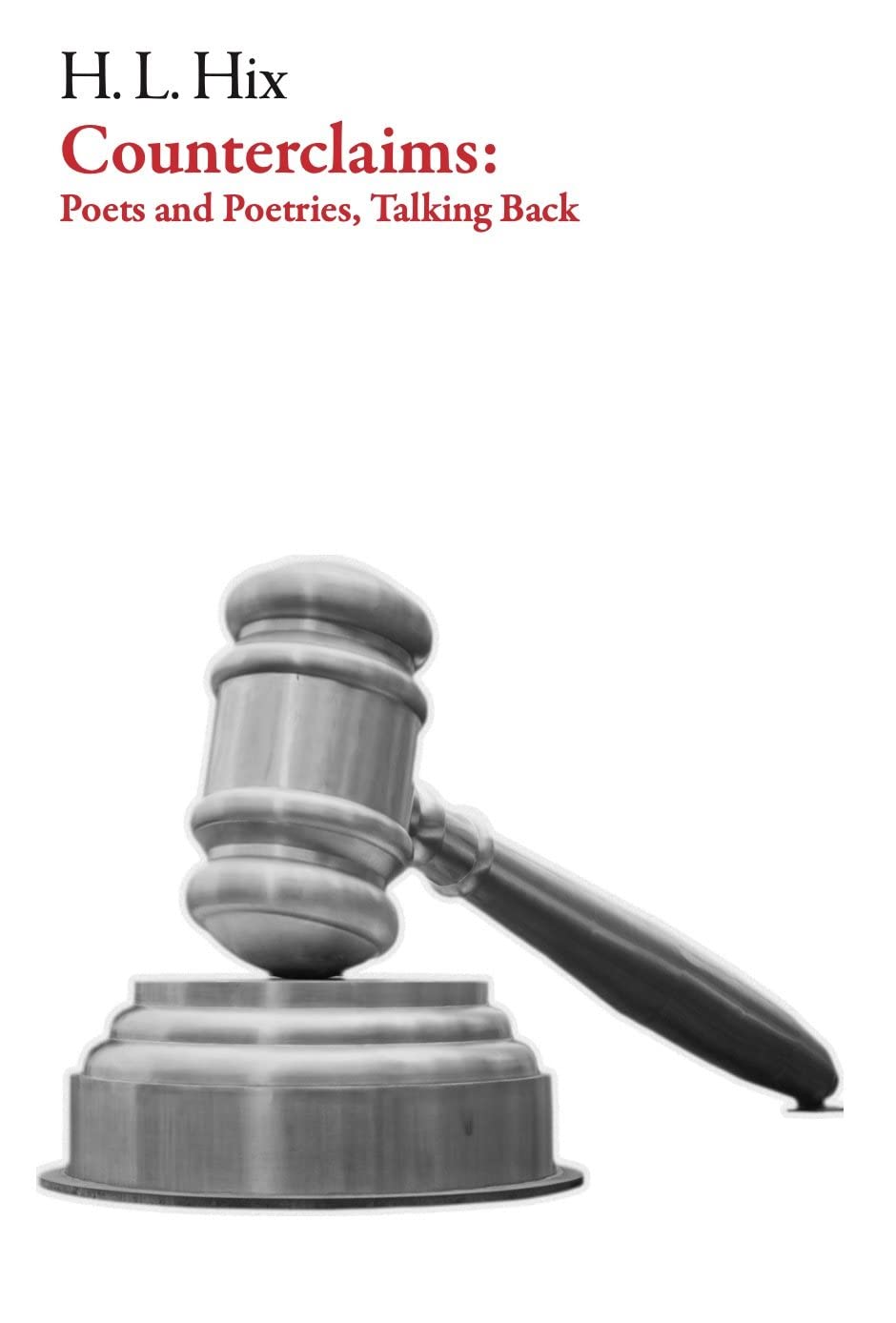



In Counterclaims , renowned poet H. L. Hix has amassed the responses of more than one hundred and fifty of his fellow writers, scholars, and artists to a singular problem, simultaneously a set of questions and a call-to-arms: whether the old truths inherent in 20th-century poetics can still be adhered to today, or whether new truths might take their place and what might they be? The answers collected in this volume from many of the greatest luminaries of their generation, writers young and old, from diverse backgrounds and cultures, form the basis of a new conversation; a step forward, not toward any one monolithic thesis or manifesto, but toward a new and ever adapting notion of poetry. H. L. Hix 's recent poetry collections include I'm Here to Learn to Dream in Your Language ; As Much As, If Not More Than ; First Fire, Then Birds: Obsessionals 1985-2010 ; and Incident Light . He is a Professor in the Department of Philosophy and the Creative Writing Program at the University of Wyoming. He lives in Laramie. It is not difficult to see, but it is difficult to honor, the distinction between an aspiration and its Aspiration. Honoring the distinction matters, though, because what is lost when the distinction is lost is always the Aspiration. Reduction is reduction to the minuscule. Failing to honor the distinction, in other words, confines one to the aspiration. Counterclaims seeks to honor the distinction between poetry and Poetry. Analogy with another domain will help me gesture toward the distinction. In her book Undoing the Demos, Wendy Brown argues that neoliberalism, by “transmogrif[ying] every human domain and endeavor, along with humans themselves, according to a specific image of the economic,” has become “democracy’s conceptual unmooring and substantive disembowelment.” As part of her argument, Brown makes in regard to democracy a distinction like the aspiration/Aspiration distinction I am making here in regard to poetry. “‘Democracy,’” Brown contends, “signifies the aspiration that the people, and not something else, order and regulate their common life through ruling themselves together.” The term “contains nothing beyond the principle that the demos rules”; it “does not specify the arrangements, agreements, or institutions by which popular rule could or should be fulfilled.” The principle of rule by the demos, distinct from particular arrangements for enacting that rule, “is the bare promise of bare democracy.” The principle “affords without guaranteeing the possibility that power will be wielded on behalf of the many, rather than the few, that all might be regarded as ends, rather than means, and that all may have a political voice.” Honoring the distinction between the democratic principle and any specific set of arrangements and institutions made in its name keeps the principle alive as a critique of the specific arrangements; without the distinction, the specific arrangements are mistaken for democracy, and the principle of rule by the demos is lost. Translated into my terms, Brown’s argument is that neoliberalism, by failing to honor the distinction between democracy and Democracy, loses Democracy altogether. Translated into Brown’s terms, the case made by this book is that a plurivocal poetics more than a univocal one fulfills the bare promise of bare poetry. In other words, this project seeks not to take a position on, but to further an ongoing process of, poetics. It seeks not to assert a claim but to perform a heuristic, not to settle on one aesthetic or one institutional arrangement for poetry, but to fulfill a principle of continuing dialogue and distributed engagement. By analogy with Chantal Mouffe’s characterization of democracy, this project treats poetics as interminably agonistic (a space for claims and counterclaims), and seeks not to “establish a rational consensus” but to create “collective forms of identification” around poetic objectives. By analogy with James P. Carse’s distinction between finite and infinite games, this project seeks to extend dialogue indefinitely, not to agree on who has won but to “bring as many persons as possible into the play.” Or, again, the project seeks not to prescribe a position, but to operate within a domain, to take the “responsibility for and toward words” that Václav Havel contends “is intrinsically ethical.” The project took shape through my posing to various persons (mostly poets and scholars) a question, and gathering the responses. The question was framed in the following way. Surely no pronouncements about poetry are cited more frequently than these: Poetry makes nothing happen. (W. H. Auden, 1939) To write poetry after Auschwitz is barbaric. (Theodor Adorno, 1949) Perhaps each merits repetition: both are plenty provocative, and would move to rumination any reflective person. But the frequency with which they are repeated points to a problem. If sometimes familiarity breeds contempt, sometimes it breeds passive acceptance. Both pro