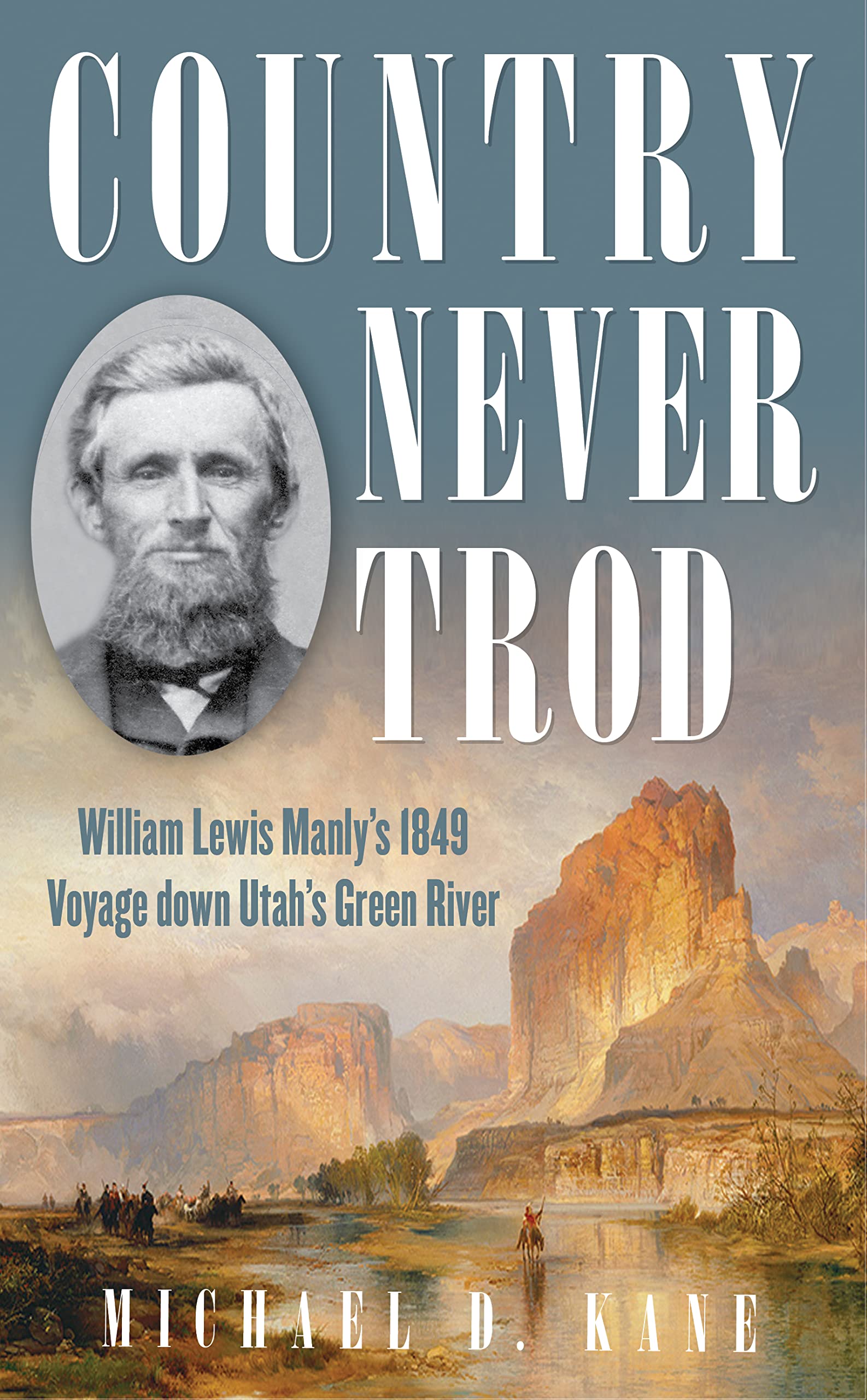
Country Never Trod: William Lewis Manly's 1849 Voyage down Utah's Green River
$16.21
by Michael D. Kane



William Lewis Manly was a forty-niner, explorer, and humanitarian whose story most people have never heard. Born in Vermont, William Lewis Manly was drawn out west by the lure of gold. Previous scholarship claims that the Yankee frontiersman floated only 290 miles down the Green River to the Uinta Basin, but author Michael D. Kane’s research of primary source materials led him to the conclusion that Manly actually traveled 415 miles, all the way to what is now Green River, Utah. This would make Manly the first to explore much of the Green River by boat—twenty years before John Wesley Powell’s famous expedition. Determined to prove his theory and establish Manly’s legacy as a trailblazer, Kane conducted research and then built his own wooden canoes and made the trip, tracing Manly’s footsteps and comparing notes with the earlier traveler. Country Never Trod follows Manly’s little-known expedition down the Green River and his overland trek through some of the most desolate stretches of Utah, interspersed with Kane’s journal entries and photographs documenting his own trip. William Lewis Manly is best known for his book, Death Valley in ’49, a travel narrative about his trek to California in 1849. At one point, Manly chose to ride the Green River from Wyoming to its junction with the Colorado River, and then planned to navigate the Colorado as far as possible before debarking and finishing up in California. Fortunately, when his buffeted adventurers reached the Green River Crossing, just short of the Colorado, he encountered a band of Western Ute traders led by the well known raider and trader, Chief Wákara. The meeting was fortuitous, for the trail-wise chief was well versed in the territory and the trail to California. His advice to not continue down the river, but to take the better-known Spanish Trail the rest of the way, may well have saved Manly’s life and the lives of all his companions. Manly’s travel narrative has given us an invaluable record of the early West. But also important is his positive description of the often enigmatic, sometimes vacillating, and too often maligned, Wákara. But Manly describes a man who was reasonable and helpful, and who chose to go out of his way to help and guide the American travelers when they were clearly headed for trouble. Michael Kane’s book also provides a deeper look at William Lewis Manly, the man, and the context from which he arose. Kane describes the events and attitudes that shaped Manly’s attitudes and outlooks on life, and which led him to be among the vanguard heading to California. It is also an additional glimpse into the nature of the many early adventurers who risked all to get to California … or those other beckoning Utopias of the West—Oregon, or Taos, or the fur-bonanza of the Rocky Mountains. -- Sondra Jones, historian and author of Being and Becoming Ute (University of Utah Press, 2019), winner of the Utah State History Society's best book award Michael D. Kane received a PhD in parks, recreation, and tourism from the University of Utah. He has been owner and operator of a professional river-running company in Jackson Hole, general manager at Zion Ponderosa Ranch Resort in southern Utah, and a university instructor. He lives in West Jordan, Utah.