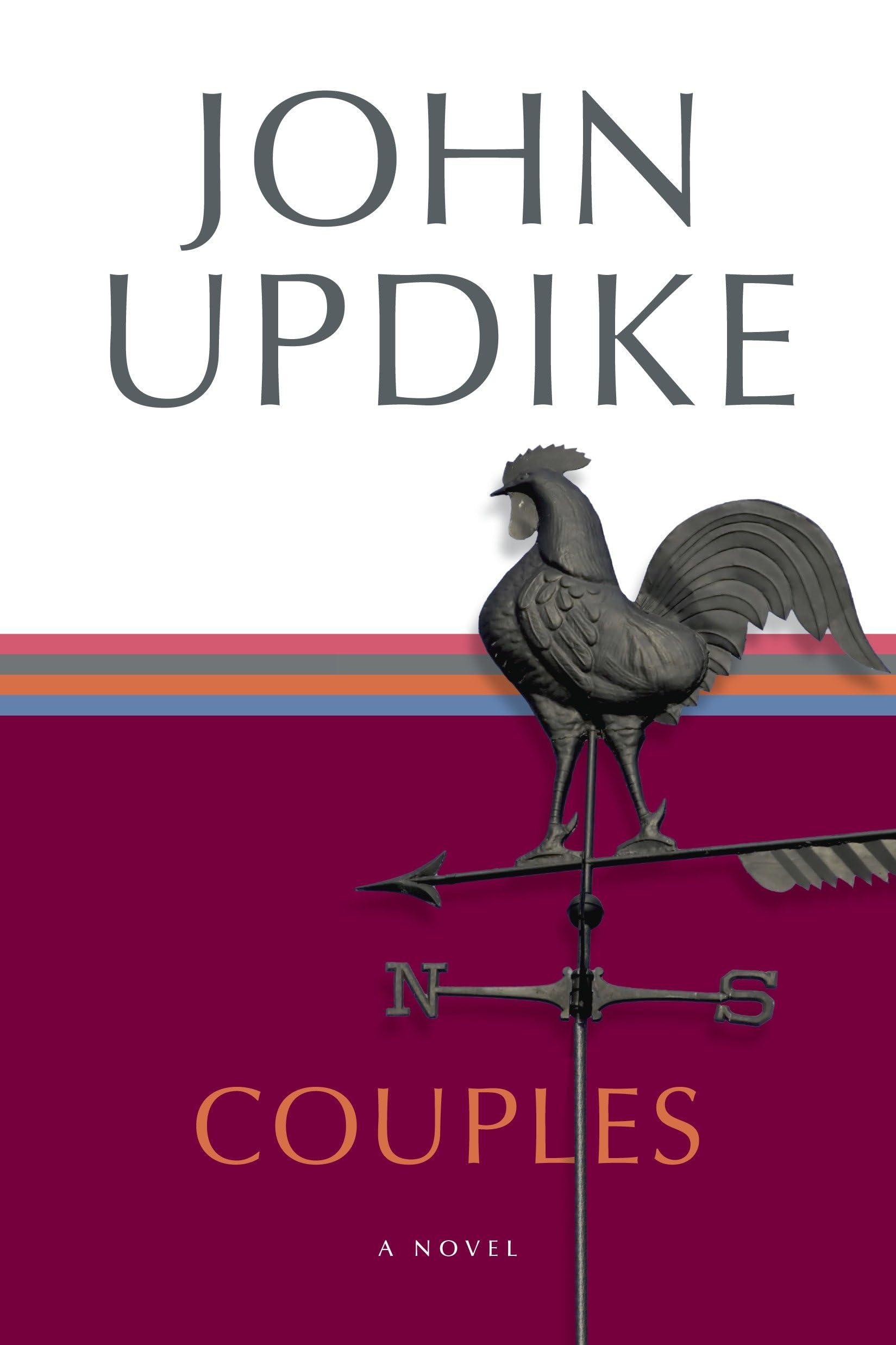



“Trapped in their cozy catacombs, the couples have made sex by turns their toy, their glue, their trauma, their therapy, their hope, their frustration, their revenge, their narcotic, their main line of communication and their sole and pitiable shield against the awareness of death.”— Time One of The Atlantic ’s Great American Novels of the Past 100 Years One of the signature novels of the American 1960s, Couples is a book that, when it debuted, scandalized the public with prose pictures of the way people live, and that today provides an engrossing epitaph to the short, happy life of the “post-Pill paradise.” It chronicles the interactions of ten young married couples in a seaside New England community who make a cult of sex and of themselves. The group of acquaintances form a magical circle, complete with ritualistic games, religious substitutions, a priest (Freddy Thorne), and a scapegoat (Piet Hanema). As with most American utopias, this one’s existence is brief and unsustainable, but the “imaginative quest” that inspires its creation is eternal. Praise for Couples “ Couples [is] John Updike’s tour de force of extramarital wanderlust.” —The New York Times Book Review “Ingenious . . . If this is a dirty book, I don’t see how sex can be written about at all.” —Wilfrid Sheed, The New York Times Book Review “ Couples [is] John Updike’s tour de force of extramarital wanderlust.” —The New York Times Book Review “Trapped in their cozy catacombs, the couples have made sex by turns their toy, their glue, their trauma, their therapy, their hope, their frustration, their revenge, their narcotic, their main line of communication and their sole and pitiable shield against the awareness of death.” — Time “Ingenious . . . If this is a dirty book, I don’t see how sex can be written about at all.” —Wilfrid Sheed, The New York Times Book Review Couples is the book that has been assailed for its complete frankness and praised as an artful, seductive, savagely graphic portrait of love, marriage, and adultery in America. But be it damned or hailed, Couples drew back the curtain forever on sex in suburbia in the late twentieth century. A classic, it is one of those books that will be read -- and remembered -- for a long time to come. John Updike was born in Shillington, Pennsylvania, in 1932. He graduated from Harvard College in 1954 and spent a year in Oxford, England, at the Ruskin School of Drawing and Fine Art. From 1955 to 1957 he was a member of the staff of The New Yorker . His novels have won the Pulitzer Prize, the National Book Award, the National Book Critics Circle Award, the Rosenthal Foundation Award, and the William Dean Howells Medal. In 2007 he received the Gold Medal for Fiction from the American Academy of Arts and Letters. John Updike died in January 2009. I. WELCOME TO TARBOX “WHAT did you make of the new couple?” The Hanemas, Piet and Angela, were undressing. Their bedchamber was a low-ceilinged colonial room whose woodwork was painted the shade of off-white commercially called eggshell. A spring midnight pressed on the cold windows. “Oh,” Angela answered vaguely, “they seemed young.” She was a fair soft brown-haired woman, thirty-four, going heavy in her haunches and waist yet with a girl’s fine hard ankles and a girl’s tentative questing way of moving, as if the pure air were loosely packed with obstructing cloths. Age had touched only the softened line of her jaw and her hands, their stringy backs and reddened fingertips. “How young, exactly?” “Oh, I don’t know. He’s thirty trying to be forty. She’s younger. Twenty-eight? Twenty-nine? Are you thinking of taking a census?” He grudgingly laughed. Piet had red hair and a close-set body; no taller than Angela, he was denser. His flattish Dutch features, inherited, were pricked from underneath by an acquired American something—a guilty humorous greed, a wordless question. His wife’s languid unexpectedness, a diffident freshness born of aristocratic self-possession, still fascinated him. He thought of himself as coarse and saw her as fine, so fair and fine her every gesture seemed transparently informed by a graciousness and honesty beyond him. When he had met her, Angela Hamilton, she had been a young woman past first bloom, her radiance growing lazy, with an affecting slow mannerism of looking away, the side of her neck bared, an inexplicably unscarred beauty playing at schoolteaching and living with her parents in Nun’s Bay, and he had been laboring for her father, in partnership with an army friend, one of their first jobs, constructing a pergola in view of the ocean and the great chocolate-dark rock that suggested, from a slightly other angle, a female profile and the folds of a wimple. There had been a cliff, an ample green lawn, and bushes trimmed to the flatness of tables. In the house there had been many clocks, grandfather’s and ship’s clocks, clocks finished in ormolu or black lacquer,