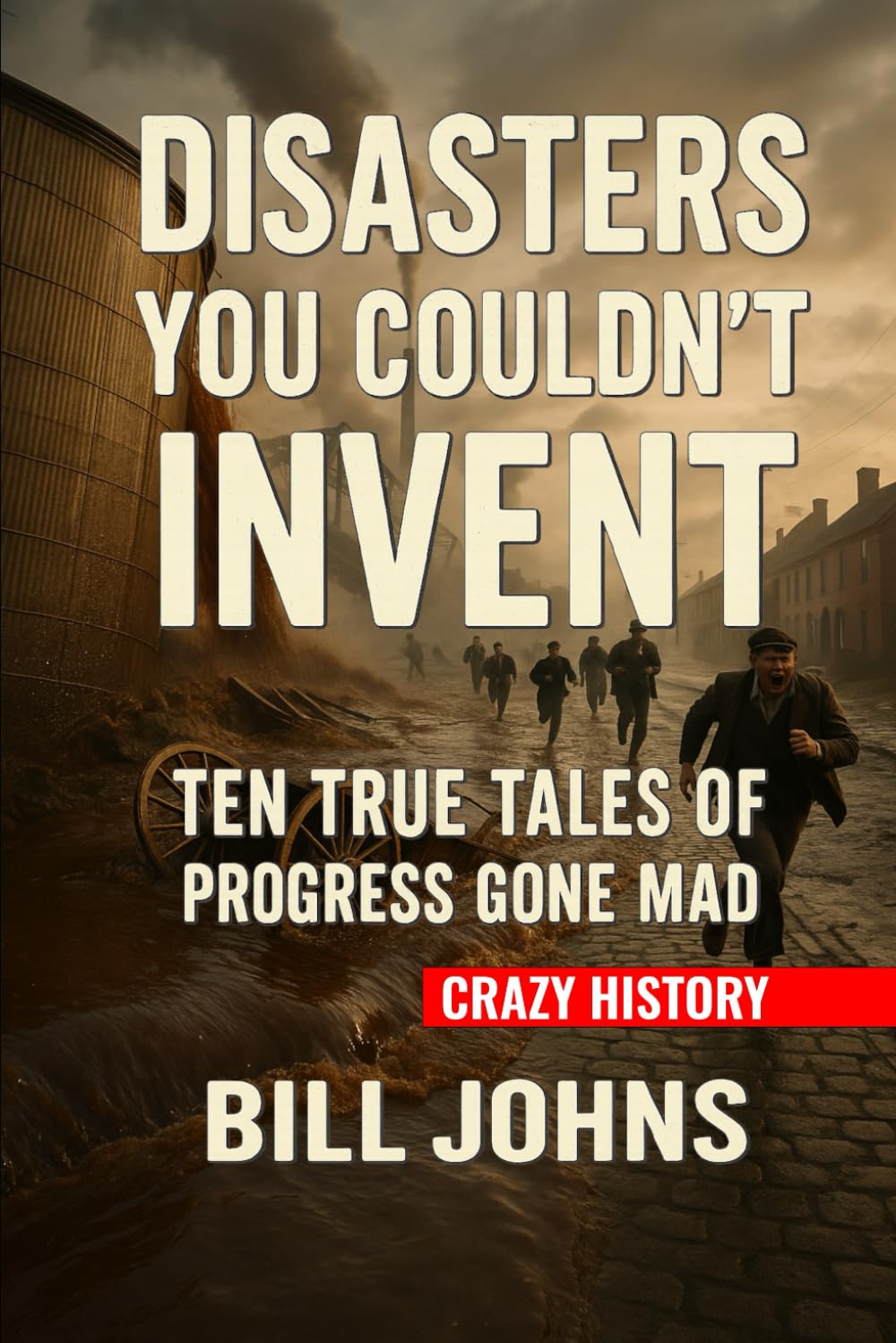
Crazy History - Disasters You Couldn’t Invent: Ten True Tales of Progress Gone Mad
$19.99
by Bill Johns



The world’s greatest disasters weren’t accidents—they were blueprints of human ambition pushed one weld too far. Crazy History: Disasters You Couldn’t Invent is a haunting, vivid journey through the moments when progress turned against its makers, when brilliance met physics, and when civilization’s most extraordinary ideas collapsed under their own perfection. From the Great Molasses Flood of 1919 to the Tacoma Narrows Bridge, from Chernobyl’s ghostly silence to the digital breaches of the present, this book uncovers how each failure reshaped our faith in mastery, safety, and control. Blending narrative history, cultural analysis, and forensic detail, Bill Johns traces how technology’s promise repeatedly exceeds its comprehension. His voice moves through shipyards, control rooms, and courtrooms, unearthing the same equation across centuries: invention, confidence, and consequence. Each disaster in these pages—industrial, architectural, environmental, or informational—reveals a civilization speaking through its wreckage. These are not merely explosions, implosions, or collapses; they are moral events, where design meets denial and brilliance becomes its own undoing. Readers of Erik Larson, John McPhee, and Henry Petroski will recognize the narrative precision that turns technical failure into human story. Johns writes not to sensationalize catastrophe, but to show how it builds us. Every modern safety code, every environmental law, every redundant circuit, exists because of what was lost first. In his hands, disaster becomes a map of learning, and history a laboratory of consequence. The book follows the architecture of risk from the Industrial Revolution to the digital frontier: the sugar tank that dissolved a city street, the bridge that danced itself apart, the reactor that became a symbol of invisible contagion, the data systems that leak identity faster than nations can regulate them. Each story unfolds with the same quiet inevitability, reminding us that failure is not an interruption of civilization but its continuation. We improve not in spite of our errors, but through them. Johns draws on engineering archives, eyewitness accounts, and the psychology of innovation to reveal how civilization builds toward its own corrections. His analysis stretches beyond mechanics to the deeper ethics of design—the cultural blindness that accompanies progress, the bureaucratic faith that paperwork is protection, the modern comfort of knowing risk only after it has been priced. What emerges is a portrait of human ingenuity not as arrogance, but as persistence: a species that learns by cleaning up after itself. Crazy History: Disasters You Couldn’t Invent is literary nonfiction in its truest sense—factual, lyrical, and unflinching. It captures the fragile poetry of progress, the tragic intelligence of collapse, and the way memory itself becomes a form of architecture. By revisiting the moments when the world’s confidence cracked, Johns invites readers to see not only how things fall, but why they endure. In the end, this is a history of consequence and repair—a chronicle of molasses, fire, radiation, and data, all leaking from the same human vessel. It asks its readers to remember that every seal, every circuit, every safeguard carries a story. The invitation is not to fear failure, but to listen to it: to trace the line where innovation ends and understanding begins, and to recognize, in the quiet after each collapse, the sound of civilization beginning again.