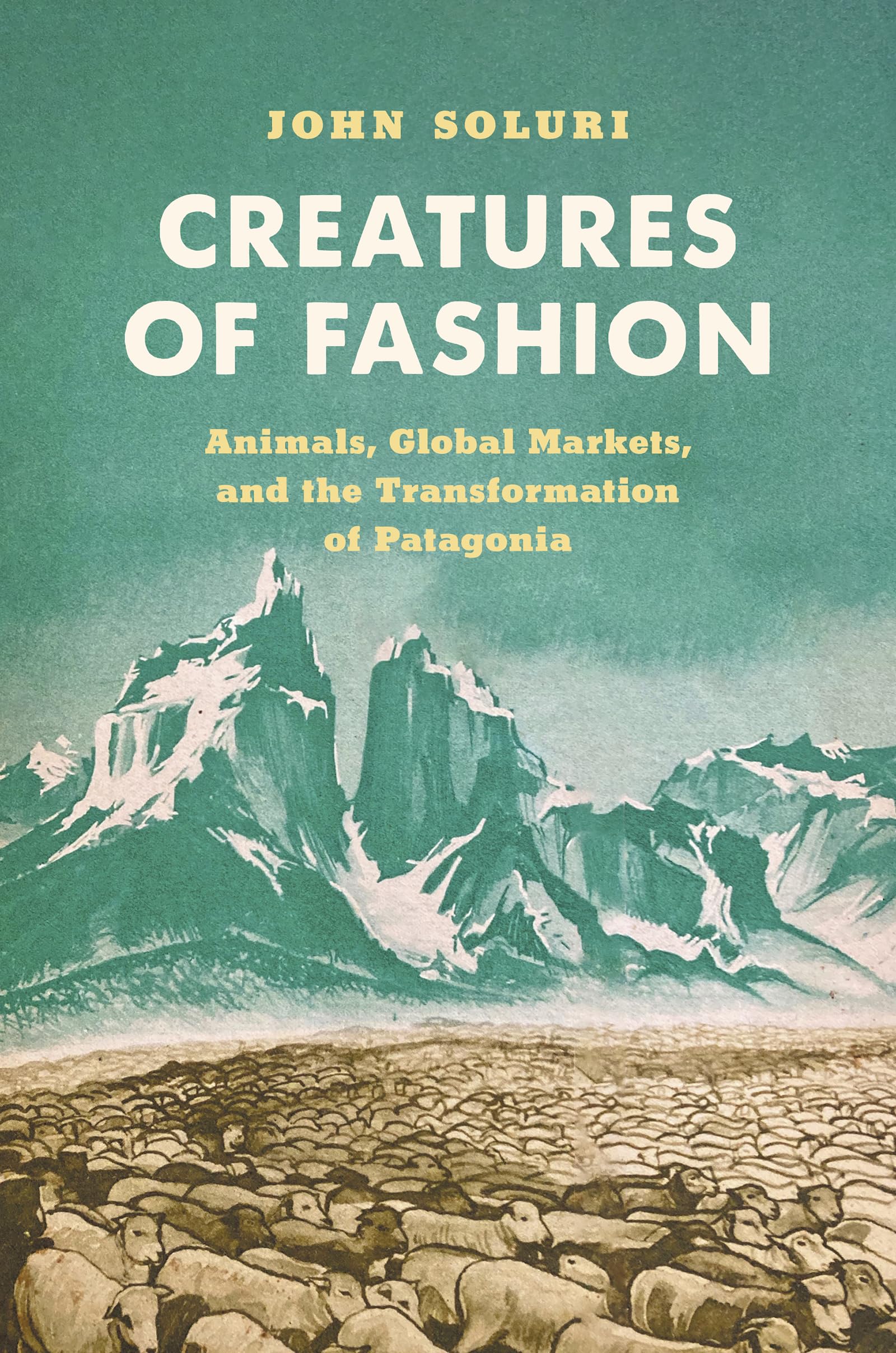
Creatures of Fashion: Animals, Global Markets, and the Transformation of Patagonia (Flows, Migrations, and Exchanges)
$27.95
by John Soluri



Today, the mention of Patagonia and Tierra del Fuego conjures images of idyllic landscapes untouched by globalization. Creatures of Fashion upends this, revealing how the exploitation of animals—terrestrial and marine, domesticated and wild, living and dead—was central to the region’s transformation from Indigenous lands into the national territories of Argentina and Chile. Drawing on evidence from archives and digital repositories, John Soluri traces the circulation of furs and fibers to explore how the power of fashion stretched far beyond Europe’s houses of haute couture to entangle the fates of Indigenous hunters, migrant workers, and textile manufacturers with those of fur seals, guanacos, and sheep at the “end of the world.” From the nineteenth-century rise of commercial hunting to twentieth-century sheep ranching to contemporary conservation-based tourism, Soluri’s narrative explains how struggles for control over the production of commodities and the reproduction of animals drove the social and environmental changes that tied Patagonia to global markets, empires, and wildlife conservation movements. By exposing seams in national territories and global markets knit together by force, this book provides perspectives and analyses vital for understanding contemporary conflicts over mass consumption, the conservation of biodiversity, and struggles for environmental justice in Patagonia and beyond. “A clear yet detailed history of interactions between animals, humans, and the global markets they create together. . . . [I]t is refreshing to read Soluri’s nuanced study of Patagonia, where relationships between humans and animals rose, fell, and changed, often creating new conditions and interactions in unpredictable ways. . . . The fact that this book analyzes so many themes in what is a surprisingly clear, readable, and efficiently written style is commendable. . . . [A] valuable tool for teaching at any level in Latin American history, animal studies, environmental history, and commodity and economic history.”— The Americas “A vibrant story. . . . Soluri weaves a complex narrative. . . . Written with elegance, Creatures of Fashion combines detailed regional descriptions with a clear connection to global forces, all within a relatively concise text. This makes it an excellent choice for both specialists and general readers across educational levels. Those exploring Latin American history, environmental studies, and transnational methods will find the book particularly compelling.”— Journal of Social History “Soluri’s unusual and interesting history of the region . . . is a lively and well informed contribution to a category of scholarship broadly referred to as Animal Studies, which positions these subjects in academic disciplines that extend well beyond departments of zoology—from environmental history to anthropology and geography—and in which Latin America is rapidly gaining prominence.”— Latin American Review of Books “This monograph . . . prompts numerous questions for reflection. . . . In doing so, Creatures of Fashion also invites conversations around time, space, and distance, and how these intersect with the environment. Certainly, this is a book that will animate future research.”— Journal of Latin American Geography “Soluri offers an in-depth study that shakes up the foundations of the historiography of the colonization process in Southern Patagonia and Tierra del Fuego.”— A Contracorriente “ Creatures of Fashion dispels [any] romantic view [of Patagonia], showing, on the contrary, how the southern tip of South America has been enmeshed in global commodity chains since the late eighteenth century. . . . [A]n engaging retelling of Patagonia’s history that offers important insights into the global impacts of animal commodification.”— H-Environment “A history of animals and fashion that has it all—from seals to sheep and desire to power. This is a stunning read.”—Bathsheba Demuth, Brown University “Soluri expertly interweaves histories of Indigenous displacement, settler colonialism, global migration, and commodity production in this sober account; it is a stellar model of environmental history and animal studies.”—Sharika Crawford, United States Naval Academy “ Creatures of Fashion is a subtle, lucid, and imaginative recasting of the environmental dynamics of global capitalist expansion with animals at its center.”—Mark Healey, University of Connecticut “ Creatures of Fashion is a subtle, lucid, and imaginative recasting of the environmental dynamics of global capitalist expansion with animals at its center.”—Mark Healey, University of Connecticut A revelatory history of the commodification of animals. John Soluri is associate professor of history at Carnegie Mellon University.