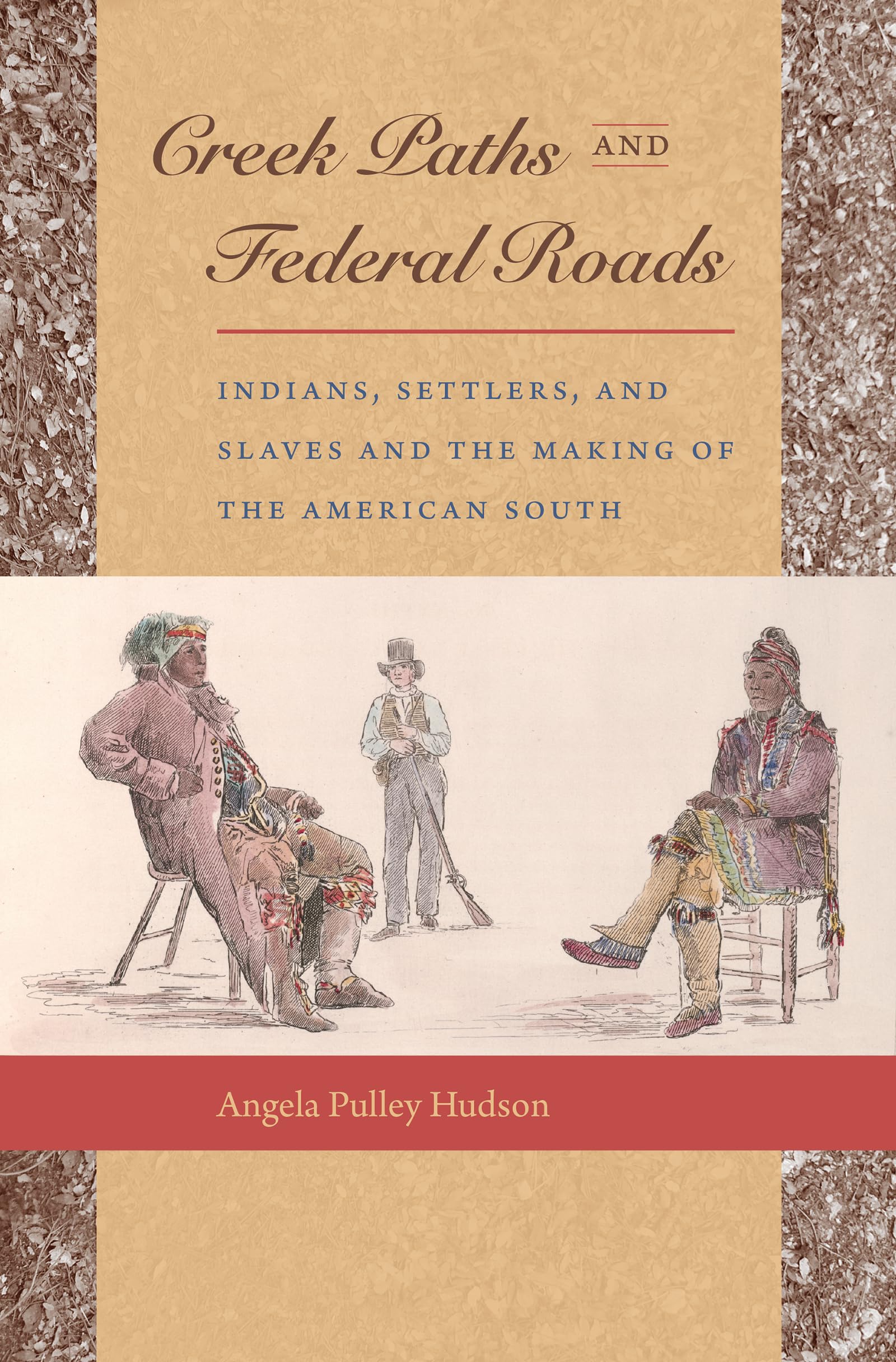
Creek Paths and Federal Roads: Indians, Settlers, and Slaves and the Making of the American South
$35.00
by Angela Pulley Hudson



In Creek Paths and Federal Roads , Angela Pulley Hudson offers a new understanding of the development of the American South by examining travel within and between southeastern Indian nations and the southern states, from the founding of the United States until the forced removal of southeastern Indians in the 1830s. During the early national period, Hudson explains, settlers and slaves made their way along Indian trading paths and federal post roads, deep into the heart of the Creek Indians' world. Hudson focuses particularly on the creation and mapping of boundaries between Creek Indian lands and the states that grew up around them; the development of roads, canals, and other internal improvements within these territories; and the ways that Indians, settlers, and slaves understood, contested, and collaborated on these boundaries and transit networks. While she chronicles the experiences of these travelers — Native, newcomer, free, and enslaved — who encountered one another on the roads of Creek country, Hudson also places indigenous perspectives squarely at the center of southern history, shedding new light on the contingent emergence of the American South. “Gracefully written and carefully argued, [ Creek Paths and Federal Roads ] deserves the attention of all scholars of Native America and the early American frontier.” — Journal of American History “Both informs and raises more questions. Recommended” — CHOICE “This is a sound, well-written, and important work that tells the story of Indians in the South and reveals the complexity and interrelatedness of American history.” — The North Carolina Historical Review “A logically argued and well-supported work….Of the numerous recent works on the Creeks, none considers the significance of mobility and roadways in a similar manner giving Hudson a truly unique perspective….Intersecting several rarely connected topics, Creek Paths and Federal Roads should have a broad appeal.” — Florida Historical Quarterly “In this groundbreaking study, which will attract the interest of historians in the fields of ethnohistory as well as southern history, and which is easily accessible to casual readers interested in Indian removal, Creek Paths and Federal Roads represents a major contribution to our understanding of the pathways, both figurative and literal, of United States expansion into the New South.” — The Alabama Review “Provides a more complete understanding of the development of the antebellum South.” — Journal of East Tennessee History “[Hudson’s] ventures into new realms of research and analysis will be greatly appreciated by scholars examining the transformation of the Native South into the Old South.” — Georgia Historical Quarterly “In a vivid exploration of old and new routes through Creek Indian country, Hudson sheds new light on contested meanings of territory and mobility in the early South. Brought closer than ever to political negotiation and conflict over travel as well as to cross-cultural interaction along roads, the reader discovers that internal improvement, expansion of slavery, Indian dispossession, and southern political separatism — subjects usually treated separately — were in fact intimately connected to each other.” — Daniel H. Usner Jr., Vanderbilt University Uses travel as a lens to observe the Creek world turning into the Old South Hudson examines travel within and between southeastern Indian nations and the southern states from the founding of the United States until the forced removal of southeastern Indians in the 1830s. She focuses particularly on the creation and mapping of boundaries between Creek Indian lands and the states that grew up around them the development of roads, canals, and other internal improvements within these territories and the ways that Indians, settlers, and slaves understood, contested, and collaborated on these boundaries and transit networks. Angela Pulley Hudson is assistant professor of history at Texas A&M University.