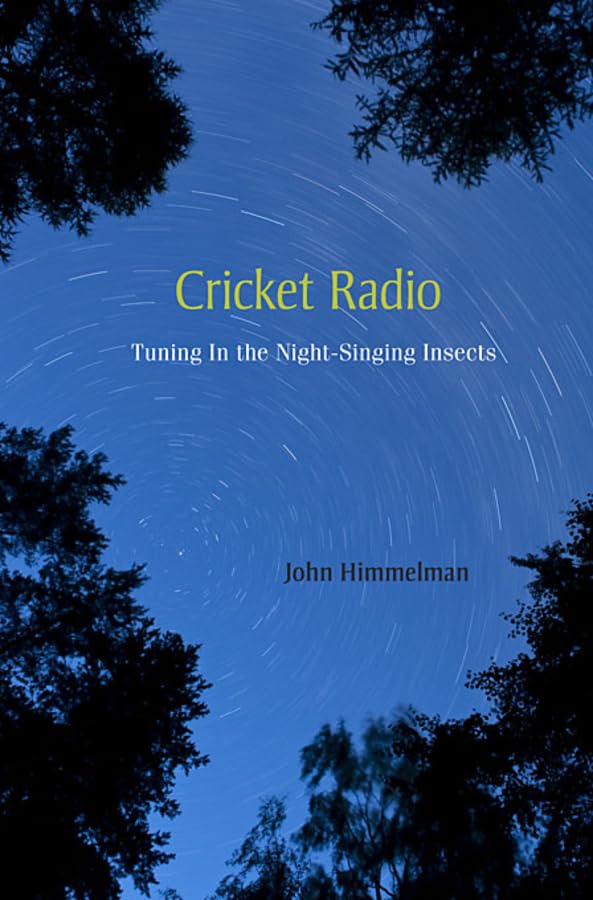



At a time when night-singing insects have slipped beyond our notice―indeed, are more likely to be heard as NatureSounds than in a backyard―John Himmelman seeks to reconnect us to creatures whose songs form a part of our own natural history. On warm summer evenings, night-singing insects produce a whirring, chirping soundscape―a calming aural tapestry celebrated by poets and naturalists for millennia. But “cricket radio” is not broadcast for the easy-listening pleasure of humans. The nocturnal songs of insects are lures and warnings, full of risks and rewards for these tiny competitive performers. What moves crickets and katydids to sing, how they produce their distinctive sounds, how they hear the songs of others, and how they vary cadence, volume, and pitch to attract potential mates, warn off competitors, and evade predators is part of the engaging story Cricket Radio tells. Himmelman’s narrative weaves together his personal experiences as an amateur naturalist in search of crickets and katydids with the stories of scientists who study these insects professionally. He also offers instructions for bringing a few of the little singers into our homes and gardens. We can, Himmelman suggests, be reawakened to these night songs that have meant so much to the human psyche. The online insect calls that accompany this colorfully illustrated narrative provide a bridge of sound to our past and to our vital connection with other species. “ Cricket Radio is beautifully written, and it deeply impressed even a hardened, grizzled cricketeer like me. I hope and believe that this book will find its way to not only entomologists and parents of budding entomologists everywhere, but also to the bookshelves of the birders of the world―who would have their eyes and ears opened to another major group of nature's singers.” ― Ronald R. Hoy, Professor of Neurobiology and Behavior, Cornell University “I could literally feel the obsession of John Himmelman for these animals, and it is contagious. This wonderful, engaging book brings us up close, in terms of the sensual, intellectual, and historical aspects of night-singing insects and the people who love and study them. Cricket Radio provides many points of contact and will open up a new window to the natural world that is available to almost everyone, everywhere. This book is a real treat.” ― Bernd Heinrich, author of The Nesting Season “In this ear-opening book, John Himmelman shows us not only how to identify the songs these insects have sung for 250 million years but what those songs mean and how they are made...He writes about the effect of these songs on human dreams; about the Ensifera (the night-singers: crickets, katydids and the like) and how the sounds they make stimulate the human brain...We humans have shut down our listening skills to survive in a confusingly noisy world. Learning to listen to these songs is nothing less than soul-stirring.” ― Susan Salter Reynolds , Los Angeles Times “[An] engaging, knowledgeable portrait of "night-singing insects."... Cricket Radio is filled with stories of collecting trips in which the author finds previously unseen animals or identifies a species far outside its known range. In these moments, Himmelman's enchantment with the entomological soundscape is so complete that he can turn the most unpromising site--his Connecticut backyard, for example--into an insect lover's terra incognita, shimmering with possibility.” ― Hugh Raffles , Wall Street Journal “At a time when night-singing insects have slipped beyond our notice--indeed, are more likely to be heard as previously-recorded NatureSounds than in a backyard--John Himmelman seeks to reconnect us to creatures whose songs form a part of our own natural history. On warm summer evenings, night-singing insects produce a whirring, chirping soundscape--a calming aural tapestry celebrated by poets and naturalists for millennia. But "cricket radio" is not broadcast for the easy-listening pleasure of humans. The nocturnal songs of insects are lures and warnings, full of risks and rewards for these tiny competitive performers. What moves crickets and katydids to sing, how they produce their distinctive sounds, how they hear the songs of others, and how they vary cadence, volume, and pitch to attract potential mates, warn off competitors, and evade predators is part of the engaging story Cricket Radio tells. Himmelman's narrative weaves together his personal experiences as an amateur naturalist in search of crickets and katydids with the stories of scientists who study these insects professionally. He also offers instructions for bringing a few of the little singers into our homes and gardens. We can, Himmelman suggests, be reawakened to these night songs that have meant so much to the human psyche. The online insect calls that accompany this colorfully illustrated narrative provide a bridge of sound to our past and to our vital connection with other species. If you enjoy ni