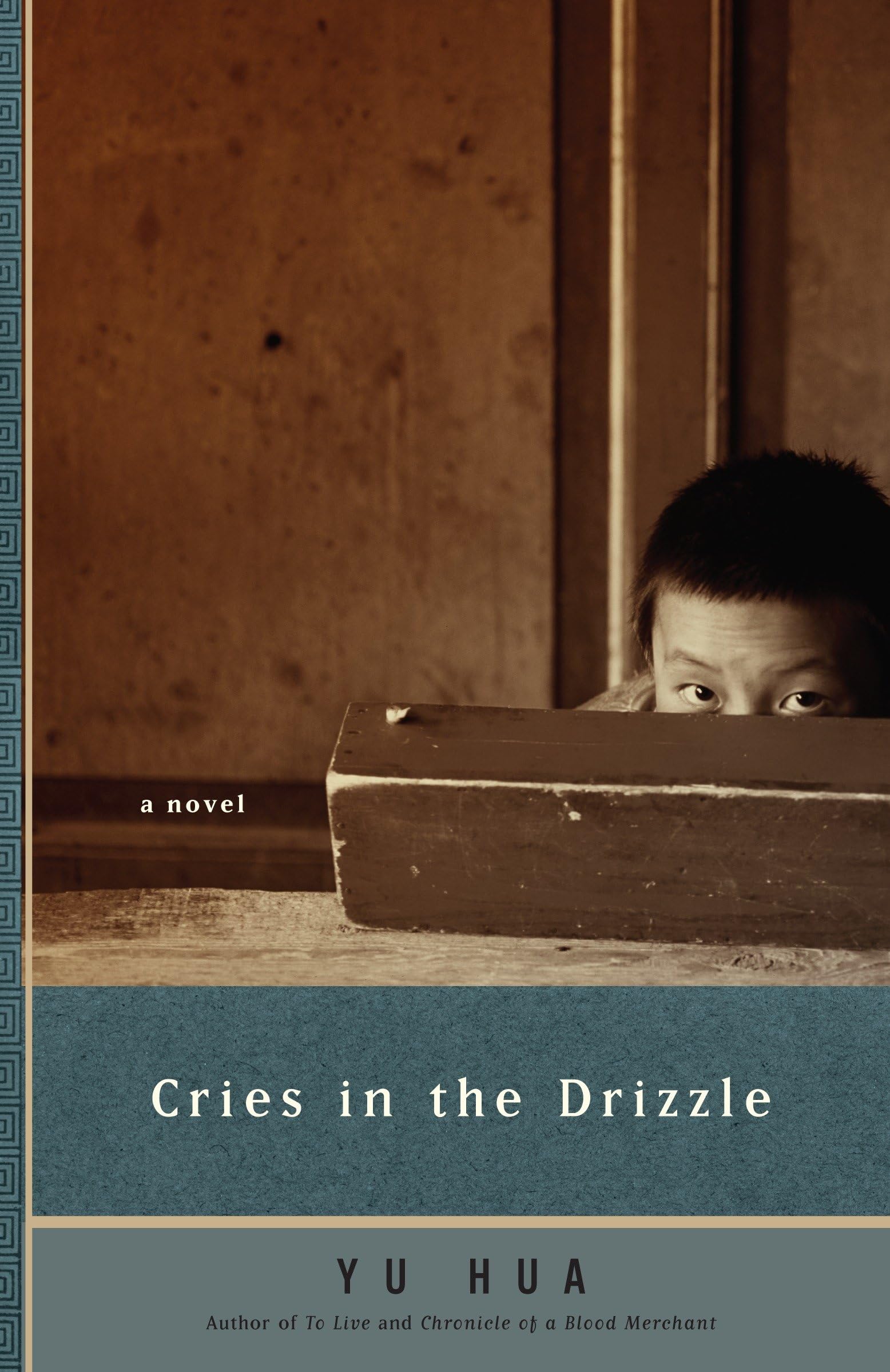



Yu Hua’s beautiful, heartbreaking novel Cries in the Drizzle follows a young Chinese boy throughout his childhood and adolescence during the reign of Chairman Mao. The middle son of three, Sun Guanglin is constantly neglected ignored by his parents and his younger and older brother. Sent away at age six to live with another family, he returns to his parents’ house six years later on the same night that their home burns to the ground, making him even more a black sheep. Yet Sun Guanglin’s status as an outcast, both at home and in his village, places him in a unique position to observe the changing nature of Chinese society, as social dynamics — and his very own family — are changed forever under Communist rule. With its moving, thoughtful prose, Cries in the Drizzle is a stunning addition to the wide-ranging work of one of China’s most distinguished contemporary writers. Praise for Yu Hua’s Chronicle of a Blood Merchant “Immensely moving. . . . Artfully constructed, beautifully written, and stealthily consuming–it repeatedly stops you in your tracks.” — The Boston Globe “Epic. . . . Offers unforgettable images of cruelty and kindness.” — The Washington Post Book World “Vital and electric. . . . Shows the persistence of human sensibility in the face of totalitarian logic.” — Slate YU HUA was born in 1960 in Zhejiang, China. He finished high school during the Cultural Revolution and worked as a dentist for five years before beginning to write in 1983. He has published four novels, six collections of stories, and three collections of essays. His work has been translated into French, German, Italian, Dutch, Spanish, Japanese, and Korean. In 2002 Yu Hua became the first Chinese writer to win the prestigious James Joyce Foundation Award. His novel To Live was awarded Italy's Premio Grinzane Cavour in 1998, and To Live and Chronicle of a Blood Merchant were named two of the last decade's ten most influential books in China. Yu Hua lives in Beijing. Allan H. Barr is the translator of a collection of short stories by Yu Hua, and his research on Ming and Qing literature has been published both in the West and in China. He is Professor of Chinese at Pomona College. Chapter 1 SOUTHGATE It was in 1965 that nighttime began to stir in me a nameless dread. I am thinking now of that evening when a light rain drifted down. In my bed I lay, a child so little you could have set me there as easily as a toy. The dripping from the eaves simply called attention to the silence that surrounded me, and the steady onset of sleep was but a gradual forgetting of the rain's patter. As I glided peacefully into slumber, it was as though a secluded path had appeared before me, opening a passage between trees and shrubs. Then from far away there came the sound of a woman's anguished wails. When those hoarse cries erupted so suddenly in the still of the night, the boy that I was then shivered and quaked. I can see myself now, a startled child, eyes wide with fear, the precise outline of my face obscured by the darkness. The woman's cries persisted. Anxiously, I expected to hear another voice, a voice that would respond to her wails, that could assuage her grief, but it never materialized. I realize now why I was gripped by such intense disquiet: it was because I waited in vain for that answering voice. Surely there is nothing more chilling than the sound of inconsolable cries on such a desolate night. A second memory comes hot on the heels of the first: three or four white lambs trotting across the grass by the riverside, a daytime image, a way of easing the agitation evoked by the previous memory. But I find it hard to decide just where I was when this sight left its mark on me. Several days may have passed before I seemed to hear a voice that answered the woman's cries. It was late afternoon. A storm had just passed, and dark clouds filled the sky like billows of smoke. I was sitting by the pond behind the house, and out of the damp landscape a man I did not recognize walked toward me. He was dressed completely in black and as he approached his dark clothes waved like a banner under the gloomy sky. When this image began to close in on me it brought to mind the unmistakable sound of the woman's cry. Even from far off in the distance the stranger fixed me with a piercing gaze, and he continued to stare at me as he drew nearer. Just as I was about to panic, he abruptly changed direction, mounted the path on the edge of the field, and gradually moved farther and farther away, his loose black clothes flapping loudly in the breeze. Now, when I look back on the past from an adult point of view, I always linger long on this particular moment, puzzling over why it was that I interpreted the rustling of his clothes as a response to the woman's cries in the evening drizzle. Then there is a morning I remember, a crystal-clear morning when I was scampering along behind some village boys, over soft earth and windblown grasses