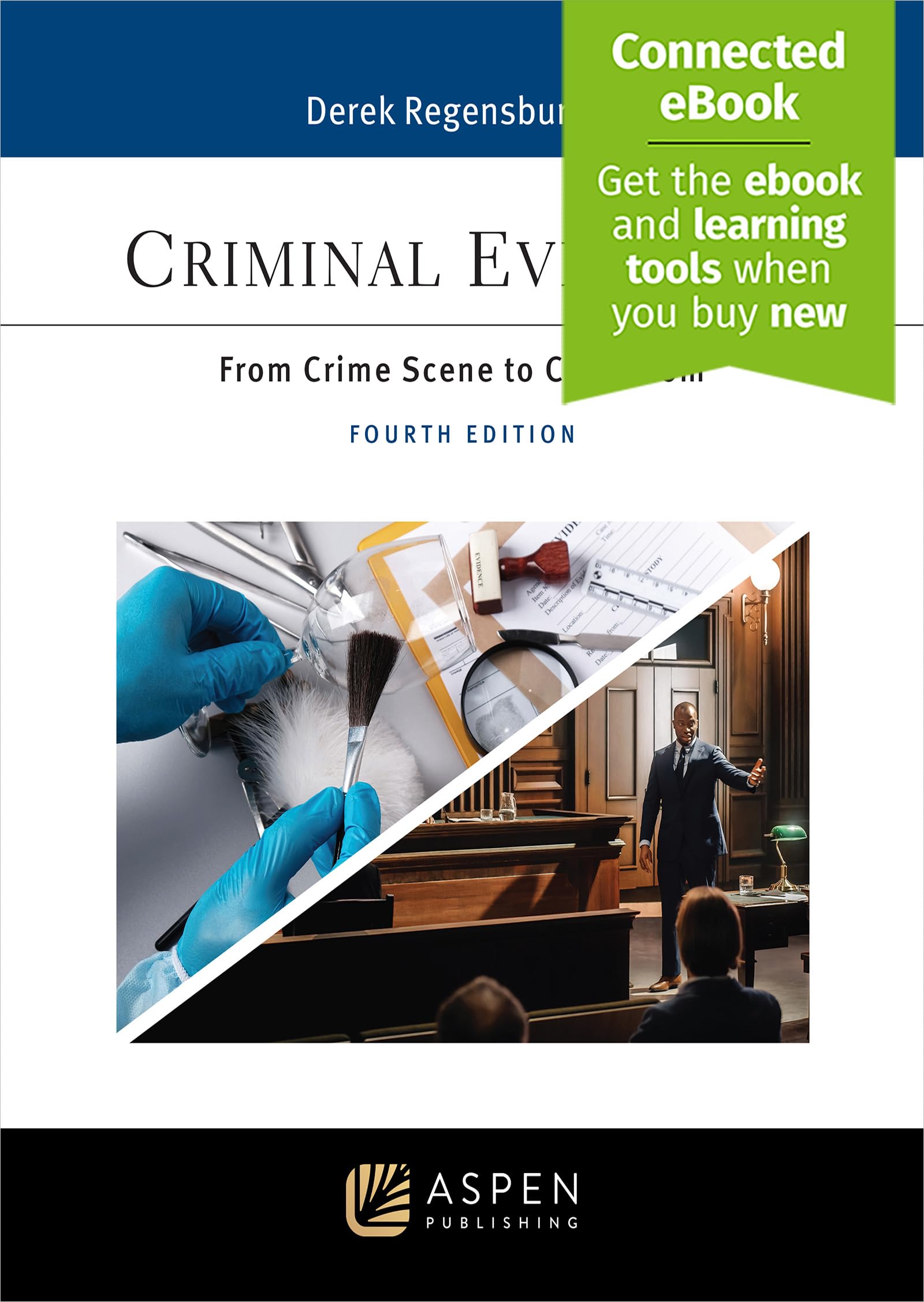
Criminal Evidence: From Crime Scene to Courtroom Connected Ebook (Aspen Criminal Justice)
$189.95
by Derek Regensburger



Buy a new version of this textbook and receive access to the Connected eBook on Casebook Connect, including lifetime access to the online ebook with highlight, annotation, and search capabilities. Access also includes an outline tool and other helpful resources . Connected eBooks provide what you need most to be successful in your law school classes. Derek Regensburger’s Criminal Evidence: From Crime Scene to Courtroom , 4th ed., is a comprehensive guide to criminal evidence from its collection to admission at trial, including topics such as burden of proof, admissibility, and expert witness testimony, that is intended for use in criminal justice courses, mock trial clubs, and attorneys’ offices. Criminal Evidence follows the path of evidence From Crime Scene to Courtroom. Focusing on the Federal Rules of Evidence and their state counterparts, Derek Regensburger offers a clear introduction to the principles of evidence and instructions for collecting, preserving, and presenting evidence in a criminal case. The book surveys the major concepts of evidence law such as relevance and burden of proof, discovery, admission of expert witness testimony, impeachment of witnesses, character evidence, hearsay, authentication of physical evidence, and more. Actual trials and news excerpts bring the material to life as they illustrate the role of evidence in real and recent cases. For professors, there are supplemental materials, including videos of mock trial scenes, to reinforce students’ understanding of key concepts. New to the Fourth Edition: Updated Evidence in Action articles on recent cases in the news such as those of Alec Baldwin and Luigi Mangione - 2023 and 2024 amendments to the Rules of Evidence - Simplified explanations and condensed coverage of topics - New and updated sections on digital evidence collection and authentication issues, including from Deepfakes and altered images - Updated caselaw covering recent Supreme Court decisions and other illustrative cases on evidence Professors and students will benefit from: Logical organization of topics grouped by stages based on case chronology - Clear and concise explanations of concepts - Practical examples of how evidence topics are applied in the field - Evidence in Action articles about diverse evidence topics and how they relate to noteworthy cases in the news - Review questions that test students’ knowledge of the topics and require them to apply what they’ve learned