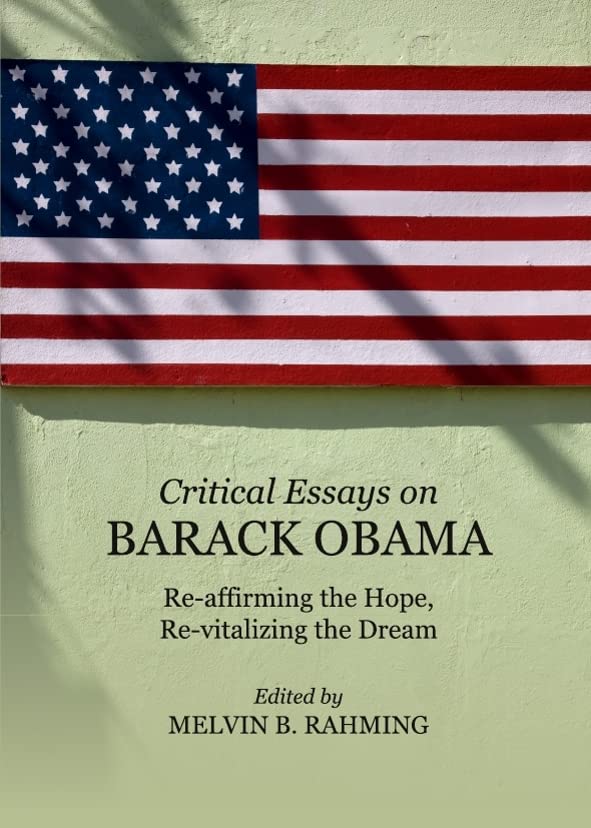
Critical Essays on Barack Obama: Re-affirming the Hope, Re-vitalizing the Dream
$17.04
by Melvin B. Rahming



This collection of critical essays explores the life and writings of President Barack Obama. The individual essays, written by a diverse body of scholars, examine specific facets of Obama’s career – from personal, communal, national and international reactions to his presidential election; to his controversial contributions to the global conversation about race; his impact on popular culture and race relations; his literary, political and philosophical visions; his attitude toward the American constitution; his enactment of new legislation; to the manner in which he attempts to influence American public policy; and to the implications his presidency holds for Europe, Africa, and the Caribbean. Ranging far beyond the presentation of personal opinions about the Obama Administration, these essays offer scholarly perspectives on Obama’s two books, and on his multidimensional efforts to remove the obstacles to equality of opportunity in the United States. They also explore Obama’s potential for re-shaping the American social and cultural terrain and, by extension, for re-vitalizing the American Dream. This book should be of interest to scholars of political science, literature, history, philosophy, religion and psycho-culture as well as to the general reading public. “The driving impulse behind the book is the desire to document and interrogate the topography of the Obama energy as it ignites the imagination of the world across race, class and generations to force into creative being a political paradigm which celebrates the beauty of the human spirit and signals the possibility of the birth of a post-racial ethos. This is an excellent collection of responses to a momentous and game-changing historical event. The book tackles issues such as the interconnectedness of Obama’s artistic and political visions, the nature of his personal, ancestral and collective narratives as he crafts his distinctive yet representational prosthetic memory; the expectation of Obama as a trigger for post-racial America where race would cease to be the normative definition of individuals and groups; and the systemic and cultural structures which must be addressed before a re-engineered post-racial America can become a reality. Some of the essays are erudite, some polemical, some reflective or data-driven and almost all witty, humorous and elegantly written. While a good number of the essays are ecstatic about the Obama victory, however, what emerges as a dominant impulse is the fact that, on the balance, he is an omen of, more than a trigger for, change.” Funso Aiyejina, PhD, Professor and Dean, Faculty of Humanities and Education The University of the West Indies, St. Augustine, Trinidad and Tobago “In this collection of essays, the authors do not shrink from the central issue of race that underlies Obama’s presidency, nor do they shrink, as the editor correctly argues, from the implicit or explicit spiritual significance that it contains. In a series of provocative chapters the diverse authors map, each in his own fashion, the outlines of certain essential issues evoked by Obama’s unexpected election. Many of the essays ably illustrate the conflicts between the widely recognized thesis of race as a social construction versus it’s social reality; the cruel realities of creating a personal identity in a world still dominated by an essentializing discourse on race; and the crucial role of Obama as a unique paradigm in American politics – a theme, as the editor recognizes, that cannot be reduced to a purely materialist analysis. Detailed readings of historical influences such as the griot tradition in African cultures or the vatic tendencies of slave narratives help one to understand the historical, ideological and ultimately spiritual baggage that Obama brings to his historically novel role. Others are particularly useful in describing the sociological scope of the extremely complex concatenation of historical and political realities that resulted in Obama’s victory. On the whole the collection’s broad range of methodological strategies provides a welcome antidote to the mass of more narrowly pragmatic political analyses of the subject and fills in an underdeveloped area in Obama Studies Trajectory.” Dr Robert Tomlinson, Professor Emeritus Emory University, Georgia, USA, Former Acting Director of African and African American Studies Dr. Melvin B. Rahming was born in Fox Hill, Nassau, Bahamas. He is a former Hugh M. Gloster Chair of the English Department at Morehouse College, where he has been teaching African American and Caribbean literatures for the past thirty years. He is the author of The Evolution of the West Indian's Image in the Afro-American Novel and co-editor of Changing Currents: Transnational Caribbean Literary and Cultural Criticism. His essays appear in numerous professional publications.