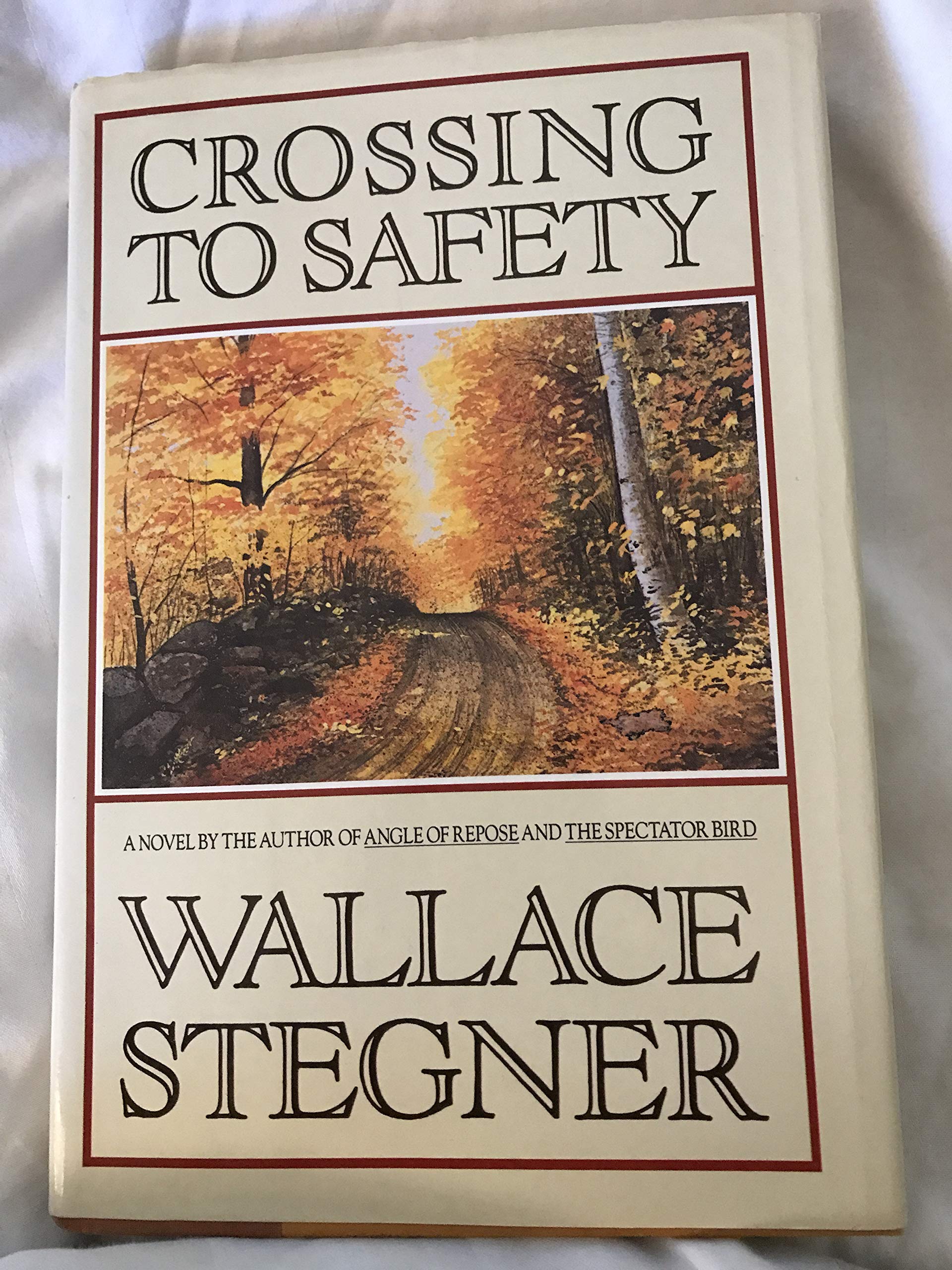



Called a “magnificently crafted story . . . brimming with wisdom” by Howard Frank Mosher in The Washington Post Book World , Crossing to Safety has, since its publication in 1987, established itself as one of the greatest and most cherished American novels of the twentieth century. Tracing the lives, loves, and aspirations of two couples who move between Vermont and Wisconsin, it is a work of quiet majesty, deep compassion, and powerful insight into the alchemy of friendship and marriage. From the Trade Paperback edition. Stegner published his first novel 50 years ago. Since then he has won both a Pulitzer Prize (for Angle of Repose, 1971) and the National Book Award (for The Spectator Bird, 1976). His latest effort, an exploration into the mysteries of friendship, deserves similar accolades. With a quiet but strong hand, he traces the bond that develops between Charity and Sid Lang and Sally and Larry Morgan from their first meeting in 1937 through their eventual separation to their final get-together in 1972 when Charity is dying of cancer and is determined "to do it right," no matter what anyone else thinks. It seems only appropriate that Charity bring them together since she has been the driving force behind the relationship. As we discover now, her bull-headedness has had its price. This is a wonderfully rich, warm, and affecting book. Highly recommended. David W. Henderson, Eckerd Coll. Lib., St. Petersburg, Fla. Copyright 1987 Reed Business Information, Inc. “A superb book. . . . Nothing in these lives is lost or wasted, suffering becomes an enriching benediction, and life itself a luminous experience.”— Doris Grumbach From the Trade Paperback edition. 220;magnificently crafted story . . . brimming with wisdom by Howard Frank Mosher in The Washington Post Book World , Crossing to Safety has, since its publication in 1987, established itself as one of the greatest and most cherished American novels of the twentieth century. Tracing the lives, loves, and aspirations of two couples who move between Vermont and Wisconsin, it is a work of quiet majesty, deep compassion, and powerful insight into the alchemy of friendship and marriage. From the Trade Paperback edition. Terry Tempest Williams is the author of Refuge: An Unnat-ural History of Family and Place; An Unspoken Hunger; Leap; and Red: Passion and Patience in the Desert . A recipient of a Guggenheim Fellowship and a Lannan Literary Fellowship in creative nonfiction, she lives in the redrock desert of southern Utah. T. H. Watkins (1936–2000) was the first Wallace Stegner Distinguished Professor of Western American Studies at Montana State University, and the author of twenty-eight books. From the Trade Paperback edition. Chapter 1 Floating upward through a confusion of dreams and memory, curving like a trout through the rings of previous risings, I surface. My eyes open. I am awake. Cataract sufferers must see like this when the bandages are removed after the operation: every detail as sharp as if seen for the first time, yet familiar too, known from before the time of blindness, the remembered and the seen coalescing as in a stereoscope. It is obviously very early. The light is no more than dusk that leaks past the edges of the blinds. But I see, or remember, or both, the uncurtained windows, the bare rafters, the board walls with nothing on them except a calendar that I think was here the last time we were, eight years ago. What used to be aggressively spartan is shabby now. Nothing has been refreshed or added since Charity and Sid turned the compound over to the children. I should feel as if I were waking up in some Ma-and-Pa motel in hard-times country, but I don’t. I have spent too many good days and nights in this cottage to be depressed by it. There is even, as my eyes make better use of the dusk and I lift my head off the pillow to look around, something marvelously reassuring about the room, a warmth even in the gloom. Associations, probably, but also color. The unfinished pine of the walls and ceilings has mellowed, over the years, to a rich honey color, as if stained by the warmth of the people who built it into a shelter for their friends. I take it as an omen; and though I remind myself why we are here, I can’t shake the sense of loved familiarity into which I just awoke. The air is as familiar as the room. Standard summer-cottage taint of mice, plus a faint, not-unpleasant remembrance of skunks under the house, but around and through those a keenness as of seven thousand feet. Illusion, of course. What smells like altitude is latitude. Canada is only a dozen miles north, and the ice sheet that left its tracks all over this region has not gone for good, but only withdrawn. Something in the air, even in August, says it will be back. In fact, if you could forget mortality, and that used to be easier here than in most places, you could really believe that time is circular, and not linear and progressive as ou