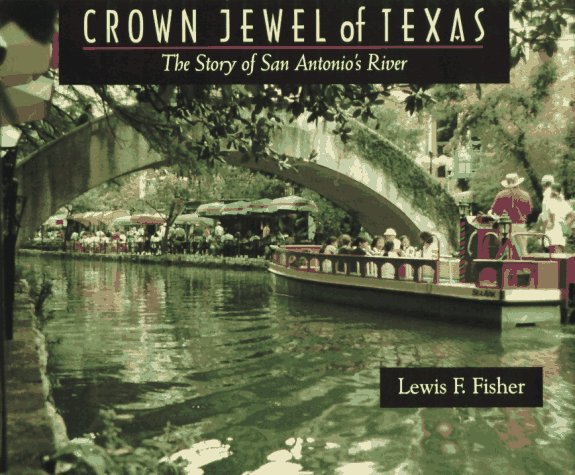



This thoroughly-illustrated book sweeps away a morass of anecdotal misinformation to tell for the first time the full story of the evolution of a wayward stream on the frontier of New Spain into an architectural and engineering triumph, enchanting millions of visitors each year and a model for cities throughout the world. A chronology, notes, bibliography and index make this more than the coffee table book suggested by the colorful photograph on the jacket. -- Review of Texas Books, Winter 1998 An enlightening account of how the two-mile River Walk evolved and grew and continues to grow. . . . The photographs are fascinating visual documents. -- Houston Chronicle, Jun. 29, 1997 This book . . . recounts the long, twisting trail that civic leaders and citizens followed to change part of the flood-prone San Antonio River into one of the nation's top tourist attractions. It is interesting reading . . . and a useful resource. -- Dallas Morning News, Oct. 26, 1997 Why succeeding generations have tried, and just as often failed, to develop the river in a sustained fashion drives the narrative of Lewis Fisher's lavishly-illustrated book. The tale . . . contains as may twists and turns as the San Antonio River's original streambed. Indeed, he effectively straightens out the conflicting stories about how the community slowly recognized the river's value, fashioned plans for its development and then altered its very course. -- San Antonio Express-News, May 11, 1997 When San Antonio began outgrowing its winding river in the 1880s, one writer suggested that if the banks were landscaped and made attractive the river could one day become "the crown jewel of Texas." Sure enough, a hundred years and many travails later, the San Antonio River became the top visitor attraction in Texas. Crown Jewel of Texas tells how the river gave birth to a colorful city which grew into the nation's eighth-largest. With the river in decline, aroused citizens in 1912 elected a reform city government that gave top priority to a river beautification project. It won national acclaim. When construction of the present-day River Walk began in 1939, it was the culmination of years of now mostly-forgotten struggles by generations of San Antonians seeking to preserve their river's historic beauty. Lewis Fisher first fell under the spell of the River Walk in 1964, when he came to San Antonio for U.S. Air Force officer training. He returned five years later as a reporter for the San Antonio Express-News and later established a group of suburban San Antonio newspapers, which he published for 21 years. His writing has received awards from state and national newspaper organizations as well as from the San Antonio Conservation Society and the San Antonio Chapter of the American Institute of Architects. His other books on San Antonio include San Antonio: Outpost of Empires, The Spanish Missions of San Antonio and Saving San Antonio: The Precarious Preservation of a Heritage. From the Preface: The impact of this part of the river on San Antonio and the world . . . has nothing to do with commercial shipping or industrial might. It has to do instead with an ambiance rarely found along metropolitan rivers, a "linear paradise" created by an intimate River Walk twenty feet below street level along a shaded, meandering stream which in other parts of the country might be dismissed as a creek. San Antonio's two-mile River Walk has become the most visited attraction in the state of Texas and a world model for sensitive urban development. Its charms have helped vault San Antonio, tourism studies show, into the league of New Orleans and London. Yet the two centuries of evolution which led to the modern River Walk's creation are only vaguely understood. Virtually nothing has been written of the crucial decades of activity which preceded its ultimate plan, leaving a knowledge vacuum to be filled by myths and fables. But ingenious conjectures cannot, in the long run, substitute for the appeal of the real story. . . . Piecing together the story of the evolution and transformation of the San Antonio River resembled an archeological dig. Like the remainder of a ruin poking above the surface, the tantalizing hints led in surprising directions when probed more deeply. From Chapter 9: Twenty feet below the street, its noises hushed by the denseness of cypress trees towering above the narrow banks and exotic plants thriving in the sheltered climate, the San Antonio River Walk creates a sense of mystery, anticipation, movement. Reflected sunlight and shade dance on the rippling water. The muffled clatter of plates delivered to a colorful blur of umbrellad tables mingles with the spicy aroma of the servings, as curving walks-close to the water but rarely with railings-wind around corners and beneath bridges framing new scenes. It is, thought one writer, "a trip through a linear paradise of infinitely changing vistas." The River Walk, noted another, "provides an exper