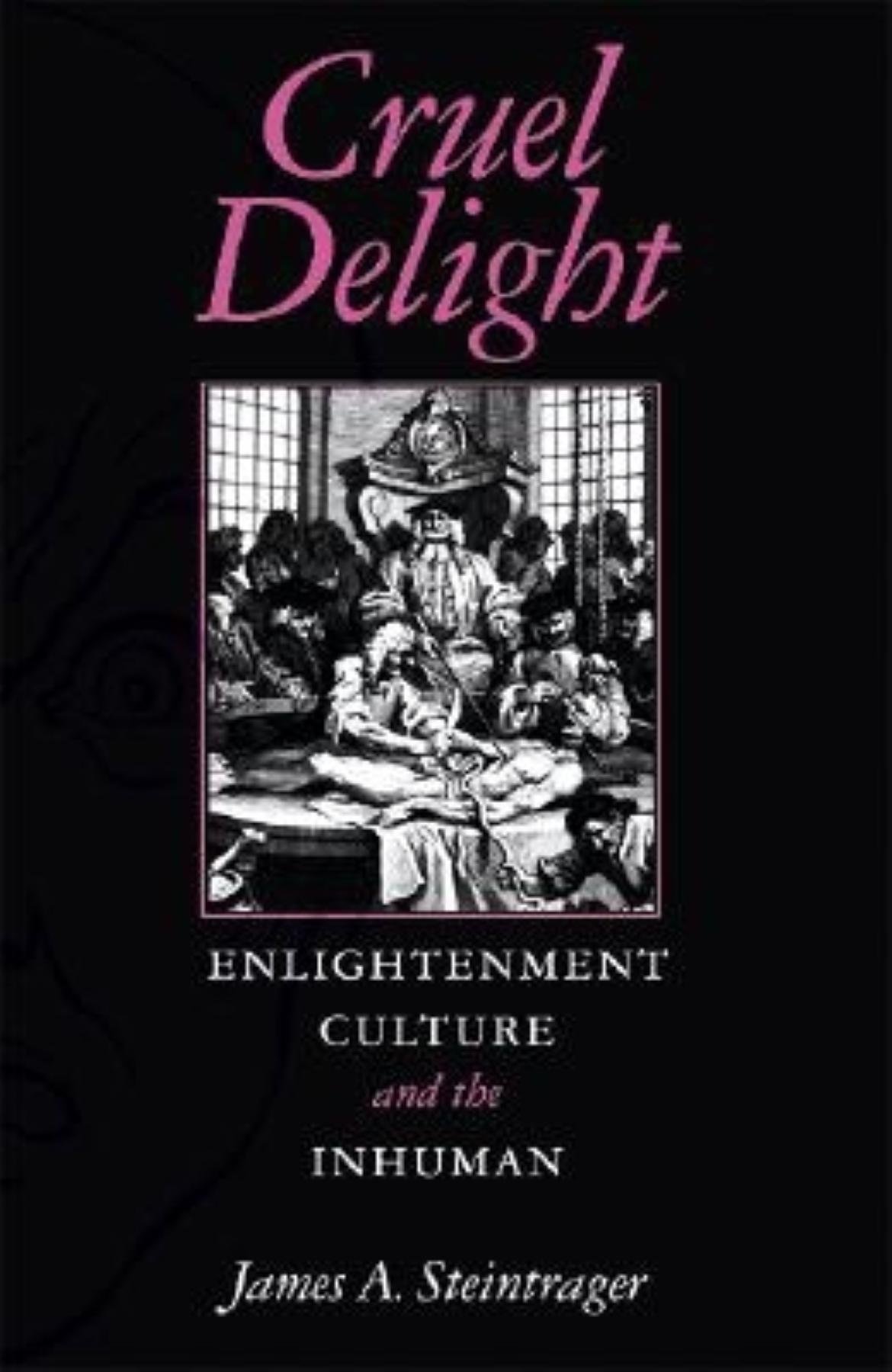



"An important contribution to studies of eighteenth-century culture and to literary history and theory and for those with an interest in horror, sentimentality, the invention of the modern individual, and ethics of 'the human.'" -Daniel Cottom, David A. Burr Chair of Letters, University of Oklahoma Cruel Delight: Enlightenment Culture and the Inhuman investigates the fascination with joyful malice in eighteenth-century Europe and how this obsession helped inform the very meaning of humanity. Steintrager reveals how the understanding of cruelty moved from an inexplicable, apparently paradoxical "inhuman" pleasure in the misfortune of others to an eminently human trait stemming from will and freedom. His study ranges from ethical philosophy and its elaboration of moral monstrosity as the negation of sentimental benevolence, to depictions of cruelty-of children mistreating animals, scientists engaged in vivisection, and the painful procedures of early surgery-in works such as William Hogarth's "The Four Stages of Cruelty," to the conflict between humane sympathy and radical liberty illustrated by the writings of the Marquis de Sade. In each instance, the wish to deny a place for cruelty in an enlightened world reveals a darker side: a deep investment in depravity, a need to reenact brutality in the name of combating it, and, ultimately, an erotic attachment to suffering. "Steintrager (English and comparative literature, Univ. of California, Irvine) offers a thoughtful and original meditation on cruelty as it appears in the English, French, and (to a lesser degree) German literature of the 18th century. Informed but not overwhelmed by Foucauldian theory, the short narrative (just 150 pages of text) is more suggestive than definitive, but it raises useful questions about those who take pleasure in inflicting pain. The 18th century found discussions of cruelty difficult because moral philosophy defined human beings as sympathetic creatures: to be human was to be humane. The prospect that people could enjoy the suffering of others threatened to disturb the age's very definition of humanity. The book's six chapters fall into three groups of two: the first pair examine the place of cruelty in moral philosophy, especially that of the Scottish Enlightenment; the next two explore cruelty to animals, using William Hogarth's prints The Four Stages of Cruelty as a case study; the final two start from the life and works of the Marquis de Sade and take on issues of vivisection and surgery. Summing Up: Recommended. Upper-division undergraduates and above.September 2004"―J. T. Lynch, Rutgers, The State University of New Jersey, Newark "Yoking Kant and Sade together in this way is questionable. For Kant's categorical imperative requires a universalization which is utterly alien to Sadean freedom to follow desire, no matter how harmful to others. Most ethical systems proposing liberty as the key value have insisted upon reciprocity. Among classic philosophers, only Friedrich Nietzsche celebrates the liberty of the strong to oppress the weak (and indeed associates cruelty and joy). Furthermore, it is not definitive that a naturalistic, sentimental ethics was a dead end and unsustainable. Hume theorized a more sophisticated account of how fellow feeling is selected and universalized in moral discourse than is reflected here. And after Sade and Kant, a powerful philosophy of morality having a basis in natural sympathy was developed by John Stuart Mill. Steintrager is right to argue that cruelty was a problem for sentimental theory, and his revelation of the difficulties theorists experienced in confronting it is valuable, making his book well worth reading. His contention that perceptions of ordinary and scientific curiosity, and the validation of the detached gaze of the professional anatomist as socially useful, offered ways in which eighteenth―century thinkers could solve this problem, is surely part of the answer. But he might also have paid attention to theories of the sublime, and the aesthetic of the gothic, which get a mention only in his short epilogue. Finally, I am not convinced that the Hogarth prints should be read as a critique of science. Did Hogarth really intend viewers of the first engraving in the series to see in the various cruelties being inflicted on animals an analogy with scientific experiment? The practitioners and the audience in the fourth print, in which Tom Nero's hanged body is being dissected, are not presented as attractive persons: but did Hogarth mean us to perceive in them a further stage or form of cruelty? It is not easy to be cruel to the dead.―― William Stafford, Department of History, University of Huddersfield.Published by:"―Ideas (October, 2007) "Certain contexts are identified as impacting on the evolution of these ideas. The principal one is the development of science, especially physiology and anatomy. There is some reference also to professional specialization with a view to a