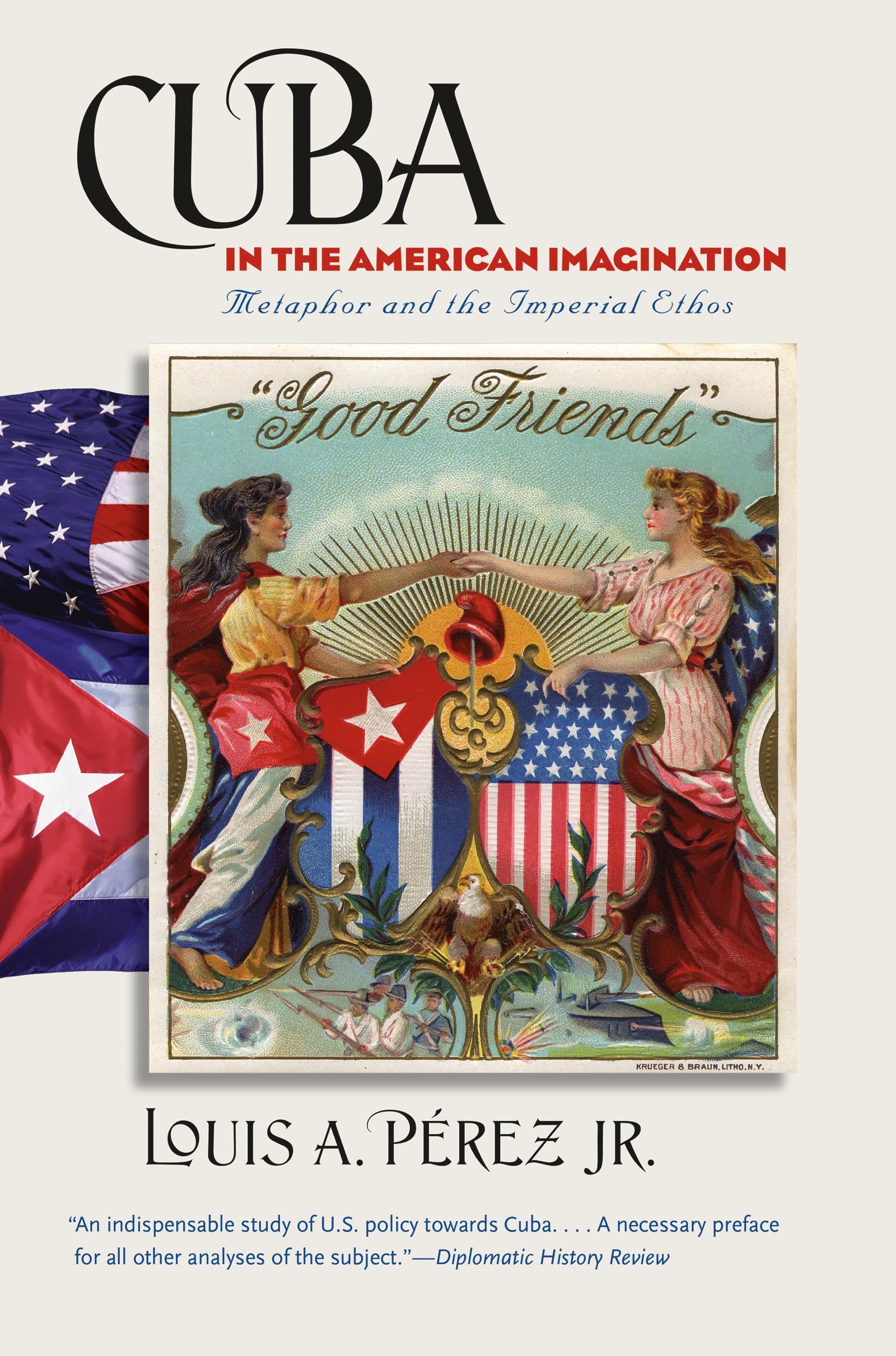
Cuba in the American Imagination: Metaphor and the Imperial Ethos
$32.28
by Louis A. Pérez Jr



For more than two hundred years, Americans have imagined and described Cuba and its relationship to the United States by conjuring up a variety of striking images — Cuba as a woman, a neighbor, a ripe fruit, a child learning to ride a bicycle. Louis A. Pérez Jr. offers a revealing history of these metaphorical and depictive motifs and discovers the powerful motives behind such characterizations of the island as they have persisted and changed since the early nineteenth century. Drawing on texts and visual images produced by Americans ranging from government officials, policy makers, and journalists to travelers, tourists, poets, and lyricists, Pérez argues that these charged and coded images of persuasion and mediation were in service to America’s imperial impulses over Cuba. “Brilliant. . . . Perez’s study — the latest in a series of perceptive books on US-Cuba relations by this prolific historian — illustrate[s] how an avid US self-interest was transformed into selfless moral enactment.” — The Nation “Perez draws on politicians' speeches, newspaper editorials and comic strips published over the century and a half before the revolution to show that Cubans were consistently represented not as agents of their own destiny but as innocent victims.” — London Review of Books “Argues that Cuba was a laboratory of American imperialism. . . . Skillfully analyses how the metaphor of neighbour and neighbourhood was employed to justify U.S. intervention in Cuba in the late 1890s. . . . Includes a remarkable number of pictorial descriptions of Cuba from a wide range of American newspapers and magazines.” — Times Literary Supplement “An indispensable study of U.S. policy towards Cuba. . . . A necessary preface for all other analyses of the subject.” — Diplomatic History Review “A quietly ferocious critique of US foreign policy as seen through the lens of Cuban-US relations.” — Virginia Quarterly Review “[An] excellent and highly recommended study. . . . One of the most important contributions to the debate about US-Cuban relations. . . . Should be required reading for policymakers, Latin Americanists, and Cuban exiles everywhere.” — Latin American Review of Books “In a thought-provoking conclusion, Pérez describes how arrogant and infantilizing metaphors from the 19th century continue to shape American policy toward Cuba.” — The Chronicle of Higher Education “The writing is elegant and free of jargon. . . . Anyone interested in self-justifying narratives of empire and especially the place of metaphor in shaping those narratives, should read this seminal contribution to inter-American cultural history. ” — The Americas “Brilliant. . . . Illustrate[s] how an avid US self-interest was transformed into selfless moral enactment.” — The Nation “This is exactly the kind of book policymakers and the chattering classes ought to be reading — something beyond the ignorant regurgitations of past thinking.” — Our Man in Boston Perez is our best historian of U.S.-Cuban relations, and this book is in one sense a summation of his distinguished work over the past several decades. It is particularly significant because the U.S.-Cuban relationship is going to have to be fundamentally rethought and reshaped in the near future, and this work not only provides critical information, but also acts as a loud warning about how that debate must not be conducted.--Walter LaFeber, Emeritus, Cornell University Images of beneficence, acts of aggression For more than two hundred often turbulent years, Americans have imagined and described Cuba and its relationship to the United States by conjuring up a variety of striking images--Cuba as a woman, a neighbor, a ripe fruit, a child learning to ride a bicycle. One of the foremost historians of Cuba, Louis A. Perez Jr. offers a revealing history of these metaphorical and depictive motifs and discovers the powerful motives behind such characterizations of the island. For more than two hundred often turbulent years, Americans have imagined and described Cuba and its relationship to the United States by conjuring up a variety of striking images--Cuba as a woman, a neighbor, a ripe fruit, a child learning to ride a bicycle. One of the foremost historians of Cuba, Louis A. Perez Jr. offers a revealing history of these metaphorical and depictive motifs and discovers the powerful motives behind such characterizations of the island. Louis A. Pérez Jr. is J. Carlyle Sitterson Professor of History and director of the Institute for the Study of the Americas at the University of North Carolina at Chapel Hill. He is a fellow of the American Academy of Arts and Sciences and the author of many award-winning books, including On Becoming Cuban: Identity, Nationality, and Culture and To Die in Cuba: Suicide and Society (both from the University of North Carolina Press). Used Book in Good Condition