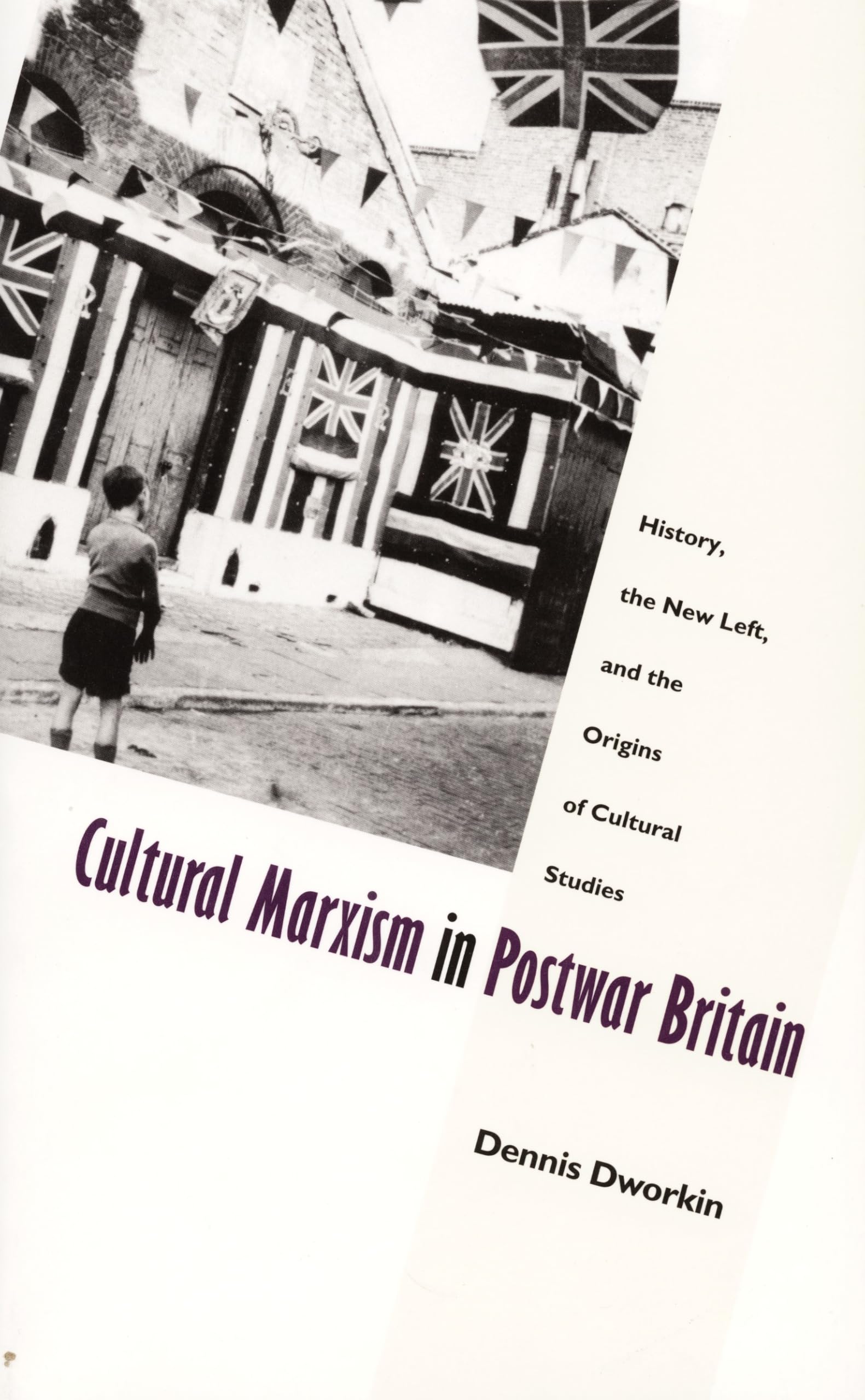
Cultural Marxism in Postwar Britain: History, the New Left, and the Origins of Cultural Studies (Post-Contemporary Interventions)
$24.38
by Dennis Dworkin



In this intellectual history of British cultural Marxism, Dennis Dworkin explores one of the most influential bodies of contemporary thought. Tracing its development from beginnings in postwar Britain, through its various transformations in the 1960s and 1970s, to the emergence of British cultural studies at Birmingham, and up to the advent of Thatcherism, Dworkin shows this history to be one of a coherent intellectual tradition, a tradition that represents an implicit and explicit theoretical effort to resolve the crisis of the postwar British Left. Limited to neither a single discipline nor a particular intellectual figure, this book comprehensively views British cultural Marxism in terms of the dialogue between historians and the originators of cultural studies and in its relationship to the new left and feminist movements. From the contributions of Eric Hobsbawm, Christopher Hill, Rodney Hilton, Sheila Rowbotham, Catherine Hall, and E. P. Thompson to those of Perry Anderson, Barbara Taylor, Raymond Williams, Dick Hebdige, and Stuart Hall, Dworkin examines the debates over issues of culture and society, structure and agency, experience and ideology, and theory and practice. The rise, demise, and reorganization of journals such as The Reasoner , The New Reasoner , Universities and Left Review , New Left Review , Past and Present , are also part of the history told in this volume. In every instance, the focus of Dworkin’s attention is the intellectual work seen in its political context. Cultural Marxism in Postwar Britain captures the excitement and commitment that more than one generation of historians, literary critics, art historians, philosophers, and cultural theorists have felt about an unorthodox and critical tradition of Marxist theory. “ Cultural Marxism in Postwar Britain is exceptionally well written, lucid, and well organized—and simultaneously accessible and sophisticated, both in its own internal argumentation and in its rendering of often complex and difficult debates.”—Geoff Eley, University of Michigan “There is nothing comparable to this book. It is an important addition to the literatures on British cultural studies, the history of Marxist thought, and the history of social historiography. Speaking particularly as a representative for scholars in cultural studies, I am happy to have this history finally told in such an effective and coherent way.”—Lawrence Grossberg, University of North Carolina, Chapel Hill ""Cultural Marxism in Postwar Britain" is exceptionally well written, lucid, and well organized--and simultaneously accessible and sophisticated, both in its own internal argumentation and in its rendering of often complex and difficult debates."--Geoff Eley, University of Michigan Dennis Dworkin is Associate Professor of History at the University of Nevada, Reno. Cultural Marxism in Postwar Britain History, the New Left, and the Origins of Cultural Studies By Dennis Dworkin Duke University Press Copyright © 1997 Duke University Press All rights reserved. ISBN: 978-0-8223-1914-6 Contents Acknowledgments, Introduction, One Lost Rights, Two Socialism at Full Stretch, Three Culture Is Ordinary, Four Between Structuralism and Humanism, Five History from Below, Six The Politics of Theory, Conclusion, Notes, Selected Works, Index, About the Author, CHAPTER 1 Lost Rights A pivotal moment in the creation of a Marxist tradition of historical scholarship in Great Britain was the launching of the Communist Party Historians' Group in 1946. The core of the Group came from the radical student generation of the 1930s and early 1940s. They became Communists in large measure because of the movement's prominent role in the Popular Front against fascism. The group included Christopher Hill, Rodney Hilton, Eric Hobsbawm, Victor Kiernan, George Rudé, John Saville, and Dorothy and Edward Thompson (though Edward-Thompson played only a marginal role). It was also shaped by Communist scholars of an older generation who were not professional historians per se but were devoted historical materialists, most importantly the economist Maurice Dobb and the Marx scholar Dona Torr. The Group's practice bore the imprint of two political moments. On the one hand, it conceived of itself as spearheading a Popular Front, a broad coalition of progressive historians combating reactionary tendencies in historiography. Its thinking was simultaneously constrained by the sectarianism already present in the 1930s but accentuated by the Cold War's polarization of intellectual and political discourse. The Group's members were relatively open-minded, considering that they were loyal Communist militants in the late 1940s and early 1950s. In spite of crippling illusions about Stalin's regime and the nature of their own party, they openly debated Marxist theory, critically examined numerous historical issues central to the study of British history, and, in conjunction with a f