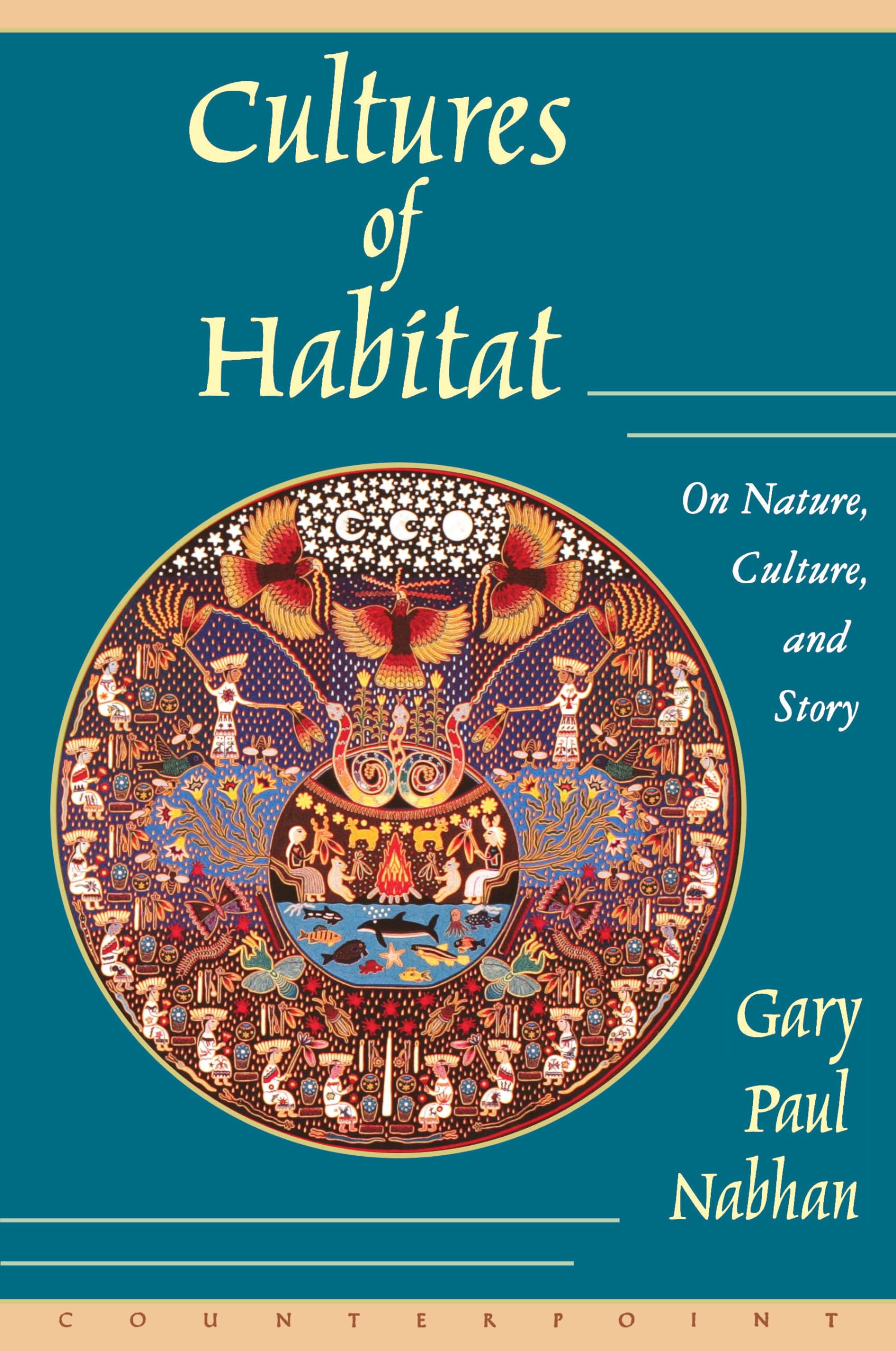



A collection of essays explores the impact of indigenous cultures with stable communities on the conservation of biological diversity in natural habitats. Ethnobotanist Gary Paul Nabhan provides 26 essays that go beyond mere observations of wildlife but offer theories of links between cultural and biological diversity. He champions a shift away from the preservation efforts of the mainstream environmental movement, rejecting the separateness of ecological preserves that exclude humans. Nabhan argues that biodviersity thrives best in the presence of an involved, participatory culture, and his argument is bolstered by research and years of field experiecne. Gary Paul Nabhan is an Agricultural Ecologist, Ethnobotanist, Ecumenical Franciscan Brother, and author whose work has focused primarily on the interaction of biodiversity and cultural diversity of the arid binational Southwest. He is considered a pioneer in the local food movement and the heirloom seed saving movement. Cultures in Habitat On Nature, Culture, and Story By Gary Paul Nabhan Treasure Chest Books Copyright © 1998 Gary Paul Nabhan All right reserved. ISBN: 9781887178969 CHAPTER ONE Finding Ourselves in the Far Outside The world in which the kestrel moves, the world that it sees, is, and will always be, entirely beyond us. That there are such worlds all around us is an essential feature of our world. MARY MIDGLEY, Beast and Man When I heard it, I was in a small meeting room in Alaska, and that was part of the trouble. I was supposed to be paying attention to what was being said in the room, where I was taking part in a symposium about the meaning of the natural world. But from my sear I could hear ravens coming in to roost in the spruce trees above us, and I wondered how their calls were different from those of the Chihuahuan ravens down where I live. I could look out the windows and see bald eagles swooping over the waters of the sound. More distracting still, I already had the stain and smell of salmonberries on my hands and had been perplexed all morning as to why the ripe berries on two adjacent bushes were entirely different colors. And that's when I heard it. A familiar warble came out of the well-educated, widely read humanist sitting a few chairs away from me. She asserted a truism I had been hearing in one form or another for nearly thirty years: "Each of us has to go inside before we can go outside! How can we give any meaning to the natural world until each individual finds out who he or she is as a human being, until each of us finds our own internal source of peace?" I immediately felt nauseated. Something had stuck in my craw. I had to leave the room. Our moderator followed me out to the porch,where I gasped for air. "Are you okay?" she asked earnestly. "You looked green all of a sudden." "I dunno." I breathed deeply and looked up at the crisp blue sky. "I must be ... uh ... under the weather a little. If you don't mind, I had better go for a walk and get some fresh air." As I ambled along a trail lined with totem poles, taking a loop through the coastal rain forest, I tried to spiral in on what had disoriented me. I realized I was uncomfortable with the notion of humans giving the natural world its "meaning." The plants and animals I have observed over twenty years as a field biologist hardly seem to be waiting for me to give them meaning. But most of the folks at the symposium wanted to feel that we are meaningful, and so we project our meanings onto the rest of the world. We read meaning into other species' behavior, but with few exceptions, they are unlikely to do the same toward us. Humans may be rare even among primates in the attention we give to the tracks, calls, and movements of a wide range of other species. To paraphrase one prominent primatologist: "If their inattention to their neighbors other than predators is any indication, most monkeys are extremely poor naturalists." The same can be said of many other wild animals that live in sight of, and in spite of, human habitations. While it may somehow be good for us to think, watch, sing, or write about the astonishing diversity of plants and animals within our surroundings, are we sure that this does any good for them? I am reminded of the realization John Daniel came to while hopping through a snake-laden boulder field: the snakes were not fazed by his thoughts, fears, or needs. Daniel writes in The Trail Home: "The rattlesnakes beneath the boulders instructed me, in a way no book could have, that the natural world did not exist entirely for my comfort and pleasure; indeed, that it did not particularly care whether my small human life continued to exist at all." Walking along, my restlessness increased as I considered the premise put forth in the meeting room: that the shortest road to wisdom and peace with the world is the one that turns inward, away from direct sensory contact with other creatures. I will not assert that meditatio