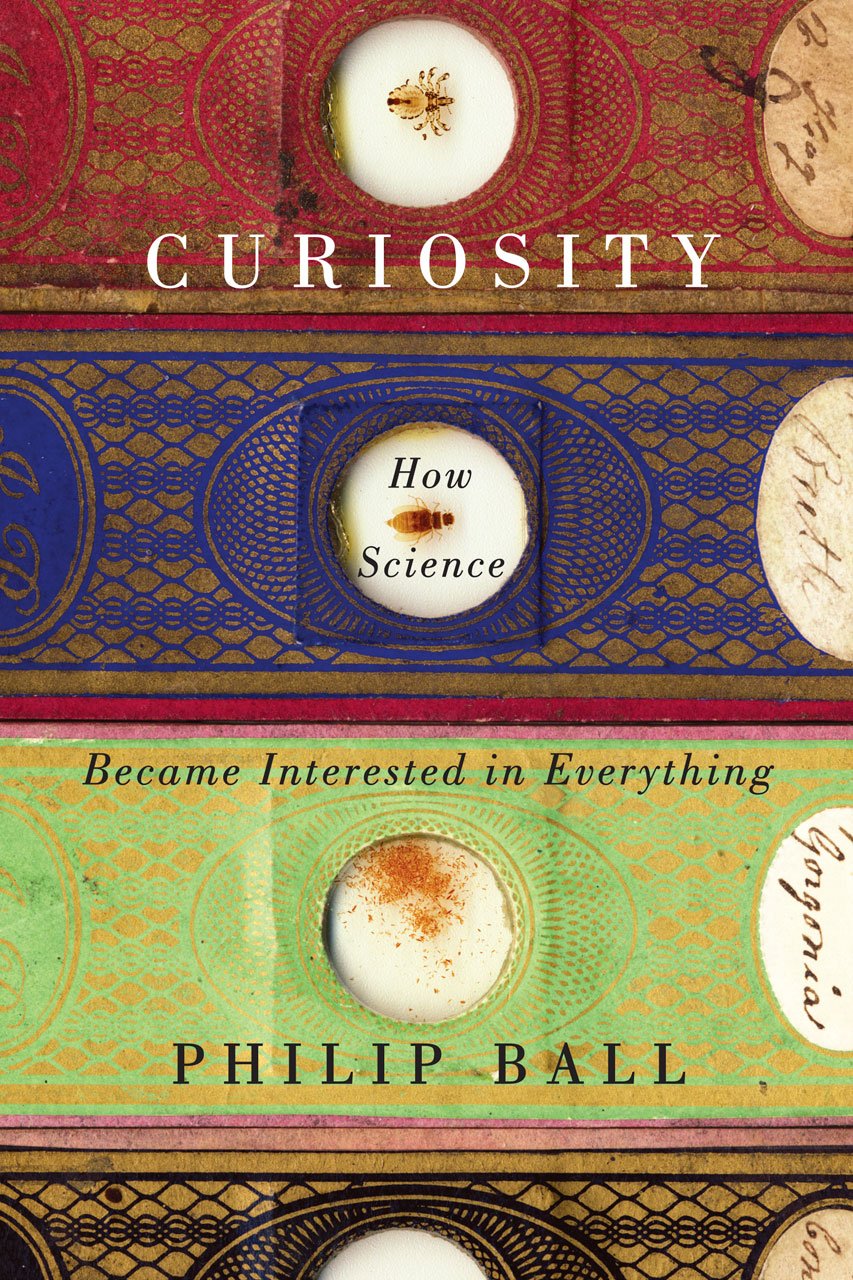



With the recent landing of the Mars rover Curiosity, it seems safe to assume that the idea of being curious is alive and well in modern science—that it’s not merely encouraged but is seen as an essential component of the scientific mission. Yet there was a time when curiosity was condemned. Neither Pandora nor Eve could resist the dangerous allure of unanswered questions, and all knowledge wasn’t equal—for millennia it was believed that there were some things we should not try to know. In the late sixteenth century this attitude began to change dramatically, and in Curiosity: How Science Became Interested in Everything, Philip Ball investigates how curiosity first became sanctioned—when it changed from a vice to a virtue and how it became permissible to ask any and every question about the world. Looking closely at the sixteenth through eighteenth centuries, Ball vividly brings to life the age when modern science began, a time that spans the lives of Galileo and Isaac Newton. In this entertaining and illuminating account of the rise of science as we know it, Ball tells of scientists both legendary and lesser known, from Copernicus and Kepler to Robert Boyle, as well as the inventions and technologies that were inspired by curiosity itself, such as the telescope and the microscope. The so-called Scientific Revolution is often told as a story of great geniuses illuminating the world with flashes of inspiration. But Curiosity reveals a more complex story, in which the liberation—and subsequent taming—of curiosity was linked to magic, religion, literature, travel, trade, and empire. Ball also asks what has become of curiosity today: how it functions in science, how it is spun and packaged for consumption, how well it is being sustained, and how the changing shape of science influences the kinds of questions it may continue to ask. Though proverbial wisdom tell us that it was through curiosity that our innocence was lost, that has not deterred us. Instead, it has been completely the contrary: today we spend vast sums trying to reconstruct the first instants of creation in particle accelerators, out of a pure desire to know . Ball refuses to let us take this desire for granted, and this book is a perfect homage to such an inquisitive attitude. *Starred Review* In the gap between the Bible’s warning against being “curious in unnecessary matters” to Einstein’s reverence for “holy curiosity,” Ball discerns a profound cultural shift. To explain the shift that transformed curiosity from a dangerous temptation to a praiseworthy motivation, Ball revisits the intellectually restless lives of great scientists across the centuries, including Copernicus, Kepler, Galileo, and Newton. But readers soon learn that the work of investing curiosity with a new and positive value also involved astrologers, magicians, courtiers, and mystics. The curiosity that licensed skeptics to transgress against religious orthodoxy also impelled the devout to probe more deeply into God’s marvels. For both the secular-minded and the pious, the boundaries of curiosity grew wider as seafaring explorers discovered new lands and as ingenious technicians opened new telescopic and microscopic vistas. Even as he watches curiosity enlarge its scope, Ball sees it mutate into two different, almost antithetical, manifestations: a pragmatic, agenda-driven desire to expand control over the knowable world, and a spontaneous capacity for contemplative wonder. As the story of how a strange coalition of revolutionaries defied traditional restraints on the hunger for new knowledge, Ball’s history of curiosity tells readers much about the dangerous adventure of being a modern human. --Bryce Christensen “Philip Ball’s fascinating book revels not just in the experiments of these early scientists, but also in their humanity, foibles and passions. Curiosity may lead us down blind alleys as often as it enlightens, but Ball shows that it is a vital part of what makes us human.” ― Sunday Times (UK) “ Curiosity emerges as a first-rate popular account of how science in Europe began. Accurate, witty, and reliable, the book ably shows modern readers how we got to be modern. Philip Ball adeptly sketches the virtuoso sensibility: a combination of intellectual nosiness and experimental dexterity plus the belief that, as he writes, ‘to understand everything, you could start from anywhere.’” ― Wall Street Journal “ Curiosity is a wonderful book that revises popular assumptions about the Scientific Revolution with great wit and insight. . . . Philip Ball wants to retain the excitement and fervor that drove scientific curiosity from the seventeenth century onwards and celebrate the ‘love, the awe, the passion’ that scientists feel but repress in their research because of the curious history of scientific experimentation. In this, Ball distinguishes himself as unquestionably one of our finest—and most curious—writers on the history and future of science." ―