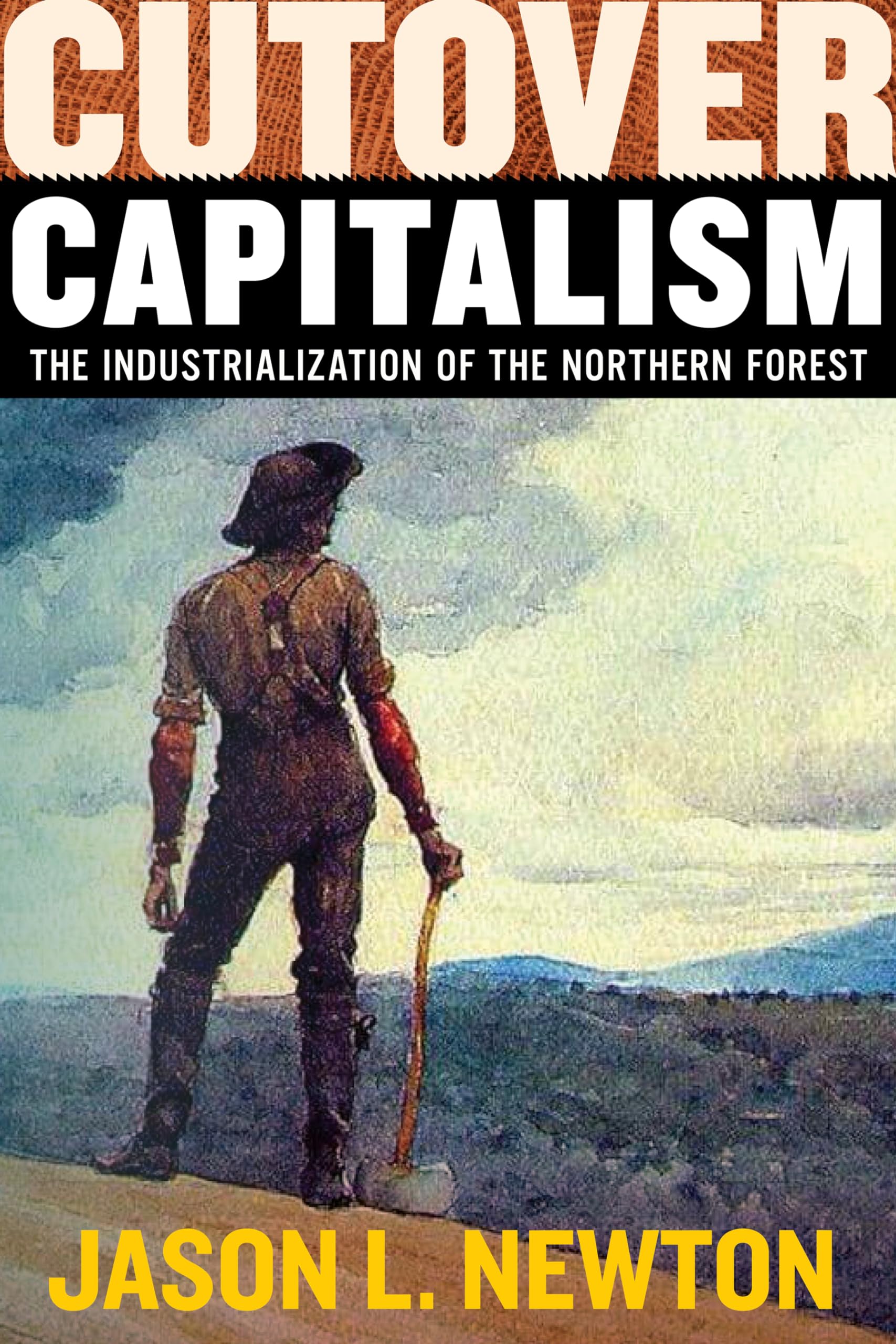
Cutover Capitalism: The Industrialization of the Northern Forest (Histories of Capitalism and the Environment)
$23.73
by Jason L. Newton



2024 George Perkins Marsh Prize Runner-up What happened to the loggers of America’s past when lumbermen moved west and south in the late nineteenth and early twentieth centuries? How did these communities continue to create value and meaning in these marginal lands? Cutover Capitalism: The Industrialization of the Northern Forest provides a new perspective on the process of industrialization in America through the study of rural workers in a cutover landscape. Back when resources started running scarce, the environment of the forest and bodies of workers became the natural resources from which mills and landowners extracted. Bodies and cutover landscapes were mobilized in new ways to increase the scale and efficiency of production—a brutal process for workers, human and animal alike. In the Northern Forest, an industrial working class formed in relation to the unique ways that workers' bodies were used to produce value and in relation to the seasonal cycles of the forest environment. Cutover Capitalism is an innovative historical study that combines methodological approaches from labor history, environmental history, and the new history of capitalism. The book tells a character-driven yet theoretically sophisticated story about what it was like to live through this process of industrialization. “Blurring the boundary between exploiting trees and exploiting workers, Cutover Capitalism is an interesting re-interpretation of the field of forest history, a discipline that has focused all too heavily on woods technology and not enough on labor process.” — Richard Judd, author of Second Nature: An Environmental History of New England "A conceptually brilliant history that instantly becomes critically important for both labor and environmental historians." — Erik Loomis, author of A History of American in Ten Strikes "With this compelling study, Jason Newton achieves an impressive disciplinary synthesis that casts new light on land and life in northern New England. Cutover Capitalism is a must-read for forest and environmental historians—and many more besides. Insights drawn from memory studies, the history of capitalism, labor history, ecology, and experience reveal much about the exploitation of people and non-human nature in the past, and raise important questions about the injustices and sustainability of our current circumstances." — Graeme Wynn, author of Environment, Power, and Justice: Southern African Histories What happened to the loggers of America’s past when lumbermen moved west and south in the late nineteenth and early twentieth centuries? How did these communities continue to create value and meaning in these marginal lands? Cutover Capitalism: The Industrialization of the Northern Forest provides a new perspective on the process of industrialization in America through the study of rural workers in a cutover landscape. Back when resources started running scarce, the environment of the forest and bodies of workers became the natural resources from which mills and landowners extracted. Bodies and cutover landscapes were mobilized in new ways to increase the scale and efficiency of production—a brutal process for workers, human and animal alike. In the Northern Forest, an industrial working class formed in relation to the unique ways that workers' bodies were used to produce value and in relation to the seasonal cycles of the forest environment. Cutover Capitalism is an innovative historical study that combines methodological approaches from labor history, environmental history, and the new history of capitalism. The book tells a character-driven yet theoretically sophisticated story about what it was like to live through this process of industrialization. Jason L. Newton, PhD is an historian of modern America specializing in the history of capitalism, labor, and the environment. He is currently an assistant teaching professor at the University of North Carolina at Charlotte.