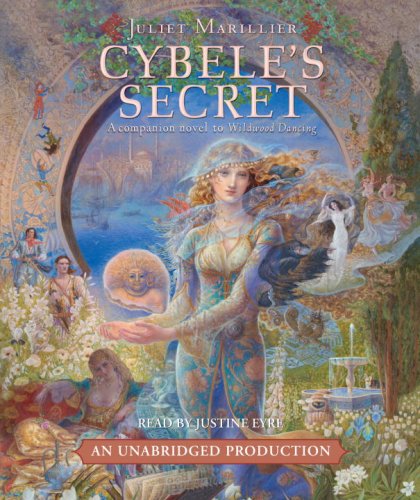



FOR PAULA, ACCOMPANYING her merchant father on a trading voyage to Istanbul is a dream come true. They have come to this city of trade on a special mission to purchase a most rare artifact—a gift from the ancient goddess, Cybele, to her followers. It’s the only remnant of a lost, pagan cult. But no sooner have they arrived when it becomes clear they may be playing at a dangerous game. A colleague and friend of Paula’s father is found murdered. There are rumors of Cybele’s cult reviving within the very walls of Istanbul. And most telling of all, signs have begun to appear to Paula, urging her to unlock Cybele’s secret. Meanwhile, Paula doesn’t know who she can trust in Istanbul, and finds herself drawn to two very different men. As time begins to run out, Paula realizes they may all be tied up in the destiny of Cybele’s Gift, and she must solve the puzzle before unknown but deadly enemies catch up to her. . . . From the Hardcover edition. Starred Review, Booklist , July 1, 2008: “Teens who didn’t know Marillier when they started this sandalwood-scented adventure will rapidly place her alongside the likes of romantic-fantasy idols Shannon Hale and Sharon Shinn.” From the Hardcover edition. Juliet Marillier is the author of several highly popular fantasy novels for adults. She is also the author of the teen novel Wildwood Dancing. She lives in Australia. The deck tilted to port, and I tilted with it, grabbing at a rope to keep my balance. One day out from Constanta, the wind had turned contrary and the waters of the Black Sea rose and fell under the Stea de Mare ’s belly like a testy horse trying to unseat its rider. “You have excellent sea legs, Paula,” my father commented. He stood perfectly balanced, a veteran of more merchant voyages than he could count. This was my first. The sail crackled in the wind. The crewmen, grim-jawed and narrow-eyed, were struggling to keep the one-master under control. When they glanced my way, their expressions were hostile. “It unsettles them to have a woman on board,” my father said. “Ignore it. It’s superstitious nonsense. They know me, and you’re my daughter. If the captain doesn’t like it, he shouldn’t have accepted my silver.” “It doesn’t bother me, Father,” I said through gritted teeth. Having good sea legs didn’t mean I relished the bobbing motion of the boat or the constant drenching in salt spray. Nor did I much care for the sense that if the Stea de Mare sank, these sailors would put the blame on me. “Is this going to delay us, Father?” “It may, but Salem bin Afazi will wait for us in Istanbul. He understands what this means for me, Paula–the opportunity of a lifetime.” “I know, Father.” There was a treasure waiting for us in the great city of the Turks, the kind of piece merchants dream of laying their hands on just once in their lives. Father wouldn’t be the only prospective buyer. Fortunately, he was a skillful negotiator, patient and subtle. When he had first agreed to take me with him, it had been to allow me to broaden my horizons now that I was in my eighteenth year, to let me see the world beyond the isolated valley where we lived and the merchant towns of Transylvania that we sometimes visited. But things had changed on the journey. Just before we were due to embark, Father’s secretary, Gabriel, had tripped coming down a flight of steps in the Black Sea port of Constanta. The resultant broken ankle was now being tended to in the physician’s house there while the Stea de Mare bore Father and me on to Istanbul. It was most fortunate that I spoke perfect Greek and several other languages and that I had Father’s full trust. While I could not take Gabriel’s place as his official assistant, I could, at the very least, be his second set of ears. It would be a challenge. I could hardly wait. The wind had brought rain, the same drenching spring rain that fell on our mountains back home, flooding streams and soaking fields. It scoured the planks of the deck and wrapped the ship in a curtain of white. From where I stood, I could barely see the sail, let alone the bow cutting its way through choppy seas. The crew must be steering our course blind. Father was shouting something above the rising voice of the wind, perhaps suggesting we should go below until things calmed down. I pretended not to hear. The tiny cabins we had been allocated were stuffy and claustrophobic. Being enclosed there only emphasized the ship’s movement, and one could not lie on the narrow bunk without dwelling on how exactly one would get out should the Stea de Mare decide to sink. “Get down, Paula!” Father yelled. A moment later a huge, dark form loomed up behind us. A scream died in my throat before I could release it. Another ship– a tall threemaster, so close I screwed my eyes shut, waiting for the sickening crunch of a collision. It towered above us. The moment it hit us, we would begin to go down. Running steps, shouts, the clank of